March 2026
Tech x Outpatient Care: Heidi, Doctolib and Eterno are redefining the ambulatory tech stack

Founder & CEO, HGM Advisory
Key takeaway
The outpatient tech stack is being unbundled and rebuilt by specialized players like Heidi, Doctolib, and Eterno. Traditional PMS and EHR vendors that fail to match this pace of innovation risk losing the ambulatory market entirely.
Outpatient care is ripe for disruption
Outpatient and ambulatory care accounts for roughly 60% of all healthcare encounters in Europe and 70% in the US, yet the technology infrastructure supporting it remains remarkably outdated. In Germany alone, over 100,000 physician practices still rely on legacy practice management systems built in the 2000s.
A 2025 study by the Bertelsmann Stiftung found that German outpatient physicians spend an average of 2.1 hours per day on administrative tasks. In the US, the figure is even higher at 2.6 hours. This is time that could be spent with patients.
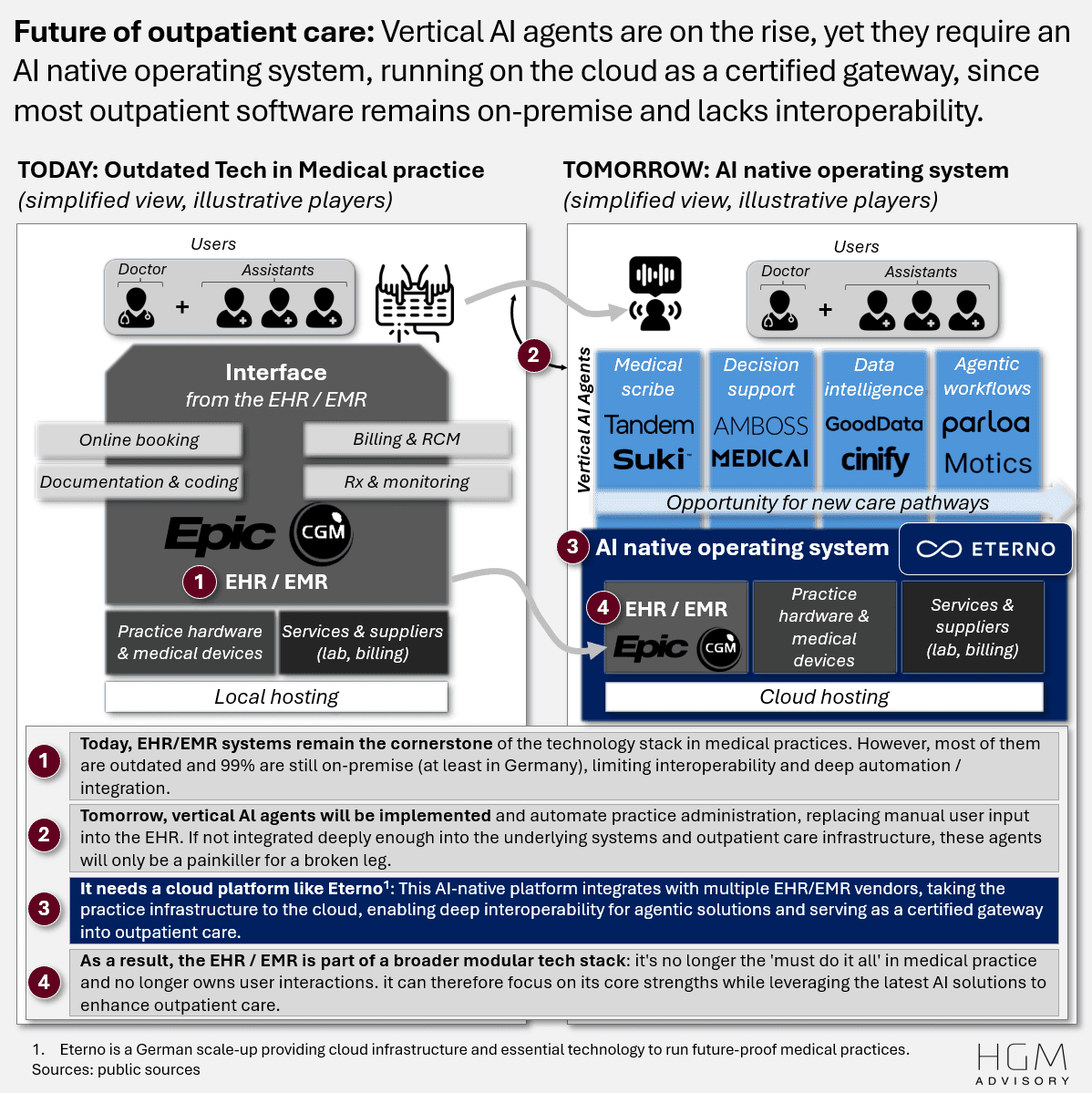
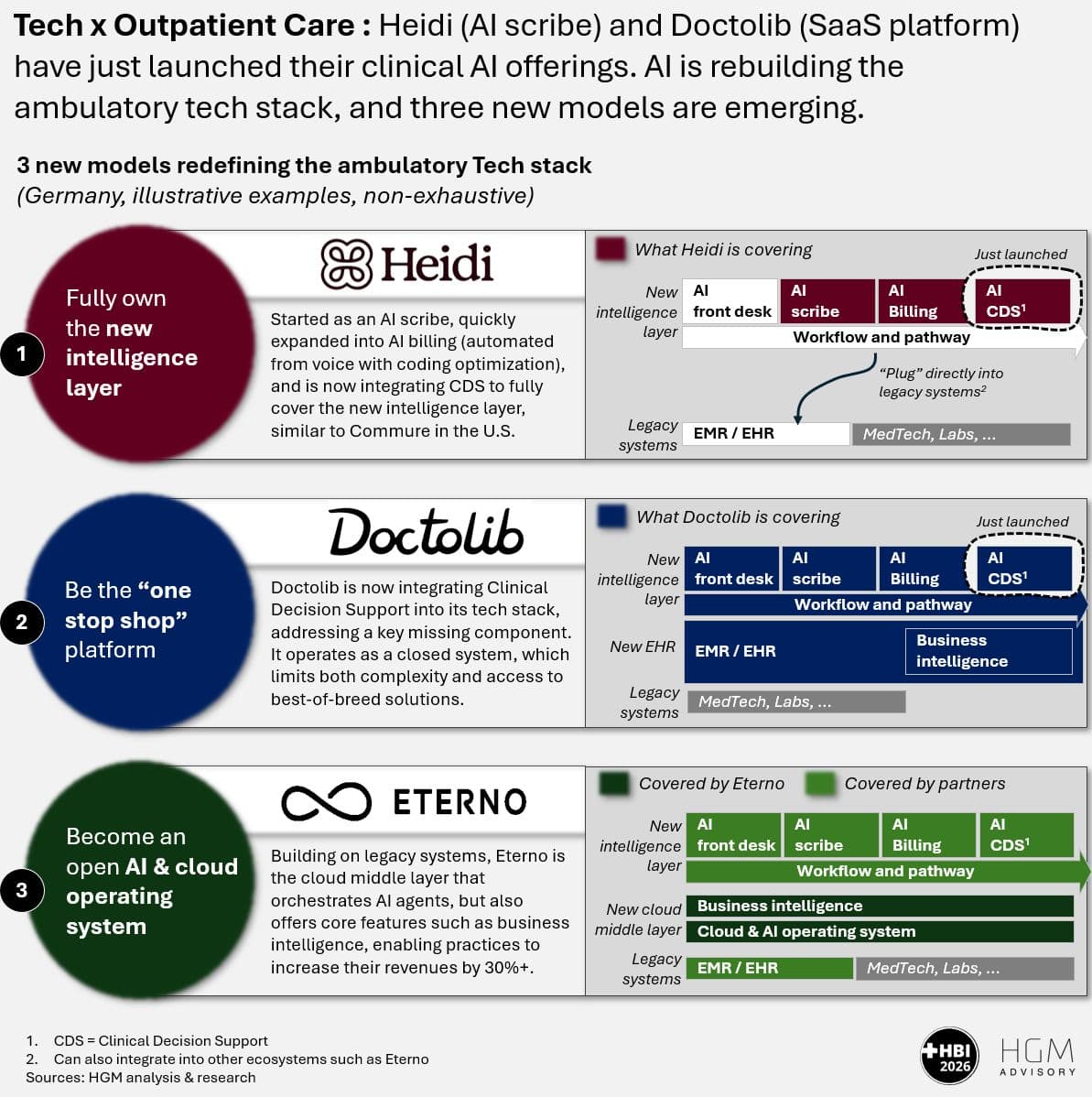
Three companies, Heidi, Doctolib, and Eterno, are attacking different layers of this problem and defining what the modern outpatient tech stack looks like.
Heidi: the AI scribe layer
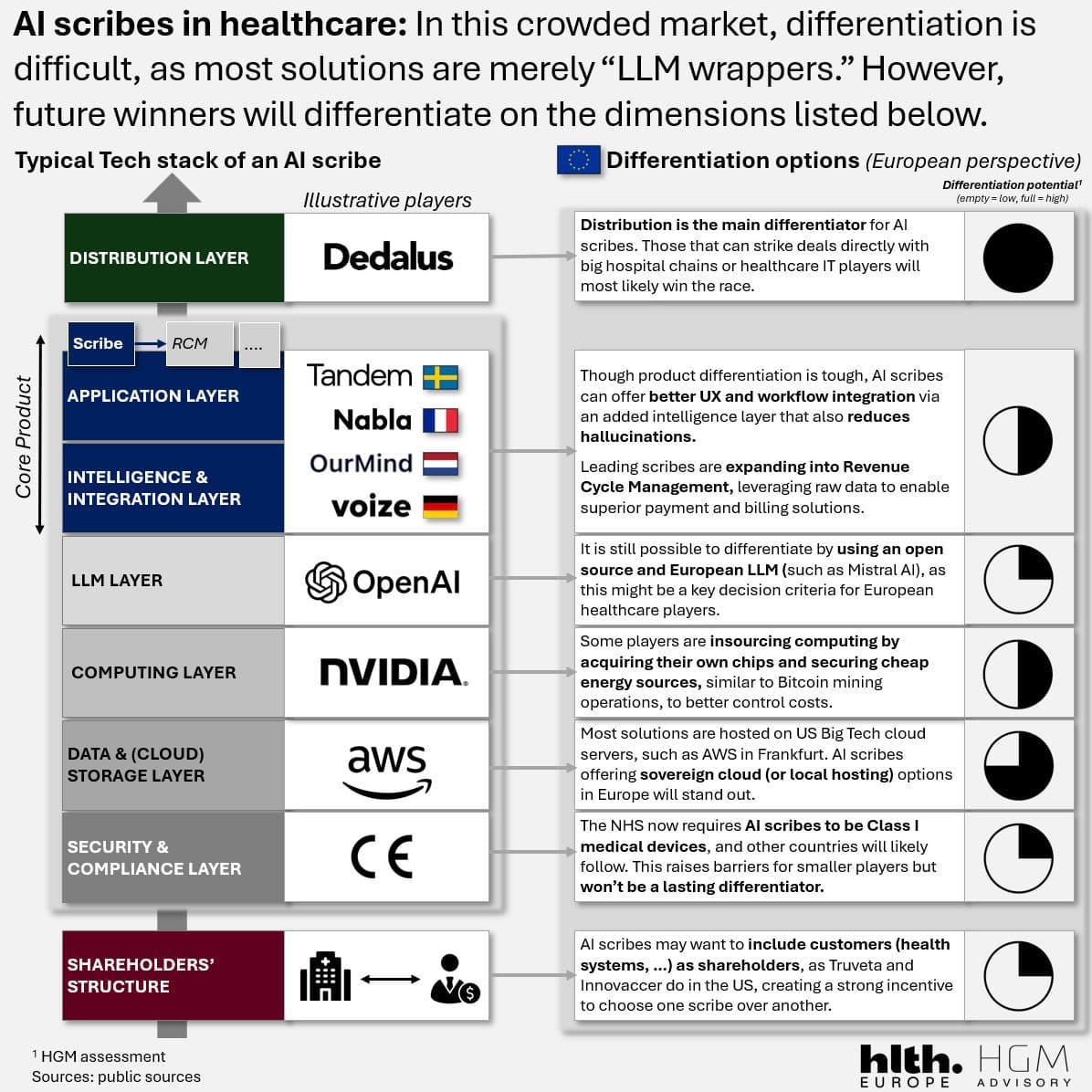
Heidi, the Australian-founded AI clinical documentation company, has emerged as one of the fastest-growing HealthTech startups globally. As of early 2026, Heidi reports over 50,000 active clinicians on its platform, primarily in Australia, the UK, and Germany.
Heidi's core product is an AI scribe that listens to patient-clinician conversations and generates structured clinical notes in real time. Clinicians using Heidi report saving 1-2 hours per day on documentation, with note accuracy rates exceeding 95%.
The company raised $16M in Series A funding in 2025 and is expanding into referral letter generation, billing code suggestions, and patient summary creation.
Doctolib: the scheduling and access layer
Doctolib, now the largest HealthTech company in Europe with a reported valuation of EUR 6.4 billion, has built its dominance through patient scheduling. Over 80 million patients and 400,000 healthcare professionals use Doctolib across France, Germany, and Italy.
In 2025, Doctolib launched its telehealth module and began integrating AI features, including smart appointment routing, no-show prediction, and automated patient intake forms.
Traditional PMS vendors like CompuGroup Medical (CGM) are now competing with Doctolib not just on scheduling but on the entire patient engagement workflow.
Eterno: the hybrid care platform layer
Eterno takes a different approach entirely. The Berlin-based company operates hybrid care centers that combine physical clinics with a proprietary technology platform. Eterno currently operates 4 locations in Germany with plans to expand to 15 by 2027.
Rather than selling software to existing practices, Eterno builds the practice around the software. Physicians at Eterno clinics spend roughly 40% less time on admin tasks compared to the national average.
Eterno represents a broader trend: tech-enabled care delivery companies that bypass the legacy PMS entirely. Companies like One Medical (acquired by Amazon for $3.9B) and Avi Medical are leading similar models.
The emerging outpatient tech stack
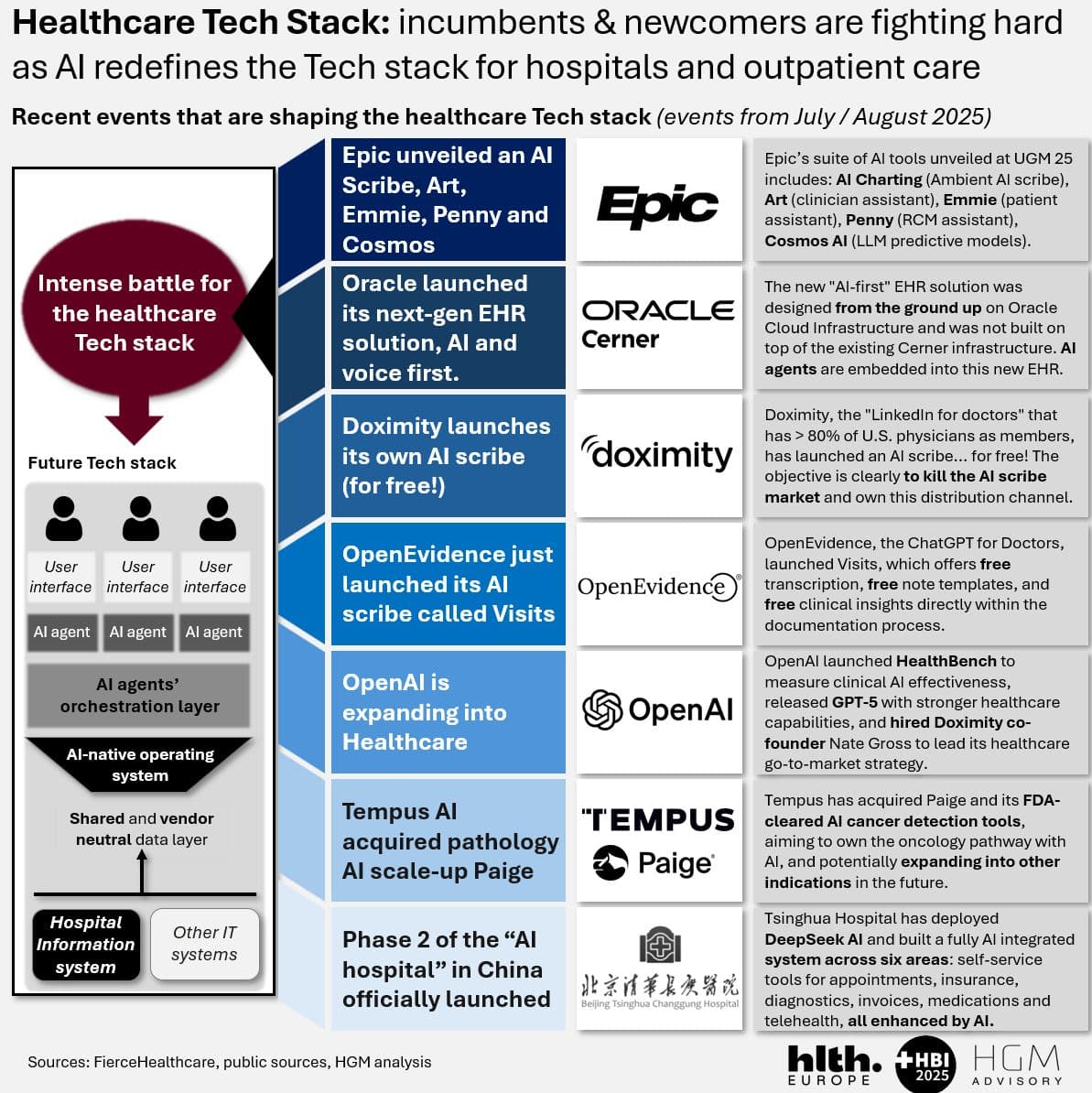
Together, these companies reveal the emerging architecture of the modern outpatient tech stack.
| Layer | Function | Key players | Disruption risk to incumbents |
|---|---|---|---|
| Patient access | Scheduling, intake, patient engagement | Doctolib, Zocdoc, Jameda | High, network effects favor platforms |
| Clinical AI | Documentation, decision support, coding | Heidi, Nabla, Abridge, Nuance DAX | High, AI-native beats bolt-on |
| Practice operations | Billing, workflow, PMS/EHR | CGM, Medatixx, athenahealth | Medium, switching costs protect incumbents |
| Care delivery platform | Full-stack integrated care | Eterno, Avi Medical, One Medical | Low-medium, capital intensive model |
Implications for traditional PMS/EHR vendors
The unbundling of the outpatient tech stack poses a real strategic threat to traditional PMS and EHR vendors. CompuGroup Medical, which dominates the German outpatient PMS market with over 40% share, faces competition on multiple fronts simultaneously.
For healthcare organizations evaluating their outpatient technology strategy, the key question is no longer which PMS to buy, it is how to assemble a best-of-breed stack from specialized players while maintaining interoperability and data continuity.

About the author
Thomas HagemeijerFounder & CEO of HGM Advisory. Management consultant and HealthTech expert working across the full healthcare ecosystem: pharma, MedTech, investors, startups, hospitals, and policymakers. Investor at Springboard Health Angels. Ambassador at HLTH Europe and HBI. Regular keynote speaker on AI in healthcare and digital health transformation.