September 2025
Healthcare Tech Stack: AI redefines hospitals & outpatient care

Founder & CEO, HGM Advisory
Key takeaway
The healthcare tech stack is being restructured from the top down: AI is no longer a feature inside the EHR, it is becoming an independent layer that sits above it, and the companies that control this layer will reshape how care is delivered.
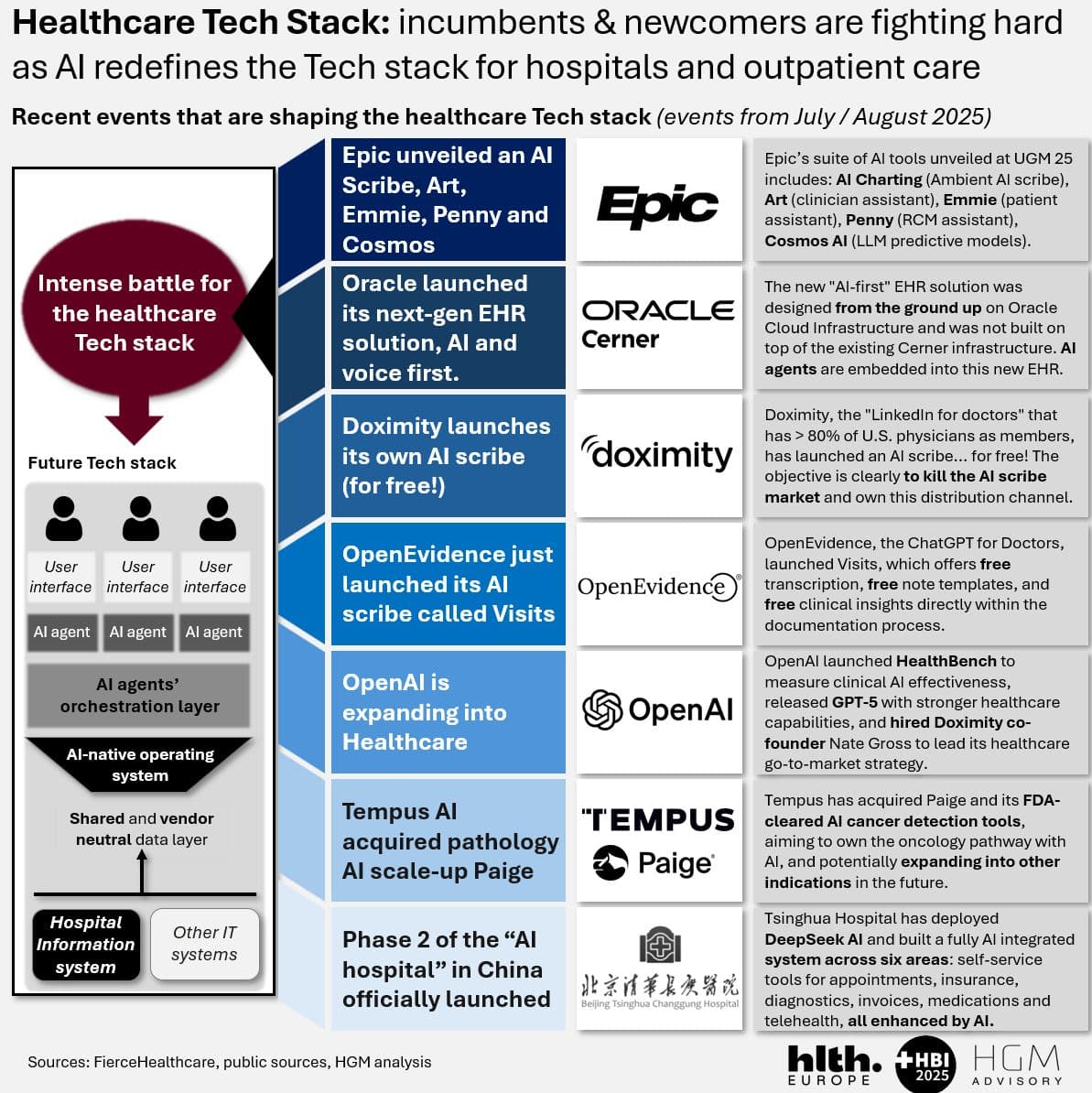
Incumbents and newcomers are fighting hard as AI redefines the tech stack. Epic, Oracle Cerner, Doximity, OpenEvidence, OpenAI, and Tempus are all making major moves in the battle for the healthcare tech stack.
The traditional healthcare tech stack
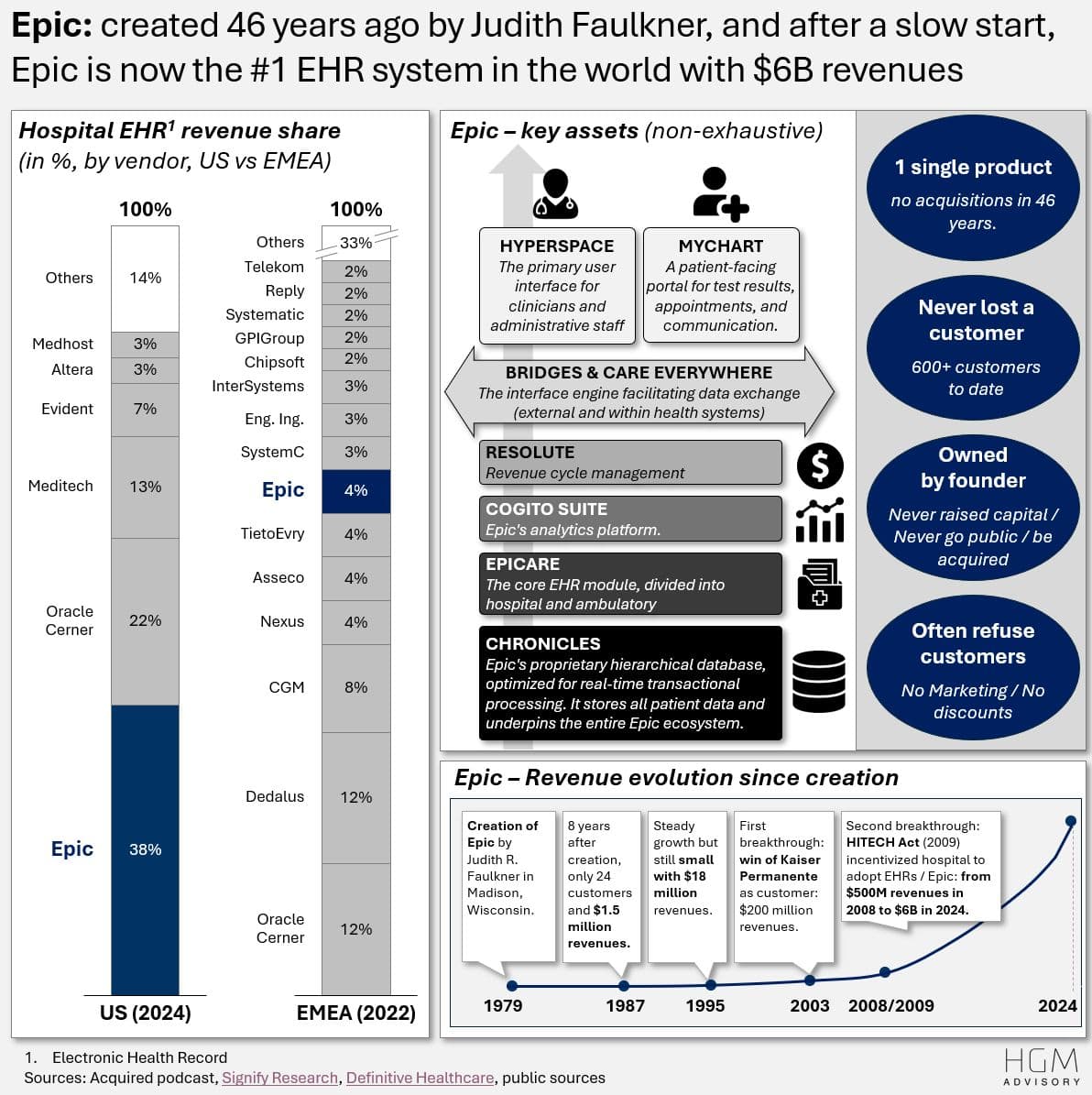
For two decades, the healthcare tech stack has been defined by the EHR at the center. Epic and Oracle Cerner captured roughly 60% of the US hospital market. Around this core, hospitals layered point solutions for revenue cycle, patient engagement, and clinical decision support.
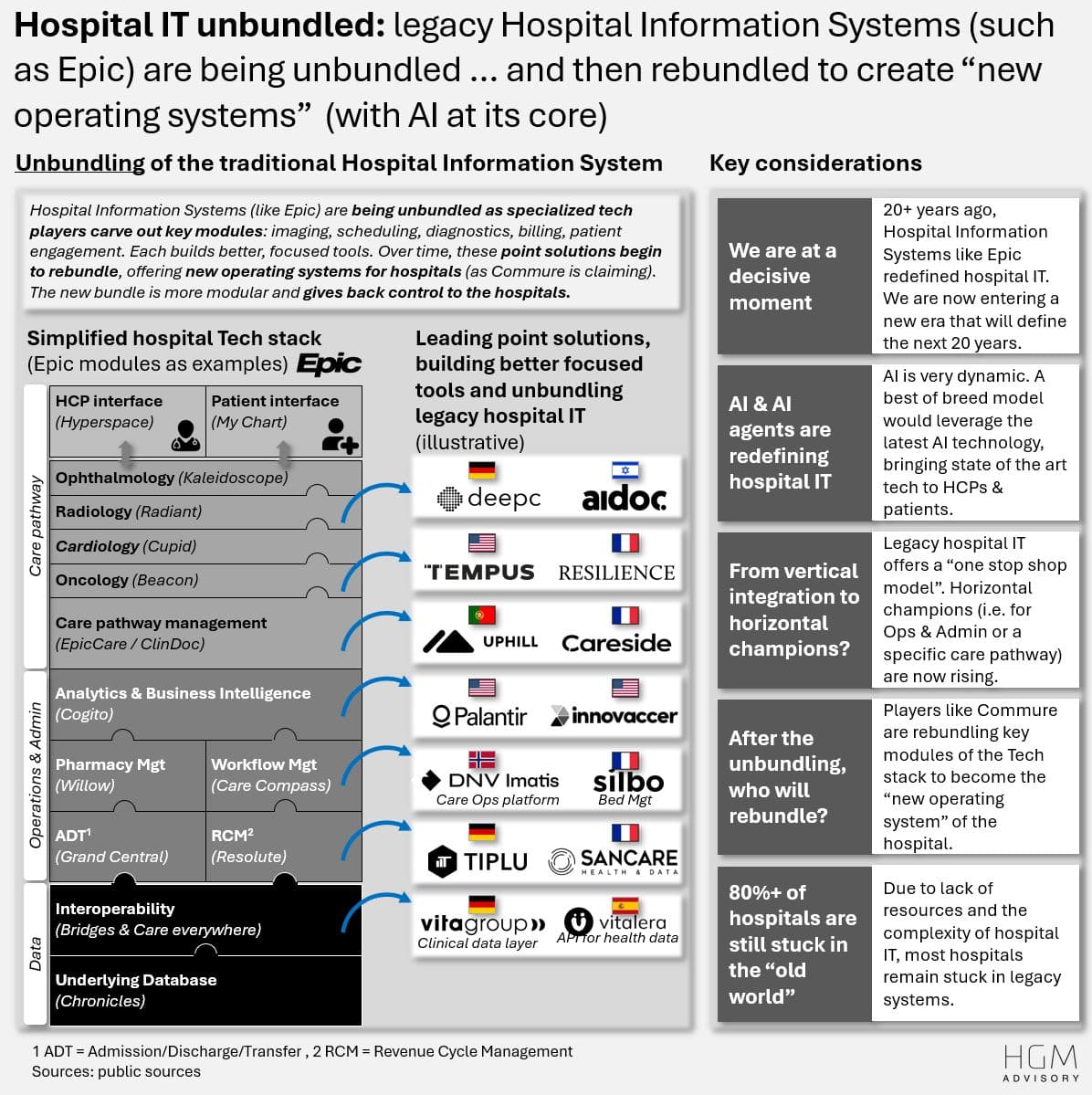
This architecture worked when software was a back-office function. It breaks down when AI needs real-time access to clinical data and the ability to take autonomous actions within a workflow.
How AI is disrupting each layer
At the clinical workflow layer, AI scribes from Nabla, Abridge, and Suki are replacing manual documentation. Approximately 35% of US health systems had deployed or piloted an AI scribe by mid-2025.
At the CDS layer, OpenEvidence has emerged with 8.5 million monthly consultations. At the operations layer, Qventus and LeanTaaS are using AI for patient flow and staffing. At the patient engagement layer, Hippocratic AI and Hyro are automating scheduling and follow-up.
Key players reshaping the stack
Epic is playing defense-as-offense, expanding AI features across its platform. Oracle Cerner is betting on cloud and Microsoft's AI. Doximity launched DocsGPT for 80% of US physicians. OpenEvidence is building the AI-native clinical intelligence layer. OpenAI is entering through partnerships. Tempus is approaching from the data side with its $6.1B IPO.
The battle for the AI layer
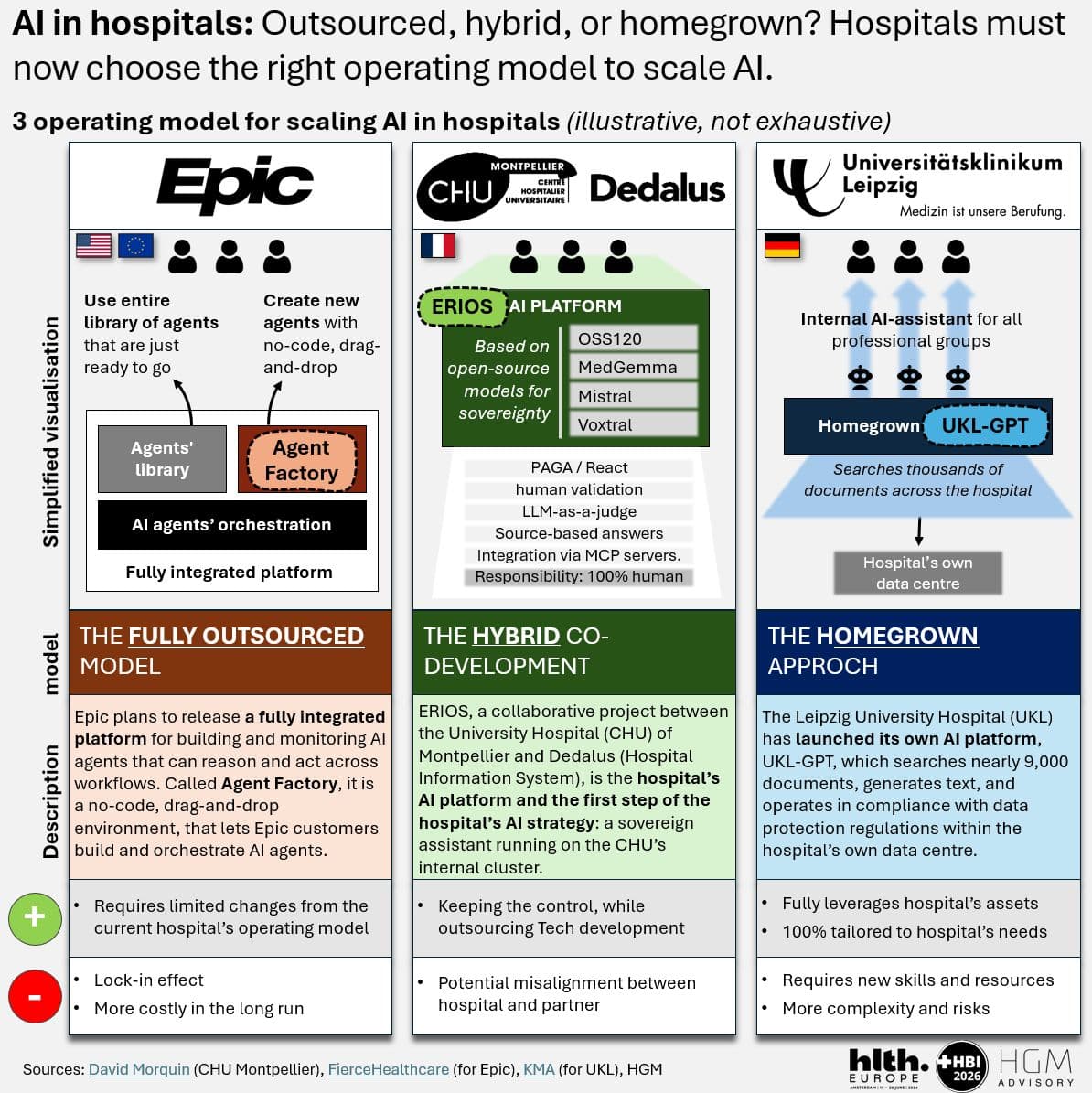
Three models are competing: EHR-embedded (Epic/Oracle), AI-native overlay (OpenEvidence, Abridge), and platform-as-infrastructure (OpenAI, Google, Anthropic).
The most likely outcome is a federated model where EHR vendors control structured workflow AI, AI-native startups own unstructured clinical intelligence, and foundation model providers supply the underlying compute.
| Layer | Function | Incumbent | AI Challenger |
|---|---|---|---|
| EHR / PMS Core | Records, orders, billing | Epic, Oracle Cerner | , |
| Clinical Documentation | Notes, transcription, coding | Nuance (Microsoft) | Nabla, Abridge, Suki |
| Clinical Decision Support | Evidence, diagnosis, treatment | UpToDate | OpenEvidence, AMBOSS Lisa |
| Revenue Cycle | Billing, claims, denials | Waystar, R1 RCM | Akasa, Regard |
| Operations | Scheduling, patient flow | QGenda, TeleTracking | Qventus, LeanTaaS |
| Patient Engagement | Scheduling, intake, comms | Phreesia, Relatient | Hippocratic AI, Hyro |

About the author
Thomas HagemeijerFounder & CEO of HGM Advisory. Management consultant and HealthTech expert working across the full healthcare ecosystem: pharma, MedTech, investors, startups, hospitals, and policymakers. Investor at Springboard Health Angels. Ambassador at HLTH Europe and HBI. Regular keynote speaker on AI in healthcare and digital health transformation.