June 2025
The new operating system of healthcare: what Commure's $200M raise means for hospitals

Founder & CEO, HGM Advisory
Key takeaway
Healthcare is following fintech's playbook: unbundling (point solutions beating incumbents) followed by rebundling (platforms reassembling the stack). Commure's $200M raise and $6B valuation signal that the rebundling phase has begun, and the companies that own the new hospital operating system will reshape healthcare IT the way Stripe and Revolut reshaped finance.
Commure raised $200M to build the 'new operating system of healthcare.' Drawing parallels to fintech's unbundling-rebundling cycle, this analysis explores how Commure, Innovaccer, and emerging European players are assembling the next-generation hospital platform.
Unbundling, rebundling, and fintech lessons
Healthcare and finance are both heavily regulated industries, but fintech is roughly a decade ahead in its digital transformation journey. The parallels are instructive.
In fintech, specialized companies first unbundled traditional banking: PayPal captured B2C payments, Stripe captured B2B payments, Revolut captured digital banking, Klarna captured lending, and Robinhood captured investing. Each solved an individual problem better than full-service banks could. Then came the rebundling: these companies expanded into adjacent services, building user-centric, integrated, digital-first platforms. Traditional banks increasingly serve as regulated back offices while fintech companies own the customer relationship.
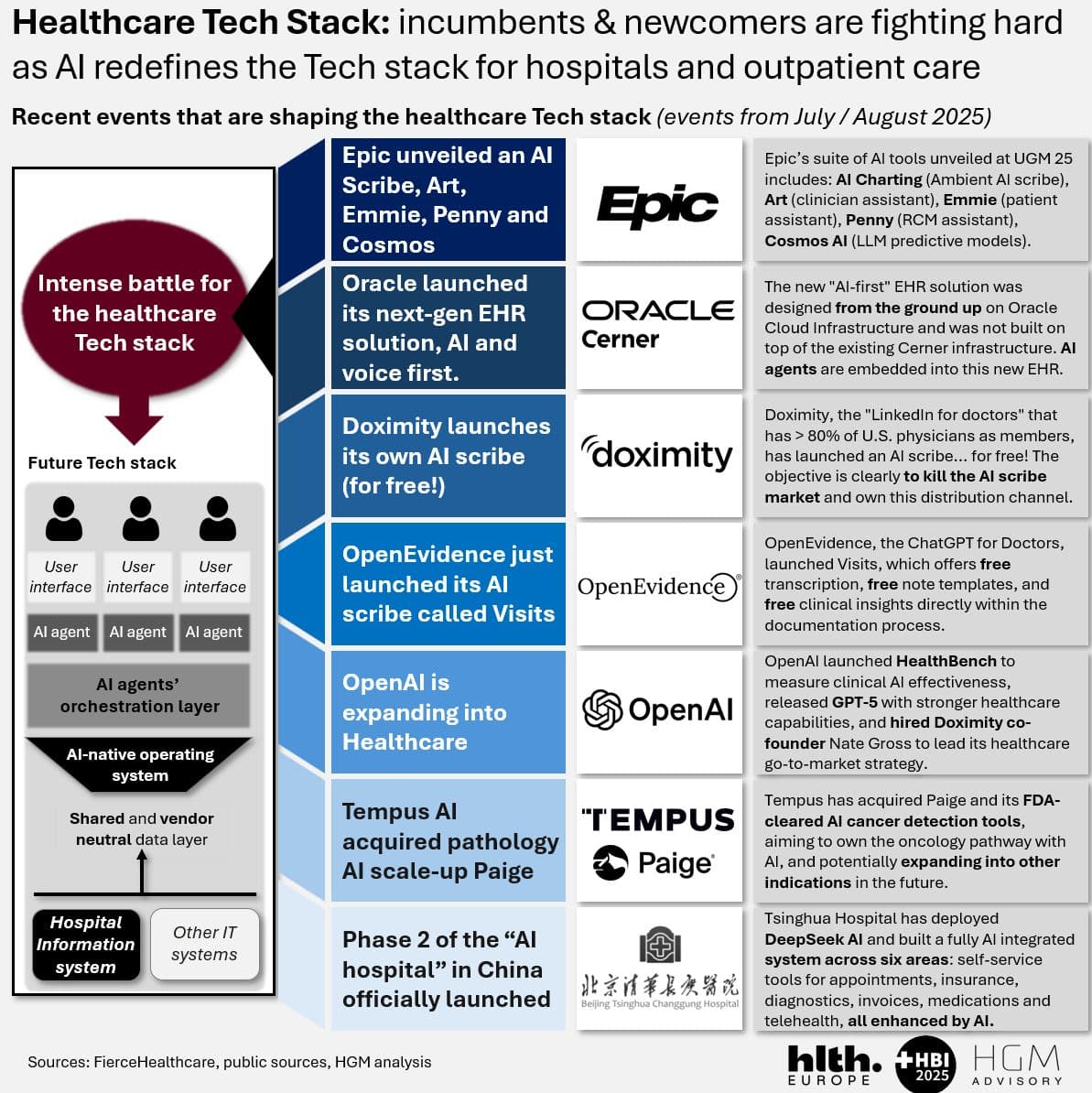
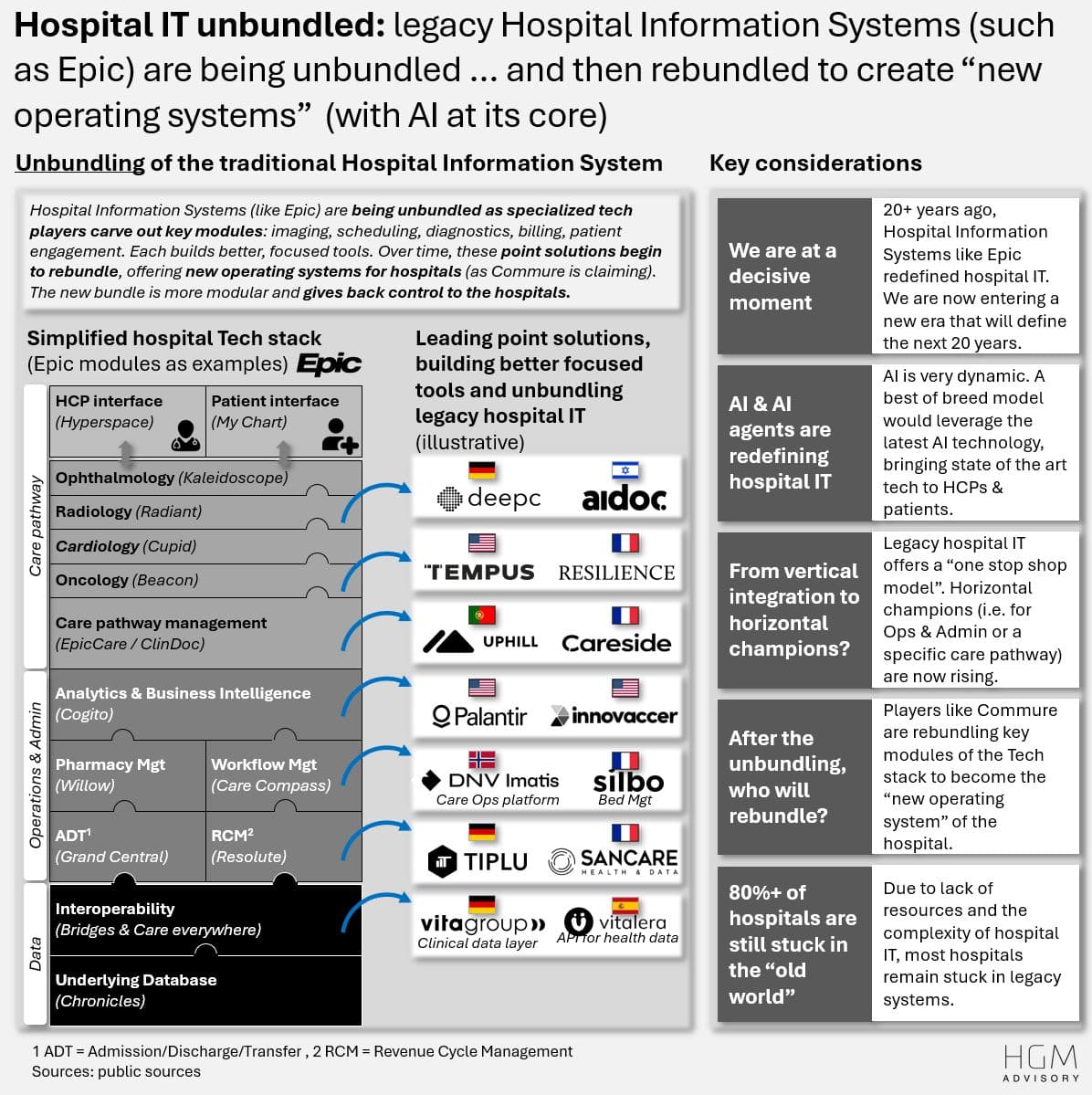
Healthcare is now entering the same cycle. Point solutions: AI scribes (Nabla, Abridge), clinical decision support (OpenEvidence), revenue cycle automation (Akasa), care coordination platforms, have unbundled specific hospital workflows from legacy EHR systems. The next phase is rebundling: assembling these capabilities into a new, integrated platform that serves as the operating system of healthcare.
| Phase | Fintech Example | Healthcare Equivalent |
|---|---|---|
| Unbundling: Payments | PayPal, Stripe | Abridge (documentation), Akasa (RCM) |
| Unbundling: Banking | Revolut, N26 | OpenEvidence (clinical AI), Qventus (operations) |
| Unbundling: Lending | Klarna, Affirm | Hippocratic AI (patient engagement) |
| Rebundling: Platform | Stripe (now full financial infra) | Commure, Innovaccer (hospital OS) |
| Incumbent response | Banks as back office | Epic/Oracle as data layer? |
Commure's rebundling strategy
Commure, which secured $200 million in growth funding from General Catalyst's customer value fund (at a reported $6B valuation as of late 2023), is executing the most aggressive rebundling strategy in healthcare IT.
Rather than building every capability from scratch, Commure has assembled its platform through a series of targeted acquisitions, each adding a critical workflow layer.
Athelas brought remote patient monitoring (RPM) and revenue cycle management (RCM). Rx.Health (now Engage) added care coordination and clinical pathway automation. Augmedix contributed ambient AI and clinical transcription, one of the fastest-growing categories in healthcare IT. Memora Health added patient engagement and care automation. On top of these acquisitions, Commure has built PatientKeeper (clinical workflow) and Strongline (staff safety) in-house.
The result is a platform that spans documentation, billing, care coordination, patient engagement, remote monitoring, and staff operations, all integrated under one umbrella. This is the healthcare equivalent of what Stripe did in fintech: starting with payments and expanding into billing, fraud detection, treasury management, and corporate card services.
Kaiser Permanente and the Innovaccer bet
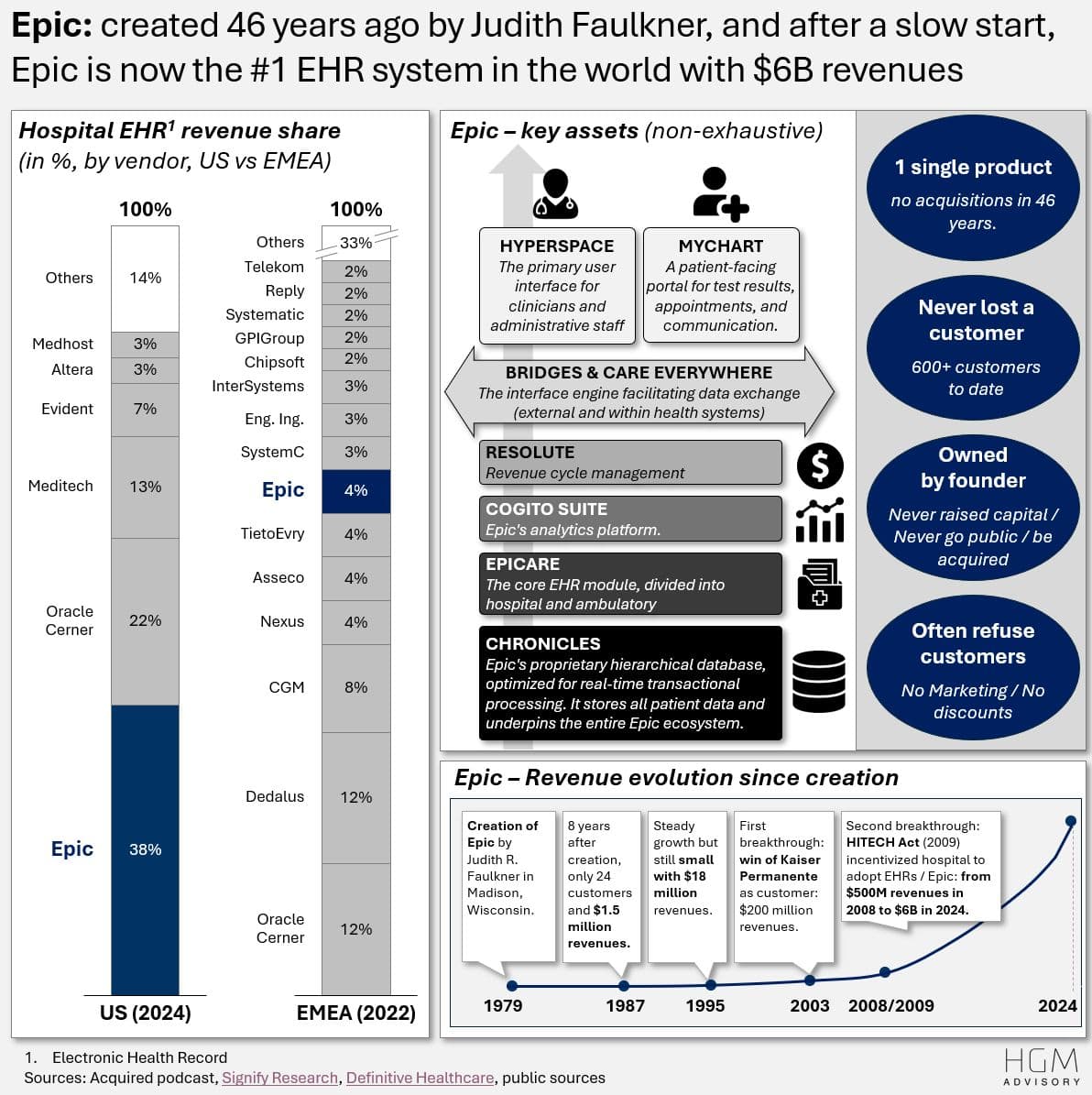
There is a telling historical parallel. In 2003, when Kaiser Permanente selected Epic as its EHR, Kaiser's leadership recognized that the EHR would become the most important platform in hospital operations. They requested an equity stake in Epic. CEO Judith Faulkner declined.
Over twenty years later, Kaiser recognized that a new generation of companies, not EHR vendors, would become the next critical hospital platforms. This time, Kaiser acted differently: it invested in Innovaccer, a company that positions itself as the 'operating system for hospitals' with a focus on data activation, care management, and population health.
The Kaiser bet is significant not because of the investment size, but because of what it signals: one of the most sophisticated health systems in the world believes the next hospital operating system will not be built by Epic or Oracle. It will be built by a new entrant that integrates data, AI, and workflows in ways that legacy EHR architectures cannot.
Europe: early signs of the same trend
Europe is showing early signs of the same unbundling-rebundling dynamic, though it is 3-5 years behind the US market.
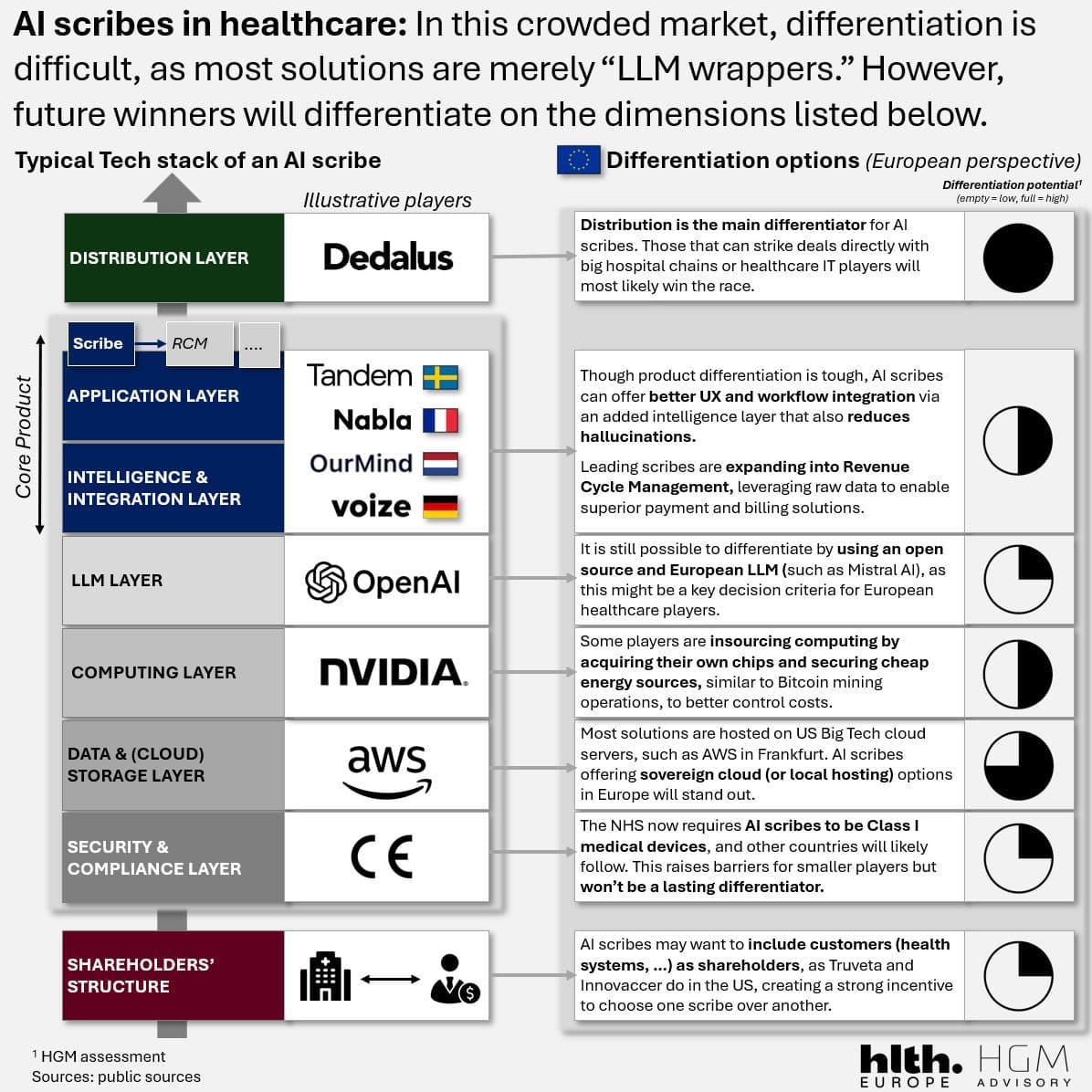
On the point solution side, companies like Tiplu and Sancare are gaining traction in revenue cycle management for German hospitals. Doctolib has captured the patient access layer across France, Germany, and Italy. Heidi and Nabla are scaling AI scribes in European outpatient care. Tandem Health is building an AI-native primary care platform in the Nordics.
On the platform side, vitagroup, with its clinical data layer for German hospitals, could emerge as the 'Innovaccer of Europe,' providing the data integration backbone that connects point solutions into a coherent platform. However, no European company has yet achieved the scale or breadth of Commure's platform play.
The most likely catalyst for European hospital platform consolidation is private equity. PE firms that acquire complementary point solutions: an RCM tool, an AI scribe, a care coordination platform, a clinical data layer, and integrate them under a single platform could create a European hospital operating system faster than any organic player.
For healthcare strategists and investors, the key insight is this: the unbundling phase in European hospital IT is well underway, and the rebundling phase is about to begin. The companies and investors that position themselves now for the platform play will capture disproportionate value.

About the author
Thomas HagemeijerFounder & CEO of HGM Advisory. Management consultant and HealthTech expert working across the full healthcare ecosystem: pharma, MedTech, investors, startups, hospitals, and policymakers. Investor at Springboard Health Angels. Ambassador at HLTH Europe and HBI. Regular keynote speaker on AI in healthcare and digital health transformation.