May 2025
As we enter the post-EHR era, it's worth understanding who won the first battle: Epic

Founder & CEO, HGM Advisory
Key takeaway
Epic won the EHR era through two structural advantages: a single unified database (Chronicles) that competitors could never match on reliability, and deep integration of clinical and billing systems in one codebase. The post-EHR era will test whether these advantages hold as AI, best-of-breed unbundling, and new care models reshape the healthcare tech stack.
Epic dominates the EHR market with a unified codebase and unmatched reliability. But as we enter the post-EHR era, with AI, unbundling, and new care models reshaping healthcare IT, the question is whether Epic's dominance will hold or fracture.
Judith Faulkner: a generational founder
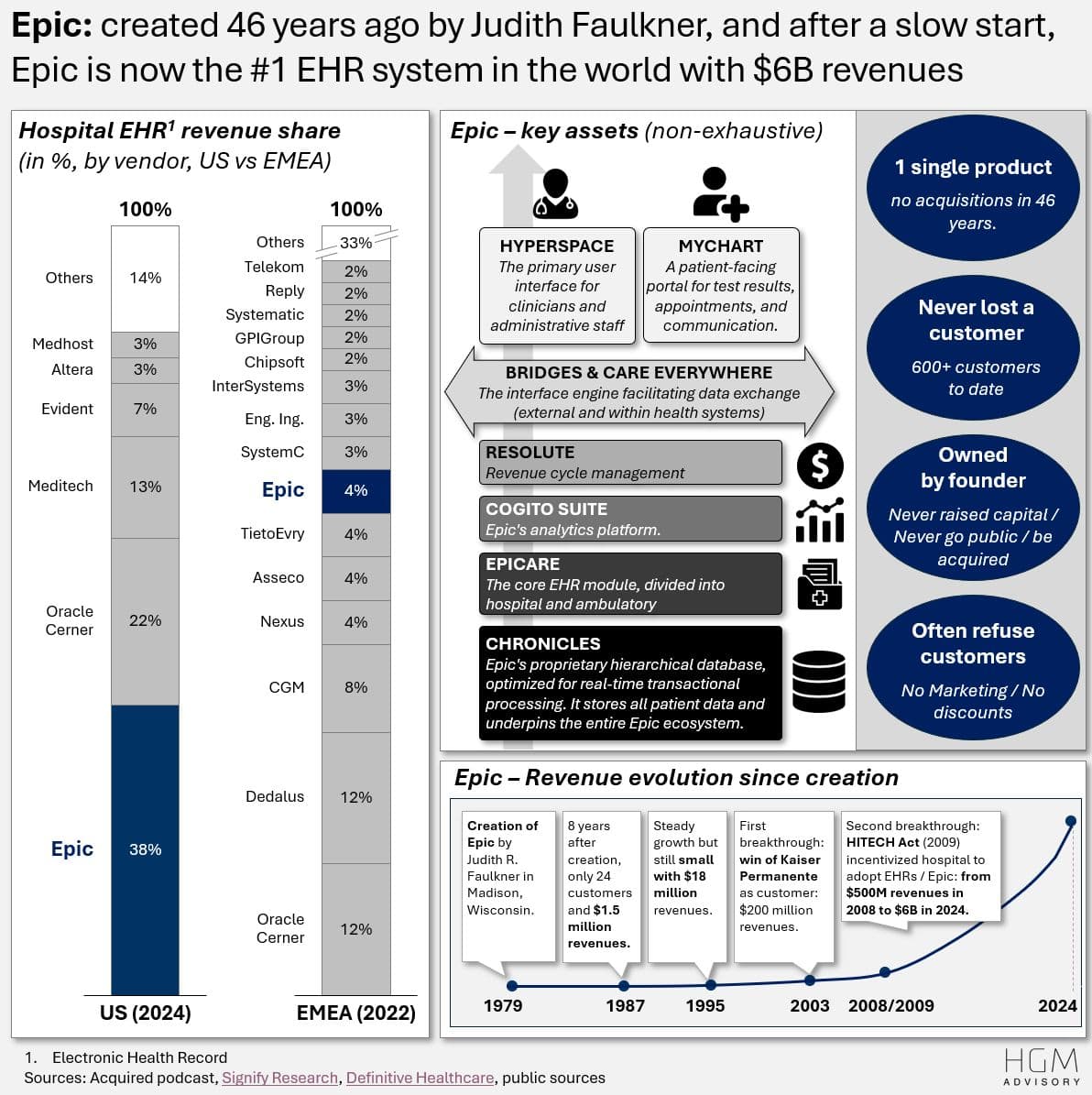
Epic's dominance starts with its founder. Judith Faulkner, who learned Fortran in a week, built the company from a basement in Madison, Wisconsin in 1979 into the world's leading electronic health record system. Unlike most enterprise software companies, Epic has never taken outside funding, never acquired another company, and never gone public. Faulkner maintained total control over product architecture and company culture for over four decades.
This matters because Epic's technical architecture, the decision that ultimately won the market, reflects a founder's long-term conviction rather than the short-term pressures of investors or quarterly earnings. When competitors were acquiring and stitching together disparate systems, Faulkner insisted on building everything on a single codebase.
The Kaiser Permanente moment
The turning point in Epic's rise came in 2003, when Kaiser Permanente, the largest integrated health system in the US, needed a new EHR. Kaiser had attempted to build its own system and failed. IBM entered the tender but could not deliver. The contest came down to Epic versus Cerner.
Epic's president Carl Dvorak made the decisive move: he presented an Excel model demonstrating that Epic's architecture could handle Kaiser's transaction volume with zero downtime. Cerner, which ran on a different database architecture, could not make the same guarantee. Epic won the contract, at the time, the largest EHR deal in history.
The Kaiser win created a flywheel: the most prestigious health system in the US chose Epic, which gave other large health systems confidence to follow. By 2025, Epic holds medical records for over 305 million patients, more than any other EHR vendor globally.
Why Epic leads: two structural advantages
Epic's market dominance rests on two technical advantages that are genuinely difficult to replicate.
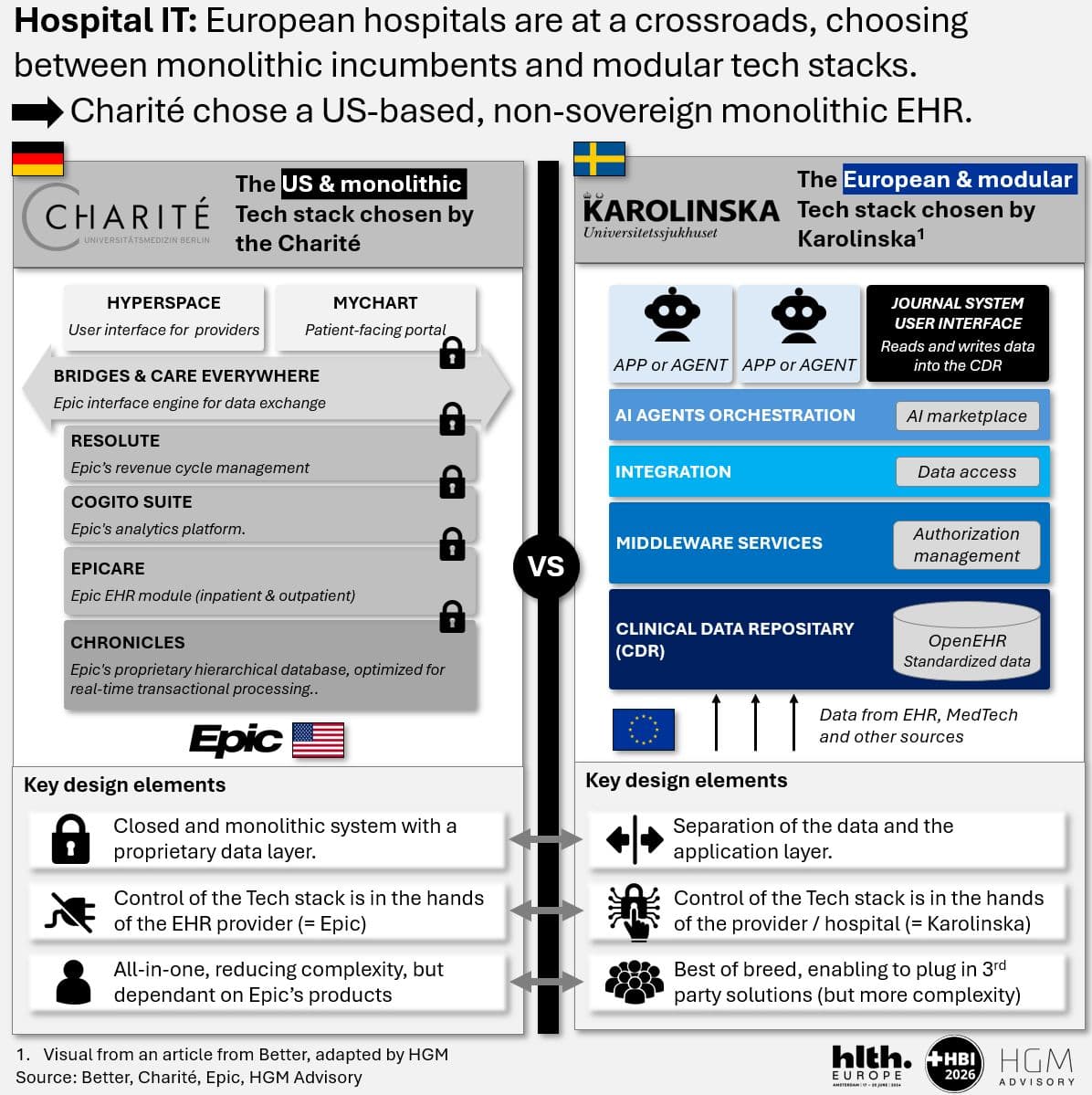
First, reliability through a single unified database. Epic's Chronicles database stores all clinical, administrative, and financial data in one system. Competitors like Oracle Cerner (formerly Cerner) achieved their scale partly through acquisitions: merging Siemens Health Services, iCode, and other systems into a combined platform. Merged systems inevitably have integration seams, data synchronization issues, and failure points that a unified system does not.
Second, clinical and billing integration in one codebase. In most health systems, clinical documentation and revenue cycle management are handled by separate systems that must exchange data. Epic handles both in the same codebase, which means a clinical note can automatically generate billing codes, a medication order can trigger a formulary check against insurance coverage, and a discharge summary can initiate claims submission, all without data leaving the system.
These two advantages compound: reliability builds trust with CIOs, and integration reduces total cost of ownership. Together, they create switching costs that make it extremely difficult for competitors to displace Epic once installed.
| Dimension | Epic | Oracle Cerner | MEDITECH |
|---|---|---|---|
| Architecture | Single unified database (Chronicles) | Merged multi-system platform | Single system (newer Expanse) |
| Clinical + billing | Integrated in one codebase | Separate modules, connected | Integrated in Expanse |
| US market share (large hospitals) | ~38% | ~22% | ~15% |
| European expansion | Aggressive (NHS, Nordics, NL) | Legacy installs, slower growth | Limited EU presence |
| Patient records | 305M+ | ~250M | ~90M |
Five questions for the post-EHR era
Epic won the EHR era decisively. But the healthcare IT landscape is shifting in ways that could either reinforce or undermine Epic's position. Five questions will define the next decade.
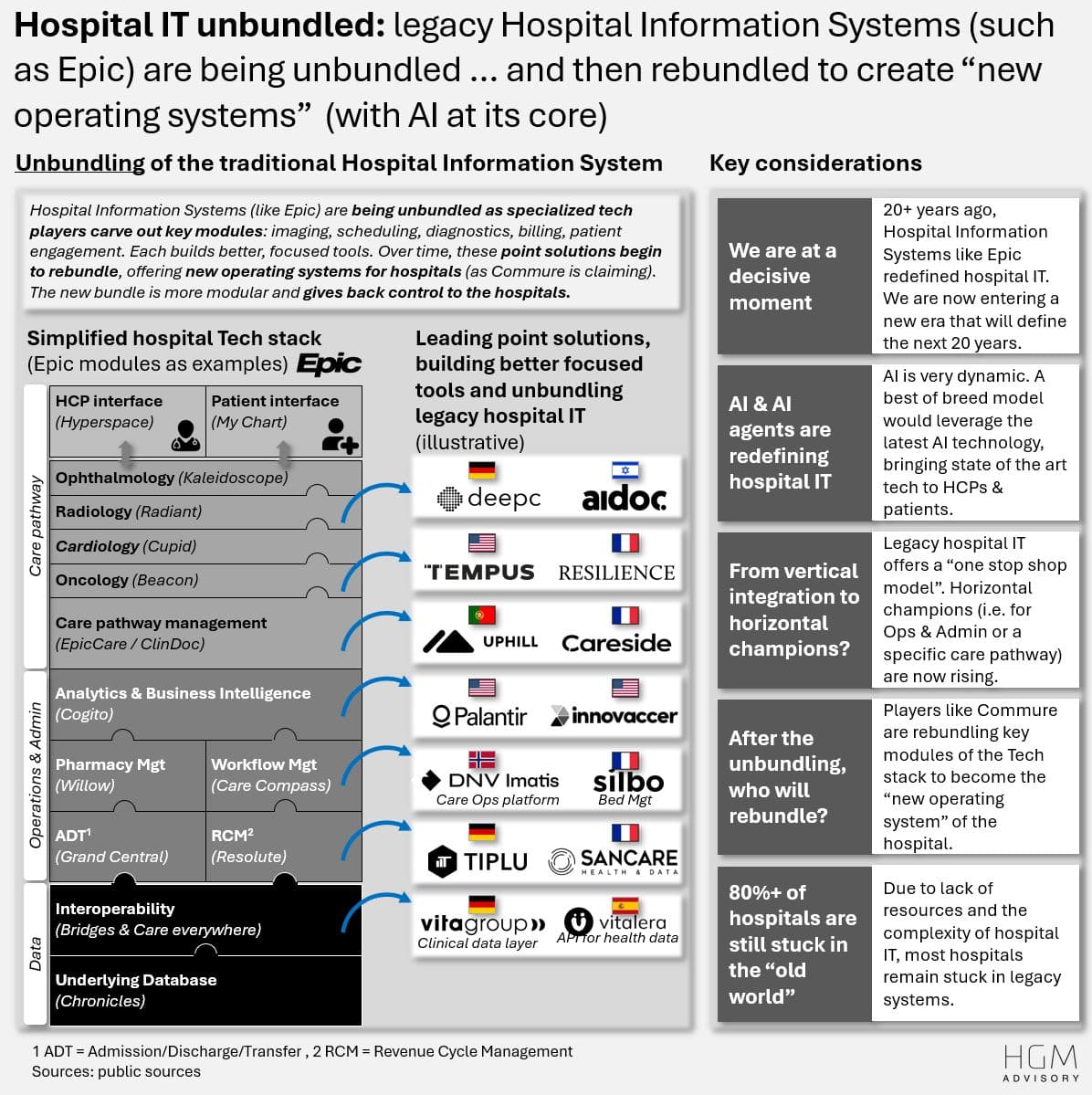
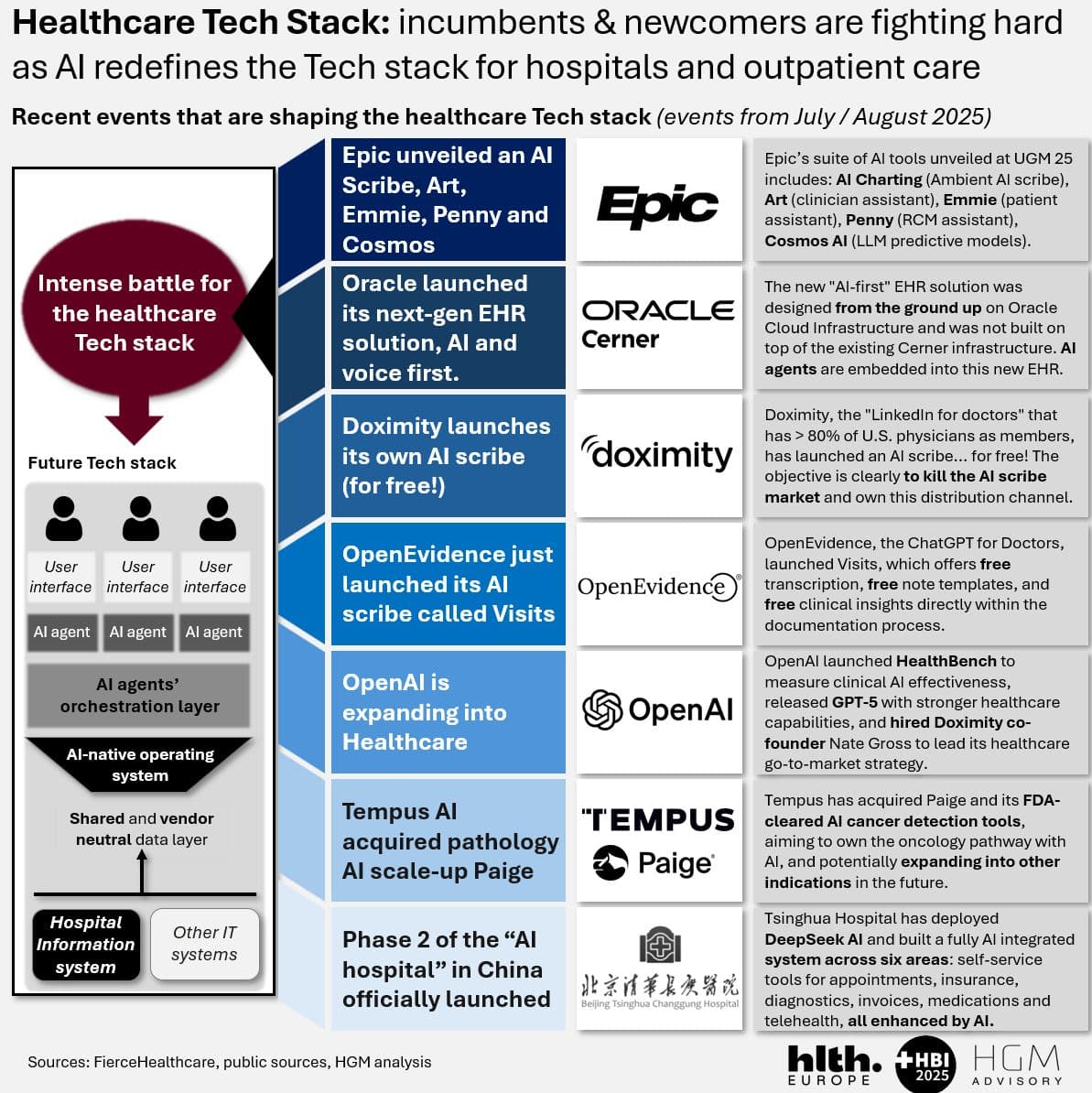
Will the single integrated system hold, or will best-of-breed unbundling win? Companies like OpenEvidence (clinical decision support), Abridge (documentation), Nabla (AI scribes), and Qventus (operational AI) are building specialized tools that sit on top of or alongside the EHR. If clinicians increasingly rely on these tools rather than Epic's built-in equivalents, the EHR's role shrinks from 'platform' to 'database.'
Can hospital business models sustain Epic's pricing? Epic implementations cost tens of millions of dollars for large health systems. As hospital margins compress, particularly in Europe where public funding is constrained, the total cost of ownership becomes a strategic vulnerability.
Will providers gain more control over their technology stack? The current model gives Epic significant influence over how health systems operate. As provider organizations mature in their technology capabilities, some may push for more modular, open architectures.
Can Epic adapt culturally to international markets? Epic's expansion into Europe (15+ NHS trusts, Karolinska, Haga, Danish regions) is its most ambitious growth bet. But European healthcare cultures, procurement processes, and regulatory environments differ fundamentally from the US market where Epic was built.
How will AI transform the EHR itself? If AI can automate documentation, suggest diagnoses, manage billing, and coordinate care, the EHR's role changes from 'system of record that humans interact with' to 'data layer that AI agents interact with.' Epic is investing heavily in AI features, but the question is whether an incumbent can move fast enough against AI-native challengers.
Epic's dominance is real and well-earned. But the post-EHR era will reward different capabilities than the ones that won the first battle.

About the author
Thomas HagemeijerFounder & CEO of HGM Advisory. Management consultant and HealthTech expert working across the full healthcare ecosystem: pharma, MedTech, investors, startups, hospitals, and policymakers. Investor at Springboard Health Angels. Ambassador at HLTH Europe and HBI. Regular keynote speaker on AI in healthcare and digital health transformation.