April 2026
New AI OS in Health: Abridge, OpenEvidence, Heidi, and Epic are racing to build the AI operating system

Founder & CEO, HGM Advisory
Key takeaway
The healthcare AI OS is consolidating around three pillars: AI Scribe, AI Billing, and AI Clinical Decision Support. As of April 2026, Abridge ($5.3B valuation, 250+ health systems), OpenEvidence (40% of US physicians, $12B valuation), Heidi (116 countries, $465M valuation), and Epic (50% of US hospital beds) have all converged on this full stack from different starting points within just 18 months. Epic's decision to cut off Abridge's integration and launch its own scribe with Microsoft signals it will compete with rather than enable the AI layer.
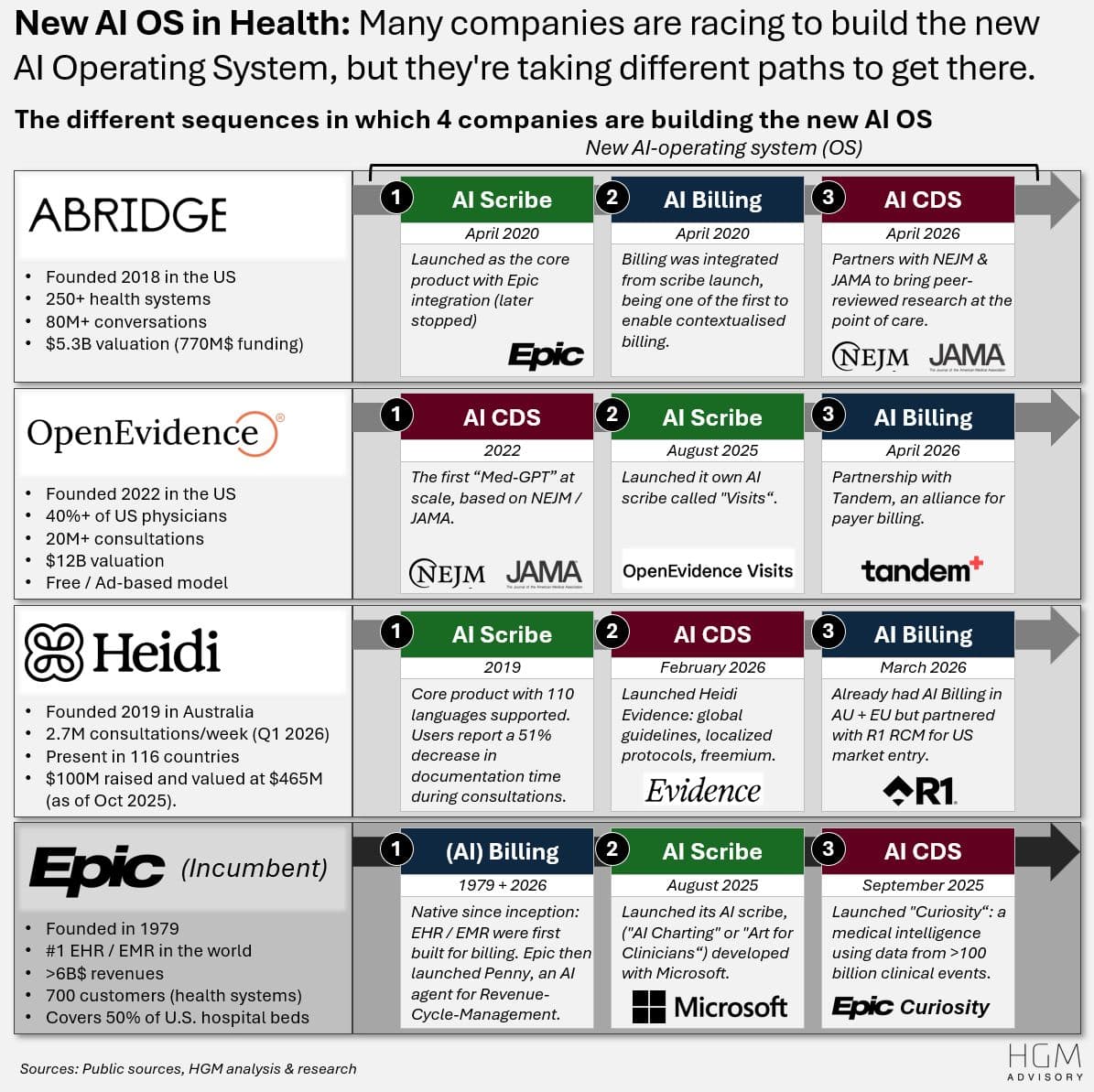
Four companies are racing to build the new AI operating system in healthcare, but they are taking different paths to get there. Abridge, OpenEvidence, Heidi, and Epic each started from a different entry point (scribe, CDS, or billing) and are now converging on the same full-stack vision: AI Scribe + AI Billing + AI Clinical Decision Support.
What is the new AI operating system in healthcare?
The new AI operating system in healthcare combines three pillars: AI Scribe (ambient clinical documentation), AI Billing (automated coding and revenue cycle management), and AI Clinical Decision Support (evidence-based recommendations at the point of care). These three functions are linked through an integrated workflow layer that sits atop legacy EHR/EMR systems, creating an intelligence layer that fundamentally transforms how physicians interact with technology.
According to HGM Advisory's analysis, this AI OS transforms the physician's interaction model in two ways. First, voice-input replaces manual data entry: the physician speaks naturally during a patient encounter and the system handles documentation, coding, and billing automatically. Second, AI-generated clinical recommendations surface in real time, drawing on peer-reviewed evidence from sources like NEJM and JAMA. The result is an AI-native operating system that does not replace the EHR but makes it invisible to the clinician, reducing the administrative burden that currently consumes up to 50% of physician time (AMA, 2024).
Which companies are building the healthcare AI OS, and how do they differ?
As of April 2026, four companies are converging on the full AI OS stack from different starting points. Abridge (founded 2018, $5.3B valuation, $770M total funding, 250+ health systems, 80M+ conversations) began with the AI Scribe as its core product through Epic integration, later added contextual billing, and in April 2026 partnered with NEJM and JAMA to add clinical decision support.
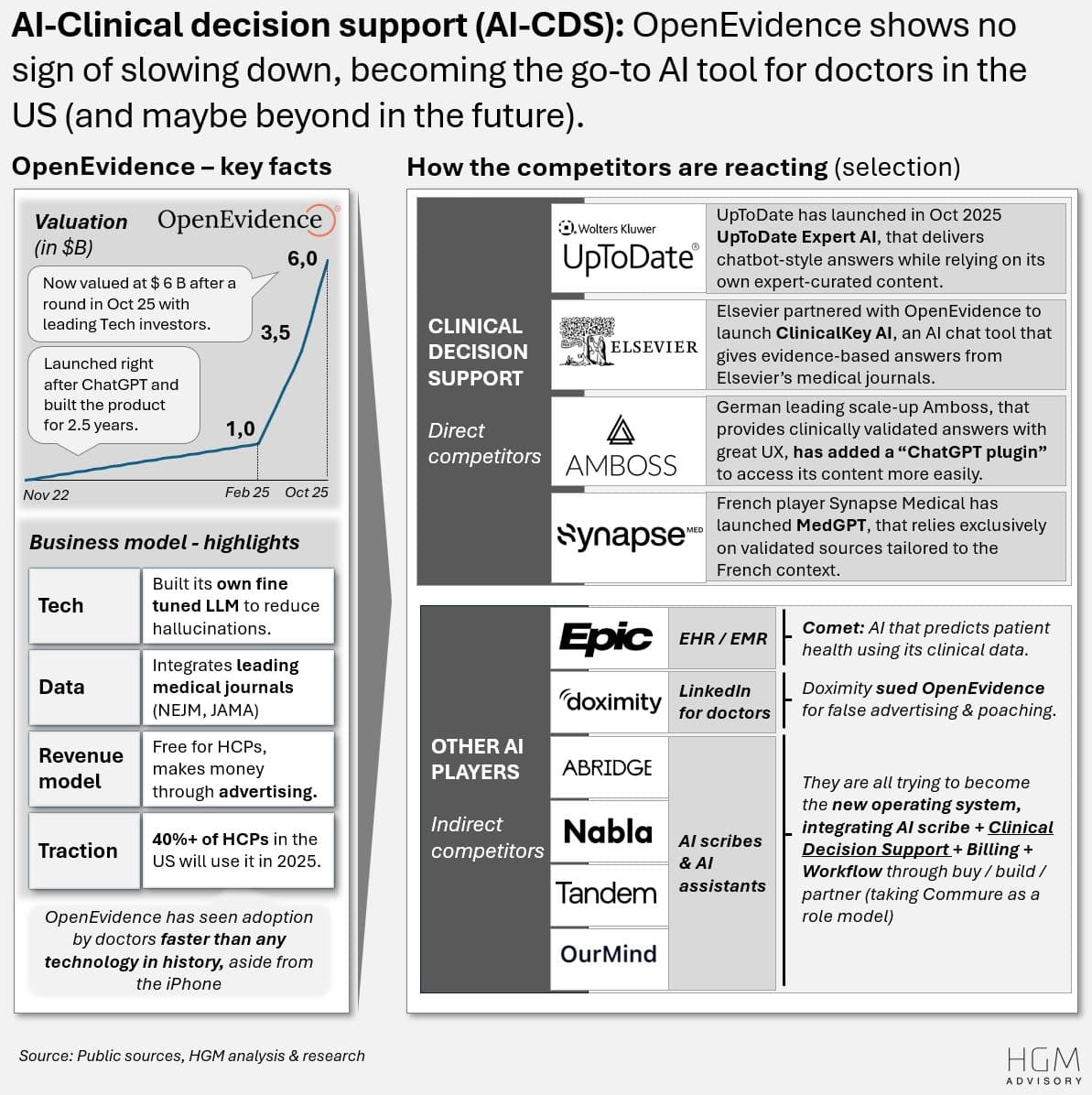
OpenEvidence (founded 2022, $12B valuation, 40% of US physicians, 20M+ consultations monthly) started with AI-CDS, building the first Med-GPT at scale based on NEJM and JAMA content. It launched its own AI scribe called Visits in August 2025, and partnered with Tandem for payer billing in April 2026.
Heidi (founded 2019 in Australia, $465M valuation as of October 2025, present in 116 countries, 2.7M consultations per week) started with the AI Scribe supporting 110 languages, with users reporting a 51% decrease in documentation time. It launched Heidi Evidence for clinical decision support in February 2026, and partnered with R1 RCM for US market billing entry.
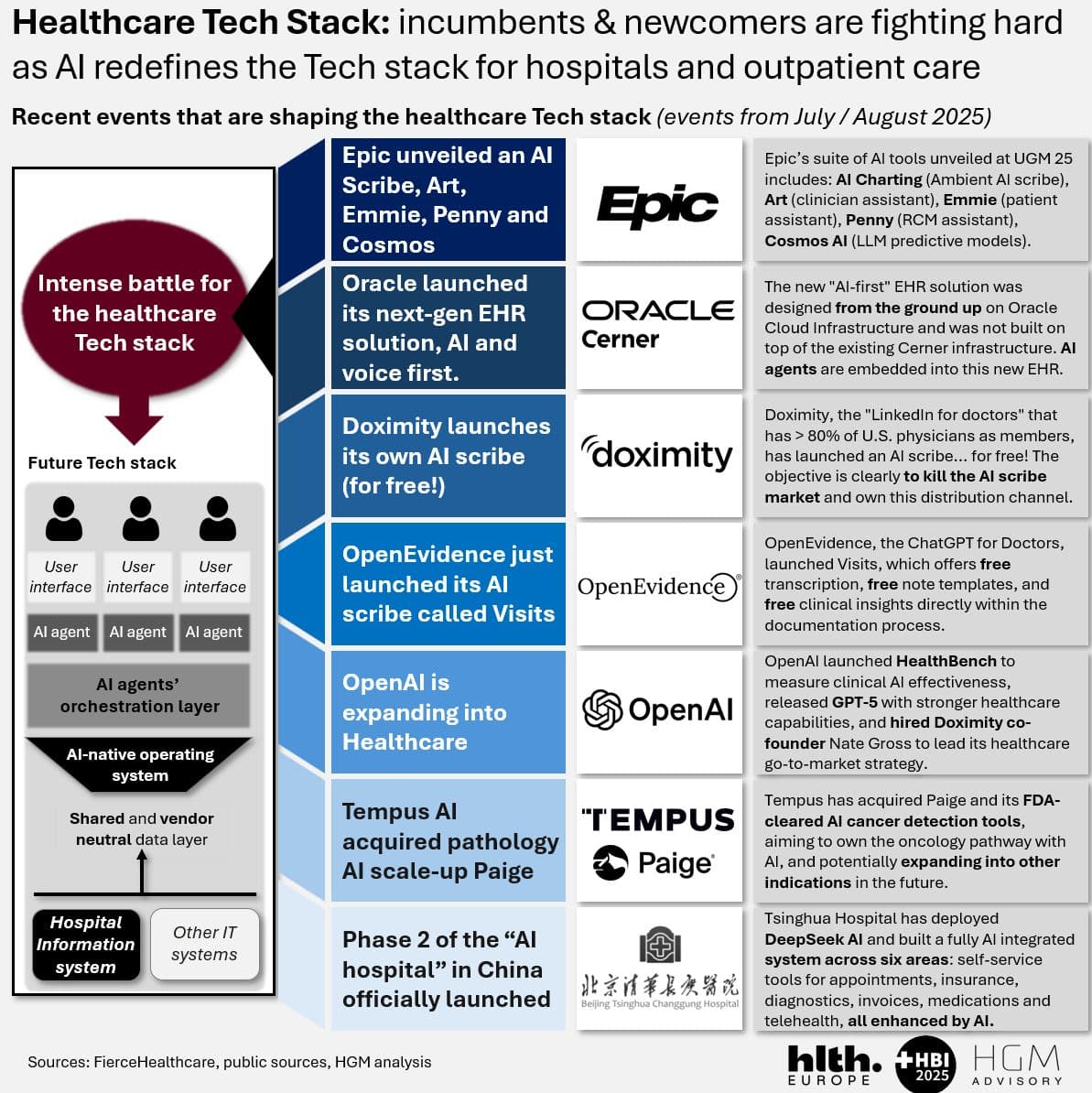
Epic (founded 1979, #1 EHR globally, 700 health systems, covering 50% of US hospital beds) has billing native since inception, launched its own AI scribe with Microsoft in August 2025, and launched Curiosity, a medical intelligence tool using data from over 100 billion clinical events, in September 2025.
| Company | Founded | Entry point | Valuation | Key metric |
|---|---|---|---|---|
| Abridge | 2018 | AI Scribe | $5.3B | 250+ health systems |
| OpenEvidence | 2022 | AI-CDS | $12B | 40% of US physicians |
| Heidi | 2019 | AI Scribe | $465M | 116 countries |
| Epic | 1979 | Billing/EHR | Private | 50% of US hospital beds |
Who holds the power: content publishers, AI platforms, or EHR incumbents?
Abridge's April 2026 partnerships with the New England Journal of Medicine and JAMA Network are strategically significant because these are the same medical journals that back OpenEvidence. This creates a three-way power dynamic. The content publishers (NEJM, JAMA) hold the authoritative clinical evidence. The AI platforms (OpenEvidence with 40% of US physicians, Abridge with 250+ health systems) operationalize that content at the point of care. The EHR incumbents (Epic with 50% of US hospital beds) control the distribution infrastructure.
Critically, these content deals are not exclusive. NEJM and JAMA are licensing to multiple AI platforms simultaneously, which means content access alone is not a sustainable competitive moat. If every AI platform can access the same evidence base, the differentiator shifts to workflow integration, physician adoption, and clinical outcome measurement. The company that owns the physician's daily workflow, not the one with the best content license, will likely capture the most value in the emerging AI OS market.
Why is Epic blocking third-party AI integrations?
In 2025, Epic cut off Abridge's preferred EHR integration path and launched its own competing AI scribe in partnership with Microsoft. This decision reveals Epic's strategic posture: it will compete with rather than enable the emerging AI OS layer. In a technology ecosystem where interoperability drives adoption, trust between platform and application vendors is the foundational currency. Epic's move to build competing products while controlling the integration layer signals to health systems and AI vendors that Epic will never serve as a neutral ecosystem integrator.
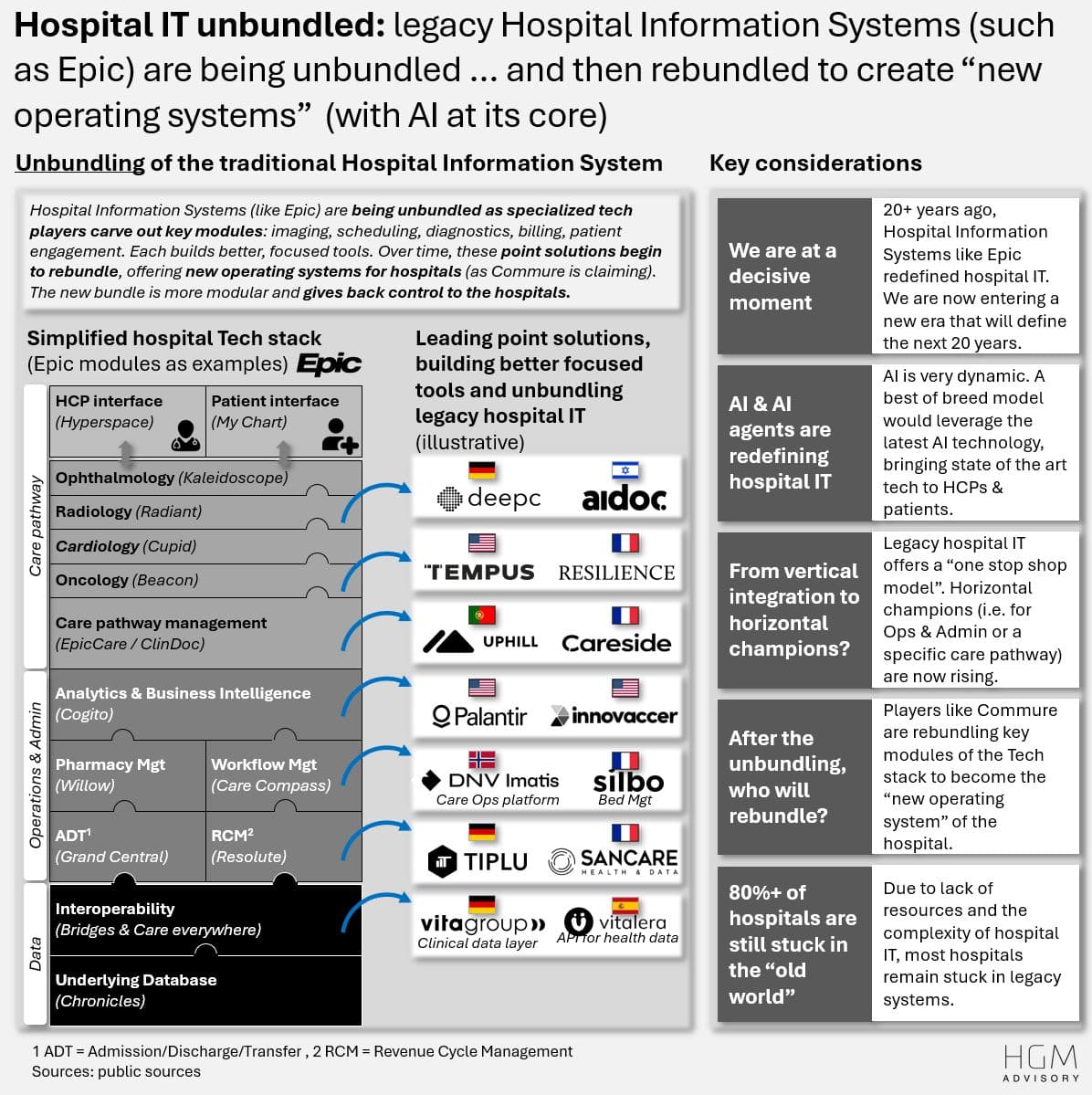
The European market offers a contrasting model. Nexus AG, Germany's fourth-largest hospital information system vendor, acquired Omilon in 2026 to create a data orchestration layer that connects third-party AI solutions rather than replacing them with proprietary alternatives. This open-platform approach may prove more sustainable than Epic's walled-garden strategy because it aligns the platform's interests with those of its ecosystem partners. Health systems evaluating their long-term technology strategy should consider whether a closed or open platform model better serves their AI adoption roadmap.
How will the healthcare AI OS market consolidate?
The healthcare AI OS market will consolidate because the three-pillar stack (Scribe, Billing, CDS) is becoming critical infrastructure for both providers and payers. The OpenEvidence x Tandem partnership, announced in April 2026, shows how the AI layer is beginning to bridge the provider-payer divide by linking clinical documentation directly to billing and reimbursement workflows. This creates a unified data flow from patient encounter to payment that legacy systems have never achieved.
Private equity continues to invest in legacy health IT systems, betting that the transition from EHR-centric to AI-native architectures will be slow. However, the pace of convergence contradicts this thesis: all four major players moved into all three AI OS pillars within just 18 months, from early 2025 to mid-2026. The window for legacy systems to adapt is narrowing faster than most investors expect. The winners will be the companies that can deliver all three pillars seamlessly while maintaining trust with health systems, and the losers will be point-solution vendors that only cover one pillar and face acquisition or irrelevance.

About the author
Thomas HagemeijerFounder & CEO of HGM Advisory. Management consultant and HealthTech expert working across the full healthcare ecosystem: pharma, MedTech, investors, startups, hospitals, and policymakers. Investor at Springboard Health Angels. Ambassador at HLTH Europe and HBI. Regular keynote speaker on AI in healthcare and digital health transformation.