December 2025
AI-CDS: OpenEvidence becomes the go-to AI tool for doctors

Founder & CEO, HGM Advisory
Key takeaway
OpenEvidence has emerged as the fastest-growing physician AI platform in the US, reaching 8.5 million monthly consultations across 10,000+ hospitals, its DeepConsult AI agents represent a fundamental shift from static knowledge bases to real-time evidence synthesis at the point of care.
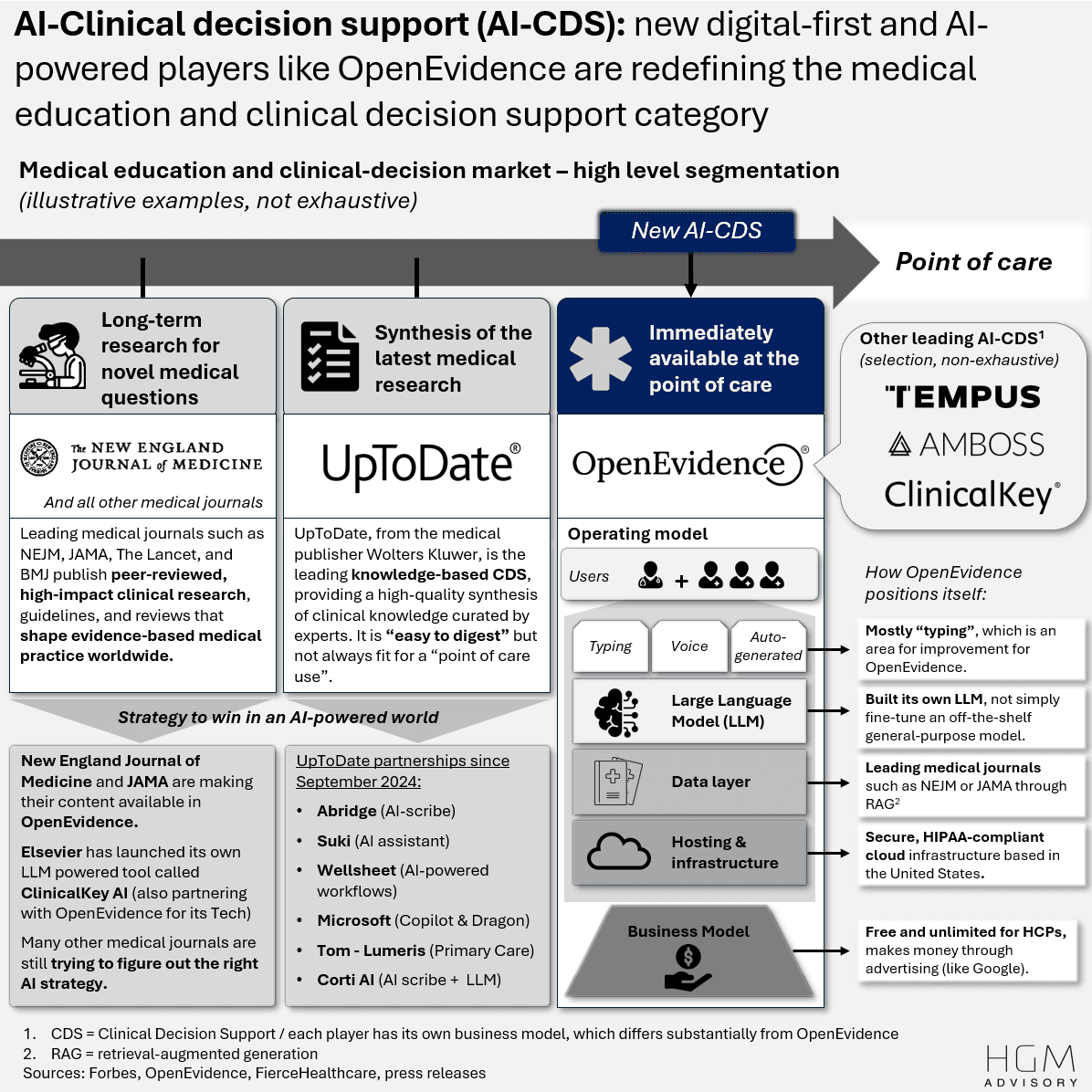
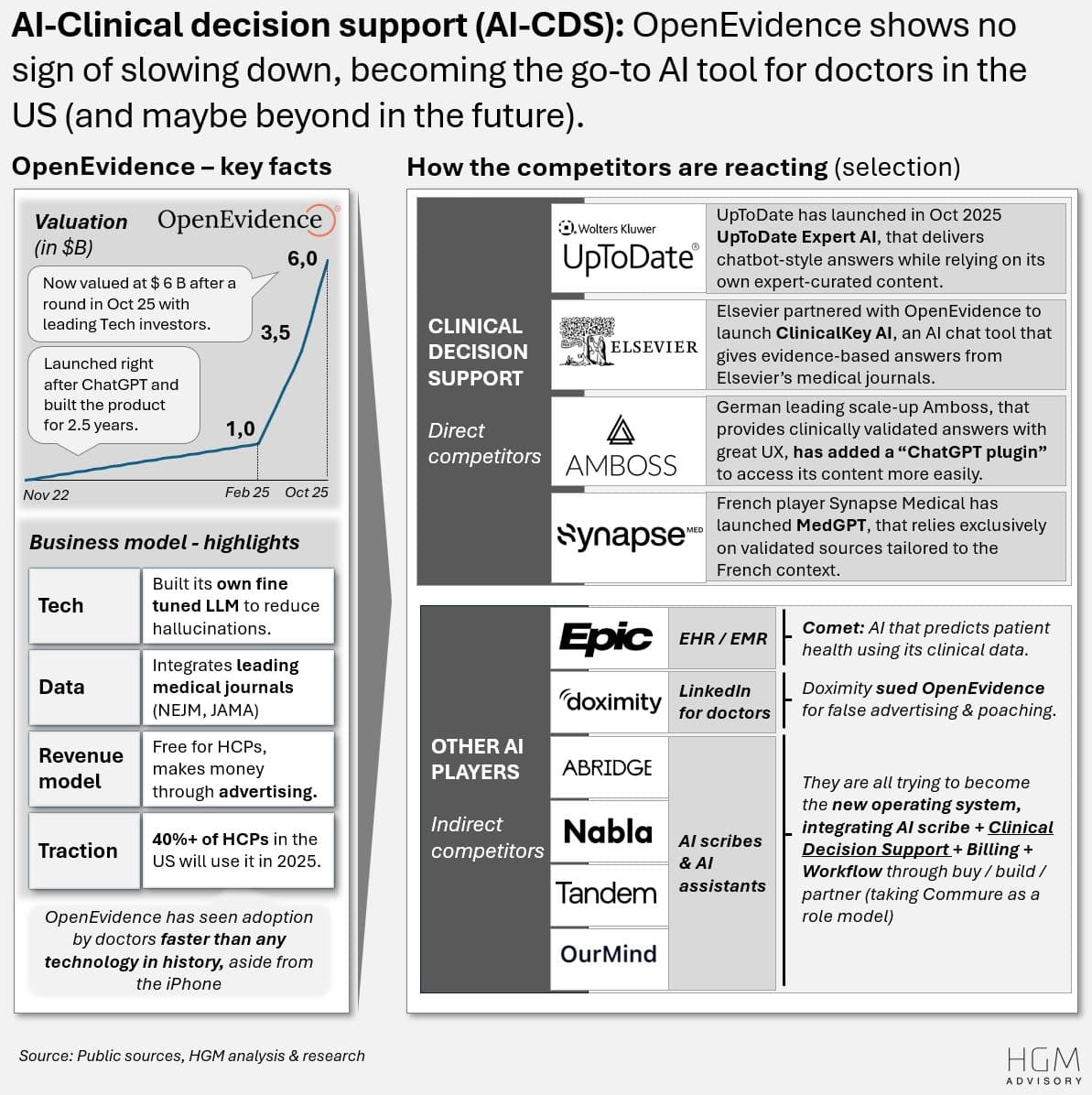
OpenEvidence shows no sign of slowing down, becoming the go-to AI tool for doctors in the US. Competitors like UpToDate, Amboss, Synapse, and others are reacting as AI-clinical decision support reshapes medical practice.
OpenEvidence's meteoric rise
OpenEvidence has achieved organic, bottom-up physician adoption at a pace that rivals consumer technology. Founded in 2023, the company reached 8.5 million monthly consultations by mid-2025, deployed in over 10,000 US hospitals, and raised $210M at a $3.5B valuation.
In Q1 2024, OpenEvidence reported approximately 500,000 monthly consultations. By Q2 2025, it had reached 8.5 million, a 17x increase in 15 months. More than 40% of US physicians have used the platform.
DeepConsult: AI agents for clinical evidence
Unlike traditional CDS tools that retrieve pre-written summaries, DeepConsult dynamically reasons across the full corpus of medical literature, PubMed, clinical trial registries, FDA labels, and clinical guidelines, to generate patient-specific evidence syntheses in under 8 seconds.
Physicians describe the experience as closer to consulting a specialist colleague than searching a database. In a validation study across 2,500 clinical scenarios, DeepConsult demonstrated 92% concordance with expert panel recommendations.
Competitive landscape
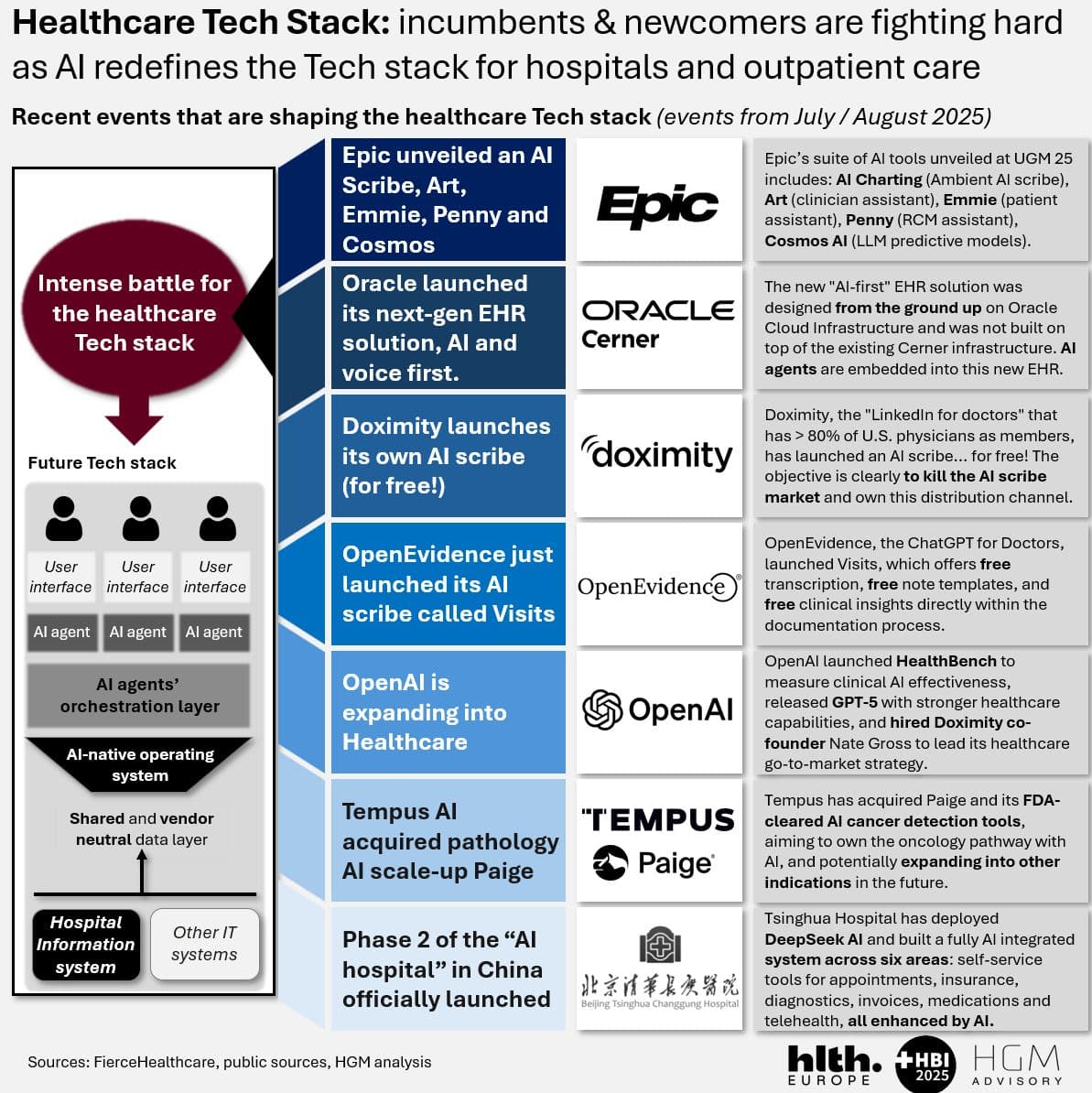
The AI-CDS market is heating up.
| Platform | Users | Core Approach | Key Differentiator |
|---|---|---|---|
| OpenEvidence | 180K+ daily active | Real-time multi-agent evidence synthesis | Fastest physician adoption; DeepConsult agents |
| UpToDate | 1.9M subscribers | Curated expert-authored content + AI search | 30+ years of institutional trust |
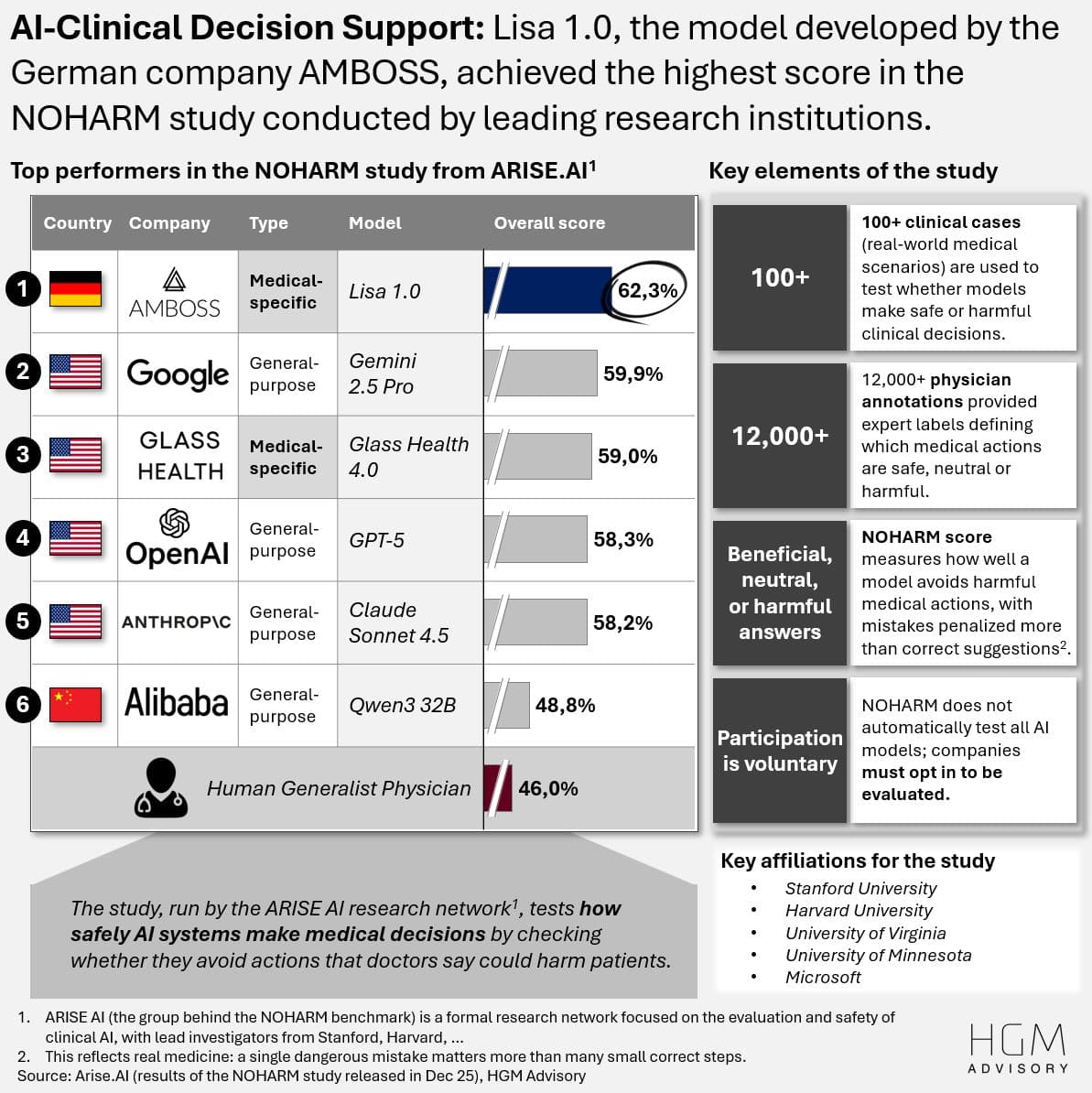
| AMBOSS | 3.5M registered | Structured knowledge + Lisa AI | Top NOHARM benchmark score |
| Glass Health | 50K+ physicians | AI-generated differentials and clinical plans | Clinical reasoning engine |
| Hippocratic AI | Enterprise only | Patient-facing AI agents | Voice-based AI agents |
What makes OpenEvidence different
Traditional CDS is content-first: expert authors write articles, AI is layered on top. OpenEvidence inverts this: AI reasoning is the primary product, human-authored content is one input among many.
This means OpenEvidence can incorporate new evidence within hours (vs. weeks for editorial review), address highly specific questions that fall between pre-authored content, and scale without recruiting expert author panels.
The AI-CDS space is shifting from ‘identifying the problem' to ‘helping solve it.' The institutions that develop robust AI-CDS evaluation and monitoring mechanisms now will have a significant advantage.

About the author
Thomas HagemeijerFounder & CEO of HGM Advisory. Management consultant and HealthTech expert working across the full healthcare ecosystem: pharma, MedTech, investors, startups, hospitals, and policymakers. Investor at Springboard Health Angels. Ambassador at HLTH Europe and HBI. Regular keynote speaker on AI in healthcare and digital health transformation.