April 2026
Is this the turning point for Value-Based Care? CMS launches the ACCESS Model

Founder & CEO, HGM Advisory
Key takeaway
The US spends over $12,000 per capita on healthcare annually, nearly double peer nations, yet has a life expectancy of just 79 years. The CMS ACCESS Model is a structural attempt to fix this by paying for outcomes rather than volume. With 150+ organizations selected across digital health platforms, traditional providers, and specialists, the program could become the blueprint that Germany and France have been missing.
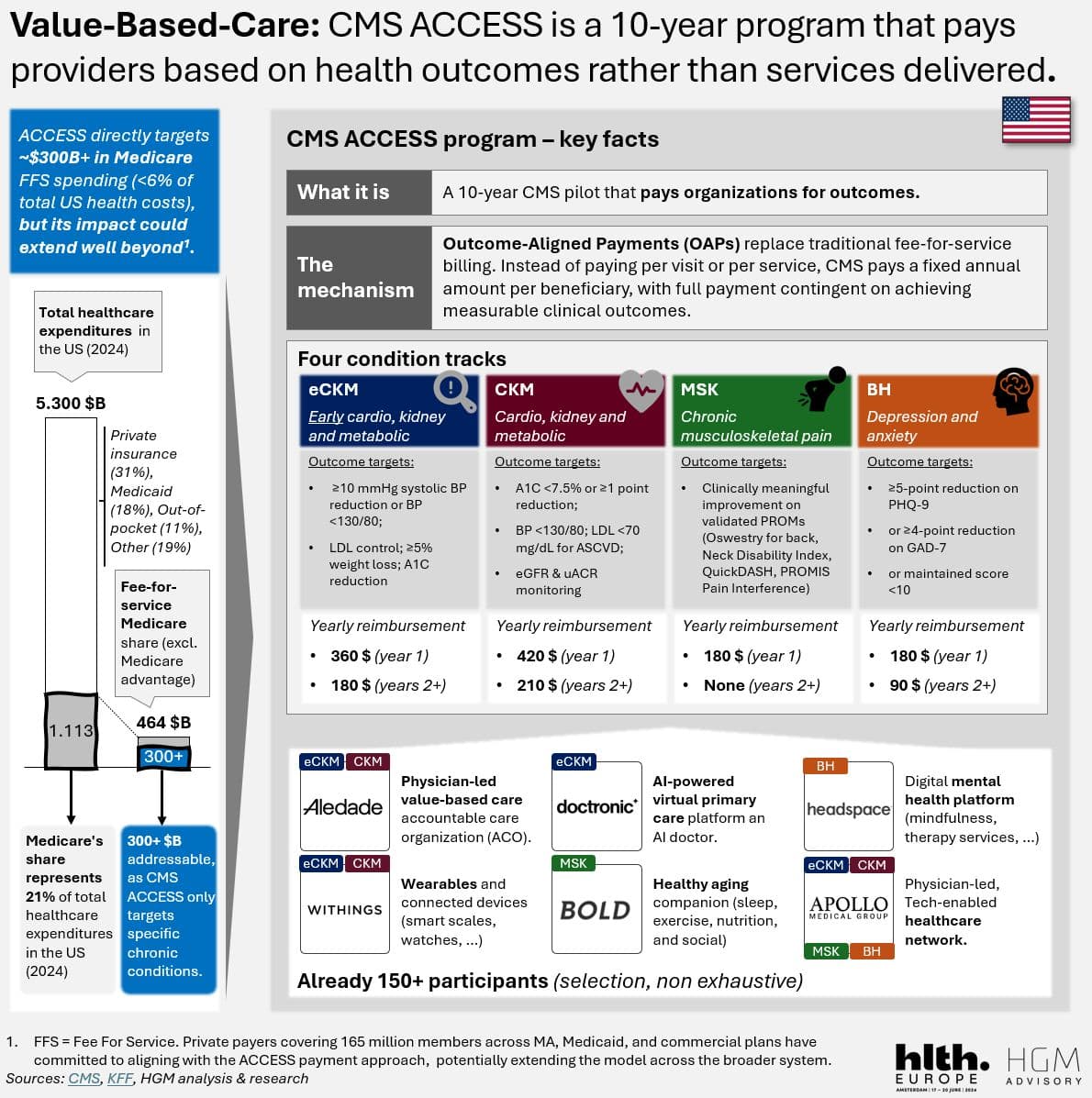
CMS is launching the ACCESS Model (Advancing Chronic Care with Effective, Scalable Solutions), a 10-year pilot paying providers based on patient health outcomes rather than services delivered. With 150+ participating organizations and coverage across Medicare, this could reshape the relationship between patients, providers, and payers.
What is the CMS ACCESS Model?
The CMS ACCESS Model (Advancing Chronic Care with Effective, Scalable Solutions) launches on July 5, 2026 as a 10-year pilot program that fundamentally changes how providers are paid. Instead of traditional fee-for-service billing, the ACCESS Model uses Outcome-Aligned Payments (OAPs): CMS pays a fixed annual amount per beneficiary, with full payment contingent on achieving measurable clinical outcomes. The program covers Medicare, which accounts for over 20% of US healthcare expenditures (CMS, 2025).
The conditions targeted are chronic and high-cost: diabetes, hypertension, chronic kidney disease, obesity, depression, anxiety, musculoskeletal conditions, and cardio-kidney-metabolic care. These conditions collectively represent the majority of Medicare spending and are the areas where outcome-based models have the greatest potential to simultaneously improve quality and reduce cost. Each condition track has specific clinical outcome targets and yearly reimbursement rates, ranging from $90 to $420 per beneficiary depending on the track and program year.
Which organizations were selected for the ACCESS Model?
CMS selected over 150 organizations for the ACCESS Model, deliberately structured into three roughly equal groups. The first third are digital health platforms, which CMS has explicitly positioned as the primary target audience for this new payment model. Companies like Aledade (physician-led value-based care), Doctronic (AI-powered virtual primary care), and Bold (healthy aging companion powered by AI) represent this category.
The second third are traditional providers: physician groups, health systems, federally qualified health centers (FQHCs), and home care organizations. The final third are specialists and enablers: kidney care specialists, cardiologists, behavioral health providers, device makers like Withings (connected health devices), and infrastructure providers. This deliberate mix forces digital-first platforms into direct competition with traditional providers under identical outcome metrics, creating an environment where clinical results rather than institutional incumbency determine reimbursement success. It is the most significant democratization of healthcare payment participation that CMS has attempted.
Why does the US healthcare system need value-based care reform?
The US healthcare system presents a striking paradox that the ACCESS Model aims to address. Per capita spending exceeds $12,000 annually (OECD, 2024), nearly double the average of peer nations including Germany, France, and the UK. Yet US life expectancy sits at just 79 years, among the lowest of comparable OECD economies. At the same time, the US captures over 60% of global HealthTech and AI investments (Rock Health, 2025), creating an unusual combination of abundant innovation and poor population health outcomes.
This broken system combined with an abundance of technology innovation creates the conditions for structural payment reform. The ACCESS Model is an attempt to channel that innovation toward outcomes rather than volume. The 10-year program duration is deliberately long, designed to give participating organizations enough time to build the infrastructure, data systems, and care models needed to succeed under outcome-based payment. If it works at scale, it could become the most significant shift in US healthcare payment since the introduction of DRGs in 1983.
How does AI reshape the relationship between providers and payers?
Providers are already spending 20x more on AI than payers (Menlo Ventures, 2025), creating an asymmetry that the ACCESS Model will accelerate. AI is reshaping the healthcare value chain unevenly across four pressure points. First, AI-assisted clinical documentation is driving a roughly 20% increase in coding intensity, meaning providers are capturing higher reimbursement per encounter through more detailed AI-generated codes. Second, payment infrastructure is being commoditized as companies like Stripe build healthcare-specific platforms. Third, care navigation platforms like Transcarent are letting self-insured employers contract directly with health systems, cutting insurers out entirely. Fourth, AI platforms are offering payers efficiency tools at the cost of growing technological dependency.
Health plans can respond strategically through seven actions: deploying AI-driven claims adjudication to match provider AI capabilities, automating administrative processes to reduce operational costs, proactively adopting AI-enabled reimbursement codes before they are imposed, building proprietary payment infrastructure, advancing their own value-based care models, developing proprietary care navigation tools (as UnitedHealthcare did with its Avery AI companion), and optimizing the operating model for an AI-native world where the traditional administrative moat no longer provides competitive protection.
| Pressure | Description | Strategic response |
|---|---|---|
| Coding intensity (+20%) | AI-assisted documentation captures higher codes | Deploy AI-driven claims adjudication |
| Commoditization | Payment infrastructure becomes standardized | Build proprietary payment infrastructure |
| Bypass layers | Platforms like Transcarent cut insurers out | Develop proprietary care navigation |
| AI dependency | Payers rely on vendor AI for efficiency | Optimize operating model for AI-native world |
What can Germany and France learn from the ACCESS Model?
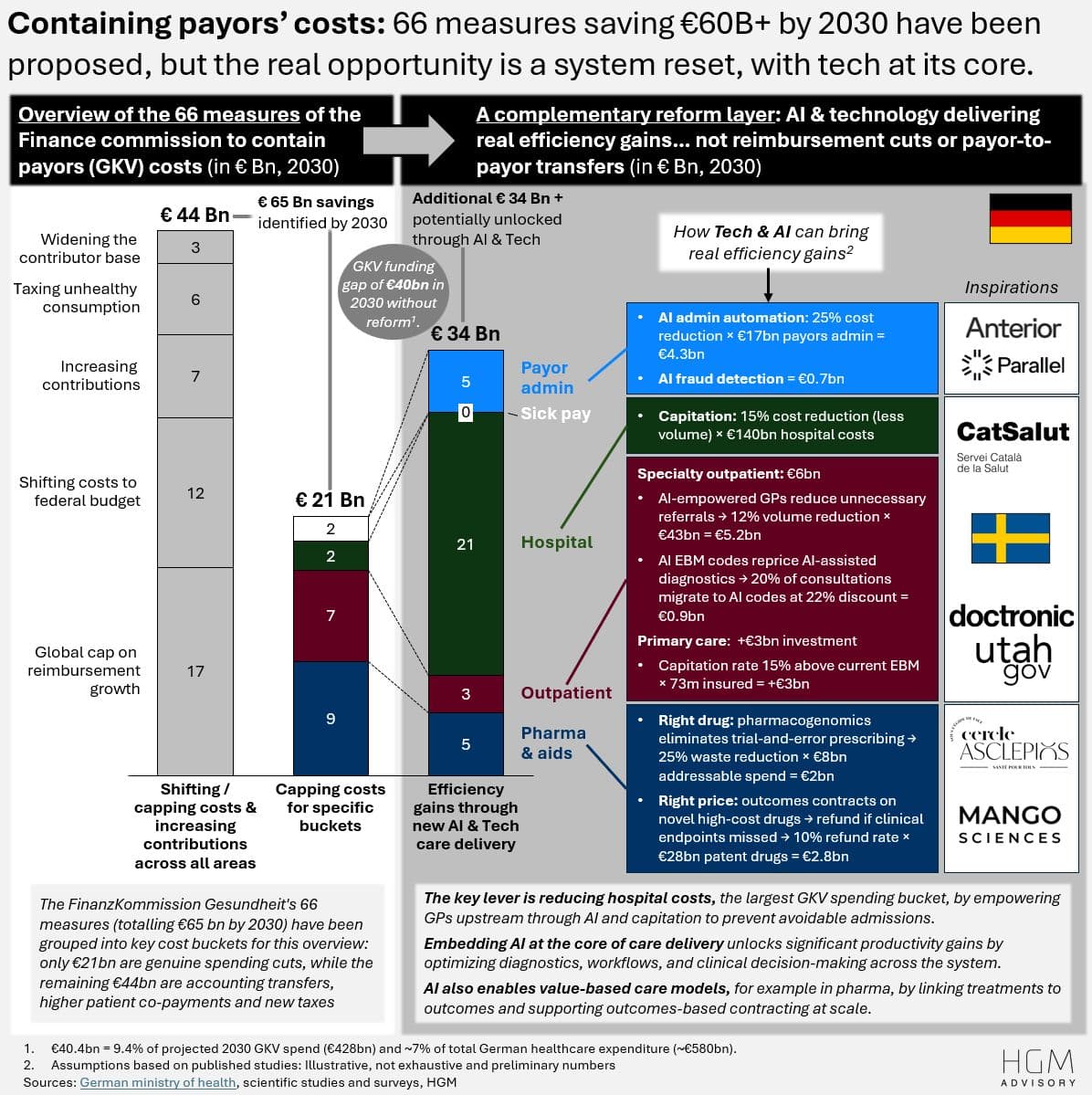
Germany's Health Finance Commission (FKG) delivered 66 short-term cost measures for 2027, but the focus remains limited to cost containment and budget shifts within the existing fee-for-service framework rather than structural efficiency gains through outcome-based payment. A second reform report is due by end of 2026. The ACCESS Model offers a concrete template for how Germany could move beyond incremental cost-cutting toward paying for health outcomes at scale, particularly given that German hospital costs represent over 25% of total healthcare spending (Destatis, 2024).
In France, the newly formed Cercle Asclepios (Sante pour tous), a non-partisan healthcare think tank chaired by Franck von Lennep, is bringing together healthcare leaders to develop proposals for population health and access. France's single-payer system (Securite Sociale) provides a structural advantage for implementing outcome-based models at national scale, though this advantage is paradoxically often framed as a constraint on innovation rather than an enabler of coordinated reform.
Both countries should study how the ACCESS Model integrates digital health platforms alongside traditional providers in the same payment program, creating competitive pressure that rewards measurable clinical outcomes and innovation rather than protecting incumbent delivery models. The 10-year horizon also provides a lesson: meaningful payment reform requires sustained commitment beyond electoral cycles.

About the author
Thomas HagemeijerFounder & CEO of HGM Advisory. Management consultant and HealthTech expert working across the full healthcare ecosystem: pharma, MedTech, investors, startups, hospitals, and policymakers. Investor at Springboard Health Angels. Ambassador at HLTH Europe and HBI. Regular keynote speaker on AI in healthcare and digital health transformation.