April 2026
German public payors are losing billions: the funding gap could reach €40B by 2030

Founder & CEO, HGM Advisory
Key takeaway
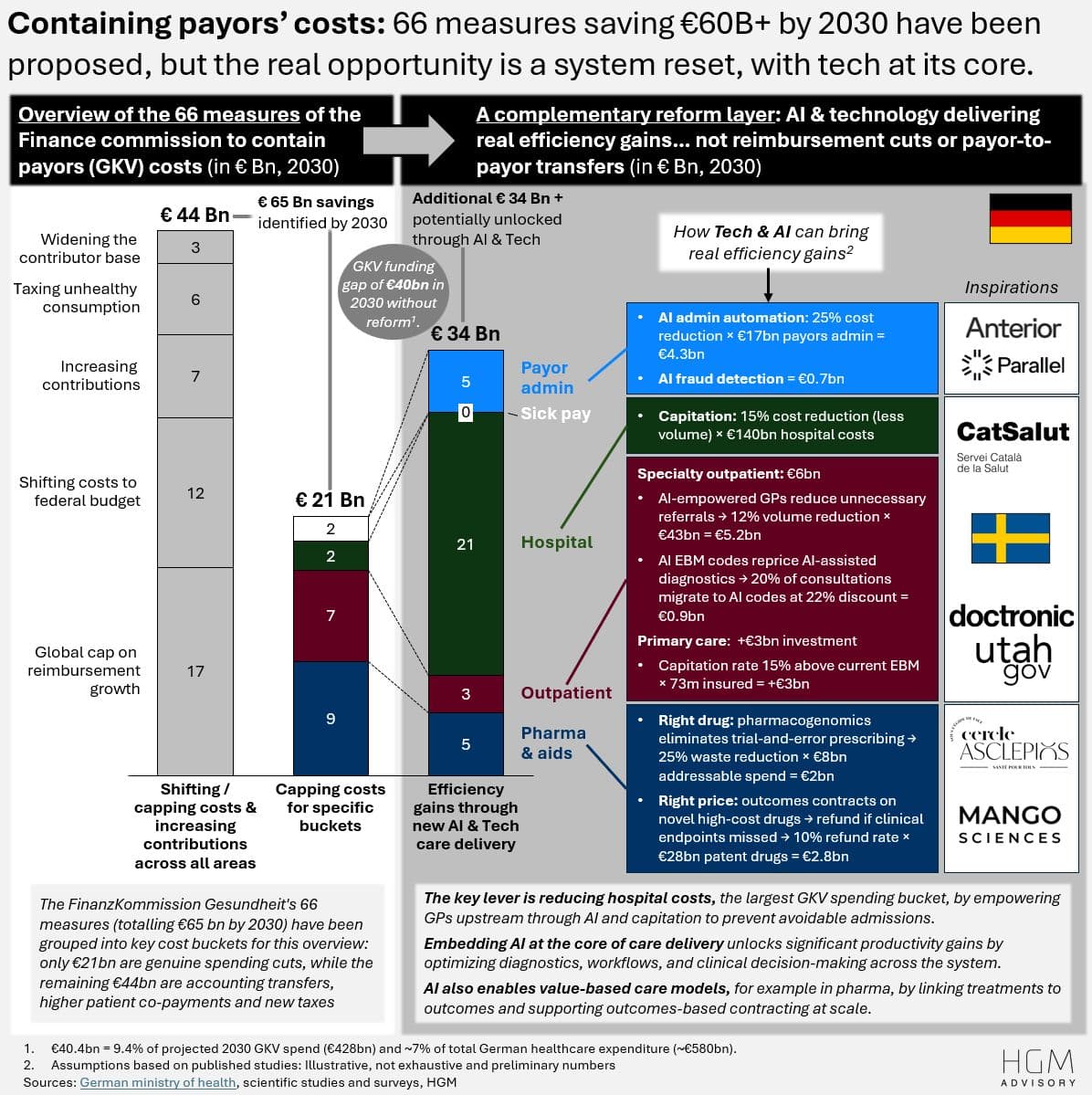
Germany's public health insurance funding gap is projected to grow from €15.3B in 2027 to €40.4B by 2030. The 66 short-term measures proposed by the Health Finance Commission focus on cost containment rather than structural efficiency. A system reset involving hospital-to-primary care shifting, AI-driven efficiencies, and value-based pricing is needed.
Public payors in Germany are losing billions every year. If nothing changes, the funding gap could reach €40B by 2030, roughly 10% of projected €400B+ GKV spending. Short-term fixes from the Health Finance Commission won't be enough: the system needs a structural reset.
A system under pressure
Germany's statutory health insurance system (GKV) is heading toward a structural funding crisis. Expenditures are rising faster than revenues, and the gap is widening at an accelerating rate. Current projections show the funding gap growing from €15.3 billion in 2027 to €40.4 billion by 2030, a trajectory that, if unaddressed, would represent roughly 10% of total projected GKV spending.
The paradox is striking: Germany spends more on healthcare per capita than almost any other European country, yet achieves only average OECD life expectancy outcomes. The Netherlands, for comparison, achieves better health outcomes at lower per-capita cost with a more streamlined system. This gap between spending and outcomes points to structural inefficiencies rather than underfunding. The money is there, but it is not being deployed effectively.
Short-term fixes: the Health Finance Commission response
The German Health Finance Commission (Finanzkommission der GKV, or FKG) has delivered a package of 66 short-term measures targeting 2027. These measures focus overwhelmingly on cost containment: adjusting contribution rates, tightening reimbursement rules, and reducing administrative overhead at the margin.
The measures are necessary but insufficient. They address symptoms rather than causes. For example, proposed cuts to the innovation fund save approximately €100 million, just 0.15% of the projected funding gap. While politically achievable, such measures cannot close a gap that is growing by billions per year.
One promising signal: the proposed taxation of sugary drinks represents a rare example of preventive health policy that could reduce long-term healthcare costs. However, the revenue impact is modest relative to the scale of the problem.
Why a system reset is needed
The 66 FKG measures buy time, but they do not solve the structural problem. Four areas require fundamental reform, expected to be addressed in a second reform wave by the end of 2026.
First, hospital-to-primary care shifting. Germany has roughly 1,700 hospitals, far more per capita than comparable European countries. Many are running at low utilization rates and operating at a loss. Shifting appropriate care from expensive inpatient settings to outpatient and primary care settings could generate billions in savings while improving access and outcomes.
Second, AI-driven operational efficiencies. Administrative costs consume an estimated 15-20% of GKV spending. AI-powered automation of claims processing, prior authorization, documentation, and care coordination could meaningfully reduce this overhead. Companies like Doctolib, Heidi, and emerging AI billing tools are already demonstrating what is possible.
Third, administrative burden reduction. The German healthcare system is one of the most administratively complex in Europe. Simplifying regulatory requirements, standardizing digital interfaces (building on gematik's infrastructure), and reducing paperwork for providers would free resources for patient care.
Fourth, pharma value-based pricing. Germany's AMNOG process for drug pricing is well-established but was designed for a pre-AI era. As precision medicine and AI-driven therapeutics mature, pricing models need to evolve toward outcomes-based contracts that align payer spending with actual patient benefit.
The funding gap in numbers
The projected trajectory of the GKV funding gap underlines the urgency of structural reform.
| Year | Projected GKV Spending | Projected GKV Revenue | Funding Gap | Gap as % of Spending |
|---|---|---|---|---|
| 2025 | ~€320B | ~€310B | ~€10B | ~3.1% |
| 2027 | ~€350B | ~€335B | €15.3B | ~4.4% |
| 2029 | ~€385B | ~€355B | ~€30B | ~7.8% |
| 2030 | ~€400B+ | ~€360B | €40.4B | ~10.1% |
What this means for HealthTech
For HealthTech companies operating in Germany, the funding crisis creates both risk and opportunity. The risk is obvious: tighter budgets mean slower procurement cycles and more scrutiny on ROI. Hospital budgets are already under pressure from the Krankenhausreform, and additional cost pressure from the GKV funding gap will compound this.
The opportunity lies in solutions that demonstrably reduce cost. HealthTech companies that can show measurable efficiency gains: in administrative automation, care pathway optimization, preventive health, or hospital-to-outpatient shifting, will find a receptive audience among payors and policymakers. The era of nice-to-have digital health innovation in Germany is ending. What comes next is a harder, more commercially disciplined phase where impact on the funding gap becomes the primary purchasing criterion.
At HGM Advisory, we expect the second reform wave to create significant demand for HealthTech advisory: from payors evaluating AI-driven efficiency tools, to hospitals navigating the transition from inpatient to outpatient models, to pharma companies adapting to value-based pricing frameworks. The companies that position themselves now for this structural shift will have a decisive advantage.

About the author
Thomas HagemeijerFounder & CEO of HGM Advisory. Management consultant and HealthTech expert working across the full healthcare ecosystem: pharma, MedTech, investors, startups, hospitals, and policymakers. Investor at Springboard Health Angels. Ambassador at HLTH Europe and HBI. Regular keynote speaker on AI in healthcare and digital health transformation.