April 2026
Mayo Clinic Platform Accelerate: 76 AI startups and the data-for-equity model reshaping clinical AI

Founder & CEO, HGM Advisory
Key takeaway
Mayo Clinic's Platform Accelerate has onboarded 76 AI startups since 2022 using a data-for-equity model that requires no capital investment. By providing access to millions of patient records, clinical validation, and FDA guidance in exchange for equity stakes, Mayo has created the most scalable approach to clinical AI acceleration among academic medical centers.
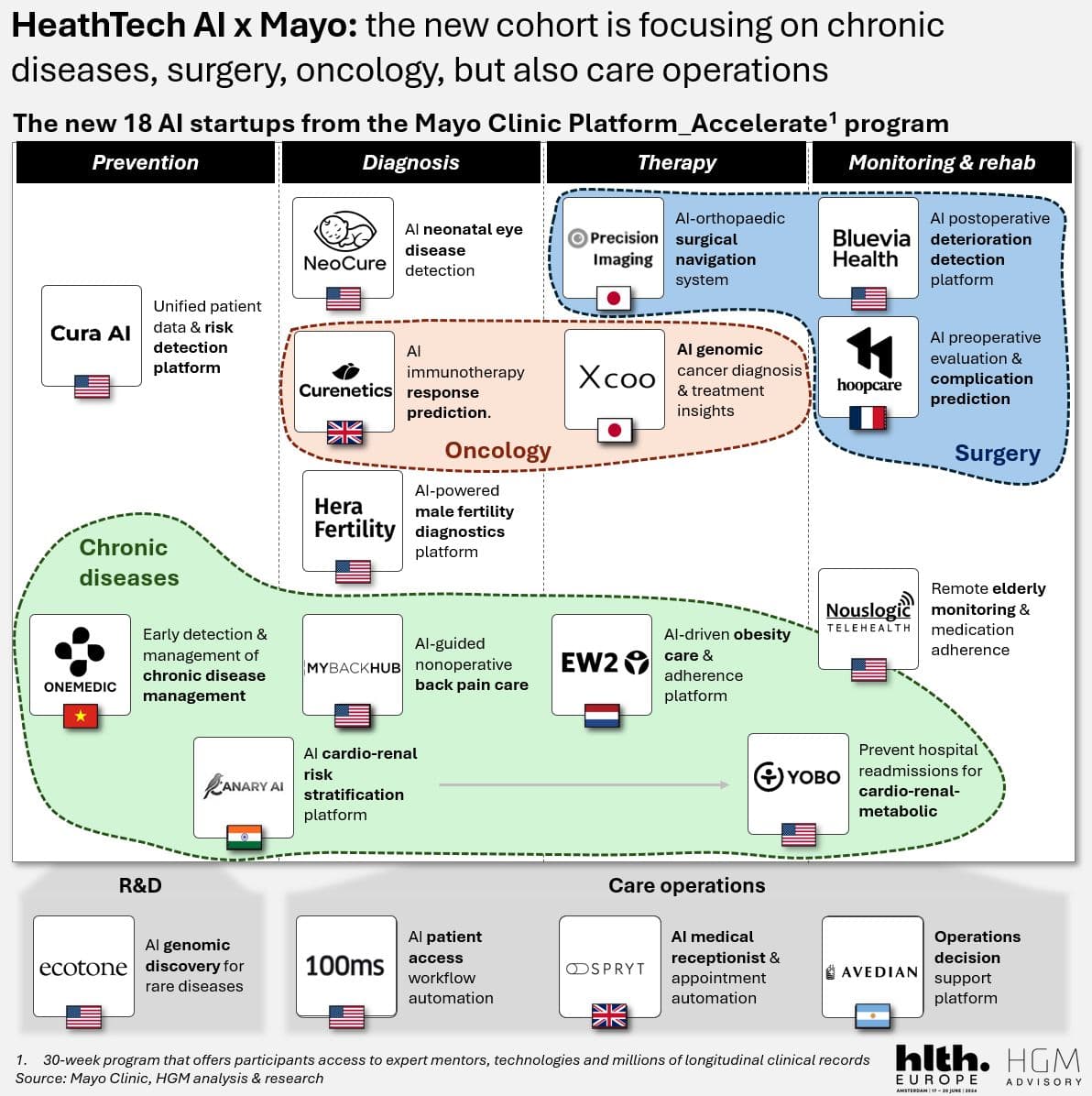
Mayo Clinic announced 18 AI HealthTech startups for cohort 7 of its Platform Accelerate program, bringing the total to 76 AI startups since 2022. The data-for-equity model, where Mayo provides patient data, clinical validation, and FDA guidance in exchange for equity, is becoming a blueprint for how academic medical centers can systematically accelerate clinical AI.
From 4 startups to 76: the growth trajectory
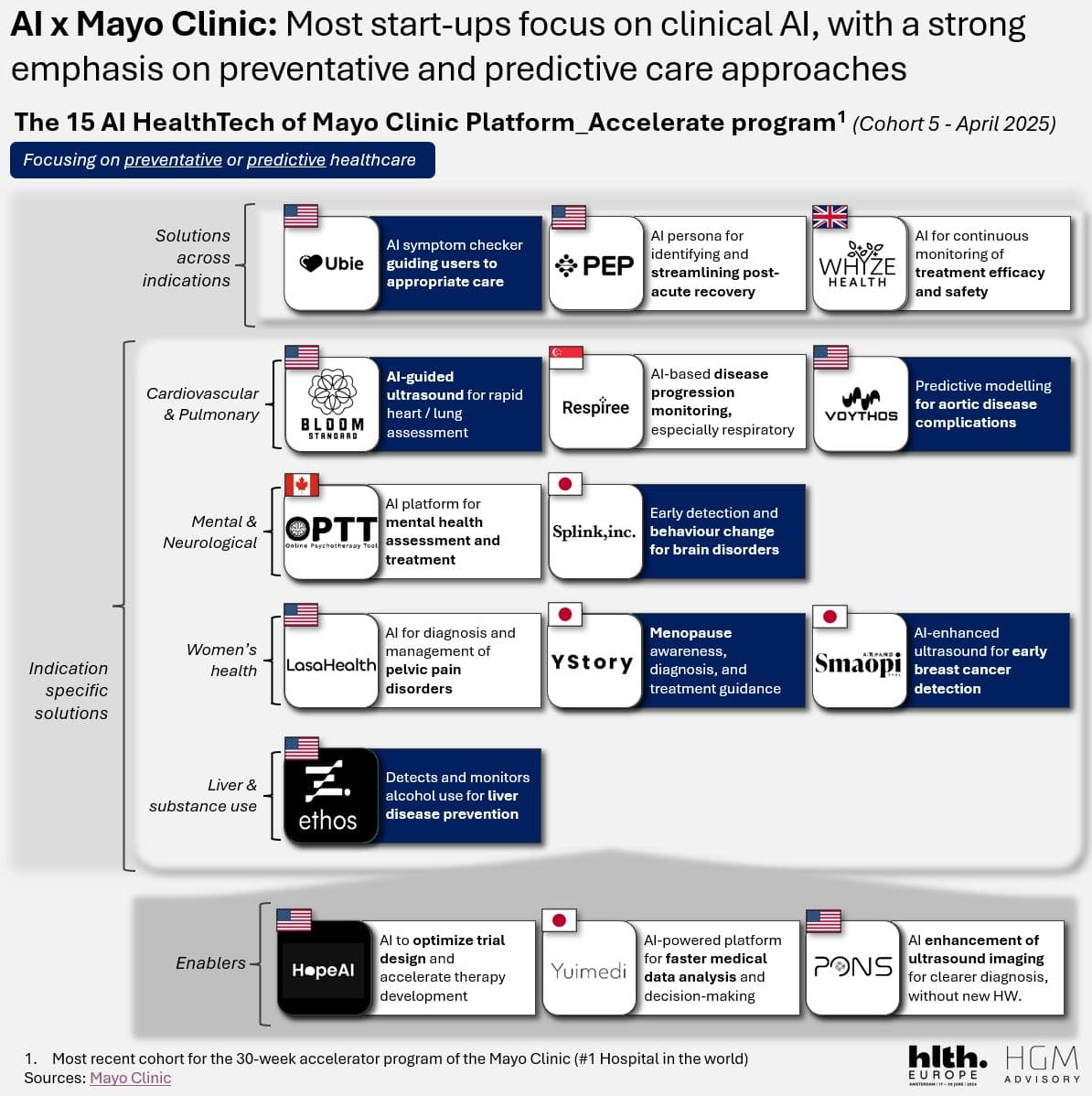
Mayo Clinic launched Platform Accelerate in 2022 with just 4 startups in its first cohort. The program has grown steadily since: 7 startups in cohort 2, 12 in cohort 3, 9 in cohort 4, 15 in cohort 5, 11 in cohort 6, and now 18 in cohort 7. The total of 76 AI startups makes Platform Accelerate the largest clinical AI accelerator program run by a health system globally.
The acceleration in cohort size reflects both growing startup interest and Mayo's increasing confidence in the model. The program has expanded from primarily US-based companies to include international participants from Ireland, Vietnam, India, and other markets, signaling that Mayo sees clinical AI as a global opportunity.
The data-for-equity model
Platform Accelerate operates on a distinctive business model that sets it apart from traditional accelerators and corporate venture arms. Mayo Clinic provides startups with access to millions of de-identified patient records, clinical validation services, expert physician feedback, and FDA regulatory guidance. In return, Mayo receives equity stakes in the participating companies.
This data-for-equity approach is elegant for several reasons. It requires no capital outlay from Mayo, turning its existing data assets into an investment vehicle. It creates alignment between Mayo and the startups: both benefit from the AI tools reaching clinical deployment. And it gives Mayo early access to innovations that may eventually be deployed across its own system.
For startups, the value proposition is equally compelling. Access to Mayo's patient data solves the single biggest bottleneck in clinical AI development: getting enough high-quality, diverse clinical data to train and validate models. The Mayo brand also serves as a powerful signal to investors, regulators, and potential health system customers.
Focus areas: where clinical AI is heading
The composition of cohort 7 reveals where Mayo sees the highest potential for clinical AI impact. The primary focus areas are oncology (AI-assisted treatment planning and early detection), chronic disease management (particularly diabetes, cardiovascular, and respiratory conditions), surgical AI (preoperative planning and intraoperative guidance), and CareOps (operational workflow automation).
Notable startups in the latest cohort include SPRYT (Ireland, surgical AI), EW2Health (GLP-1 adherence monitoring), Hera Fertility (male fertility diagnostics), YOBO Health (chronic disease), and MindX Sciences (mental health biomarkers). The inclusion of GLP-1 adherence monitoring reflects the explosive growth of the GLP-1 market and the emerging ecosystem of digital companions around these therapies.
The geographic diversification is also notable. Startups from Vietnam and India joining the program signals that clinical AI innovation is no longer concentrated in the US and Europe.
A blueprint for academic medical centers
Mayo's model is being watched closely by other academic medical centers considering how to engage with clinical AI systematically. The traditional approach, where individual departments run ad-hoc pilots with AI vendors, is slow, inconsistent, and rarely leads to scaled deployment.
Platform Accelerate offers a structured alternative: centralized data access, standardized validation protocols, shared regulatory expertise, and portfolio-level investment thinking. It transforms the health system from a passive customer of AI tools into an active participant in their development.
Other health systems pursuing similar models include Mass General Brigham, Cleveland Clinic, and Karolinska in Europe. However, none has achieved the scale or cohort velocity of Mayo's program.
The key question for the next phase is commercialization. Of the 76 startups that have gone through Platform Accelerate, how many will achieve FDA clearance, commercial traction, and deployment at scale?
| Cohort | Year | Startups | Cumulative Total |
|---|---|---|---|
| 1 | 2022 | 4 | 4 |
| 2 | 2022 | 7 | 11 |
| 3 | 2023 | 12 | 23 |
| 4 | 2023/24 | 9 | 32 |
| 5 | 2025 | 15 | 47 |
| 6 | 2025 | 11 | 58 |
| 7 | 2026 | 18 | 76 |

About the author
Thomas HagemeijerFounder & CEO of HGM Advisory. Management consultant and HealthTech expert working across the full healthcare ecosystem: pharma, MedTech, investors, startups, hospitals, and policymakers. Investor at Springboard Health Angels. Ambassador at HLTH Europe and HBI. Regular keynote speaker on AI in healthcare and digital health transformation.