April 2026
Anthropic's $400M Coefficient Bio acqui-hire: Claude's bid to become the life sciences operating system

Founder & CEO, HGM Advisory
Key takeaway
Regulatory AI has already delivered the clearest ROI in pharma (Novo Nordisk cut regulatory timelines from 10 weeks to 10 minutes), but the real prize is improving drug success rates. Lifting phase-to-market success from 12% to 15% would generate more value than every workflow optimization combined, and that is exactly where the Coefficient Bio acqui-hire is aimed.
Six months after launching Claude for Life Sciences, Anthropic is acquiring Coefficient Bio for $400M in an all-share deal that looks unmistakably like an acqui-hire. The move clarifies Anthropic's ambition: not another point tool, but the connective operating system across pharma's value chain.
Regulatory is the proven ROI, clinical trials are next
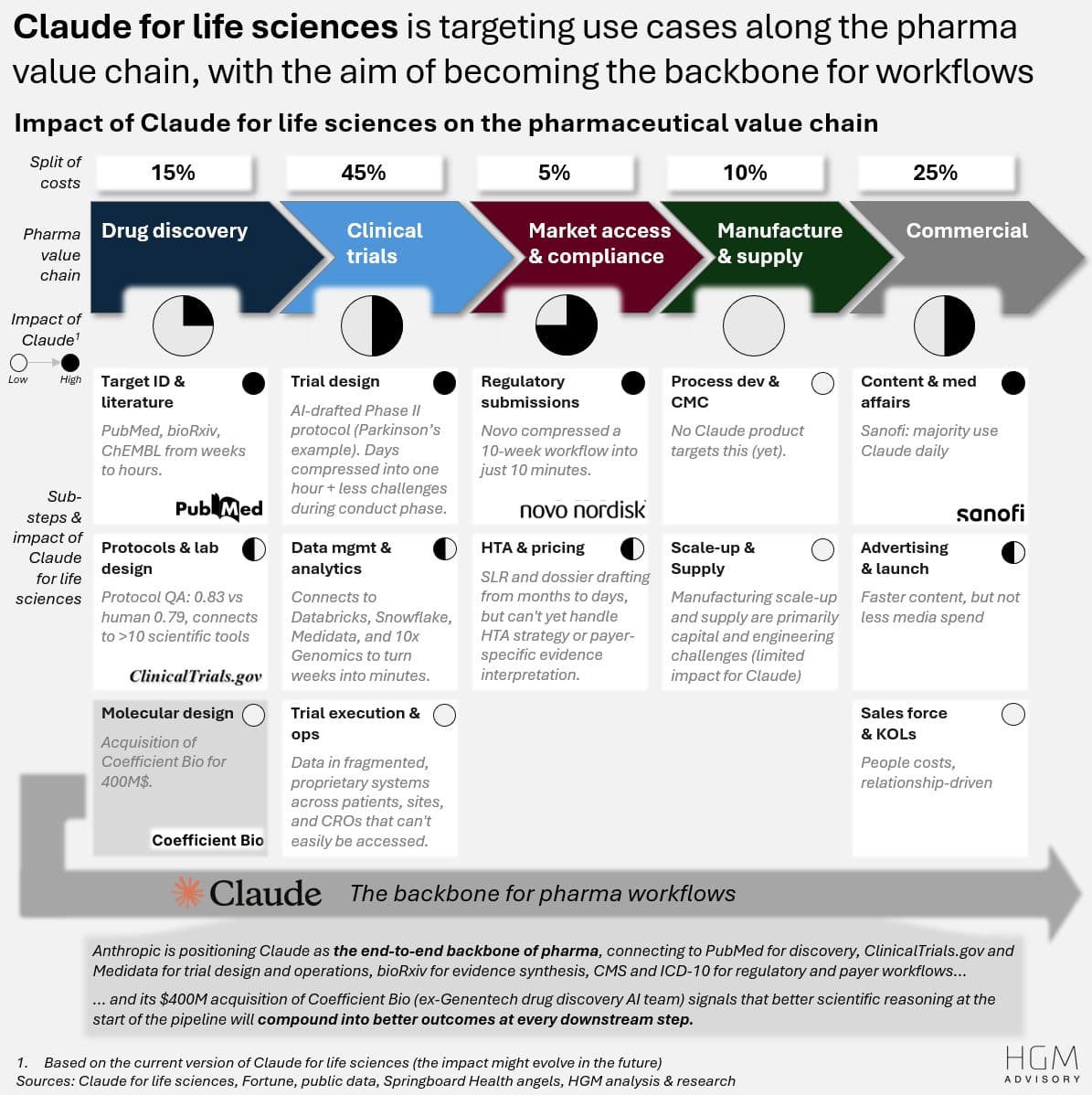
The regulatory function accounts for roughly 5% of pharma costs, yet it is where Claude for Life Sciences has delivered the most concrete returns so far. Novo Nordisk has publicly reported compressing certain regulatory timelines from 10 weeks to 10 minutes, a 99.98% reduction that reframes what 'automation' means in a highly regulated environment.
Clinical trials, by contrast, represent nearly half of pharma spending and have not yet seen comparable gains. That gap is the next battleground. Claude's integration with Medidata is designed to close it: using historical trial data to optimize protocol design, site selection, and patient stratification before a single patient is enrolled. If even a fraction of the regulatory productivity gains translate to trials, the economic impact would be an order of magnitude larger.
Manufacturing is the blind spot
Manufacturing sits at roughly 10% of pharma costs and is currently the weakest area of coverage in the Claude for Life Sciences stack. This matters because the industry is shifting from make-to-stock (large batch, long shelf life) toward make-to-order models driven by personalized medicines, cell and gene therapies, and GLP-1-adjacent biologics with complex cold-chain requirements.
That shift dramatically increases manufacturing complexity: more SKUs, smaller batches, tighter traceability, and shorter lead times. The AI tooling to orchestrate that complexity does not yet exist in a meaningful way, and incumbent MES vendors are not well positioned to build it. Expect either an acquisition or a major partnership here within the next 12-18 months.
Why Coefficient Bio: attacking the 88% failure rate
Bringing a new drug to market costs $2-3 billion, and roughly 88% of candidates that enter clinical development never reach approval. Most AI investment in pharma so far has targeted workflow efficiency: faster documentation, smarter scheduling, better data pipelines. Useful, but marginal compared to the prize of actually improving success rates.
Lifting the overall success rate from 12% to 15% sounds modest. In reality it would generate more value than every workflow optimization combined: fewer failed trials, fewer abandoned regulatory submissions, fewer manufacturing scale-ups for drugs that never launch. The Coefficient Bio acqui-hire, all $400M of it in Anthropic shares, is a direct bet on better candidate selection and translational modeling. The price tag only makes sense if Anthropic believes this team can meaningfully move the success-rate needle.
The endgame: becoming the operating system
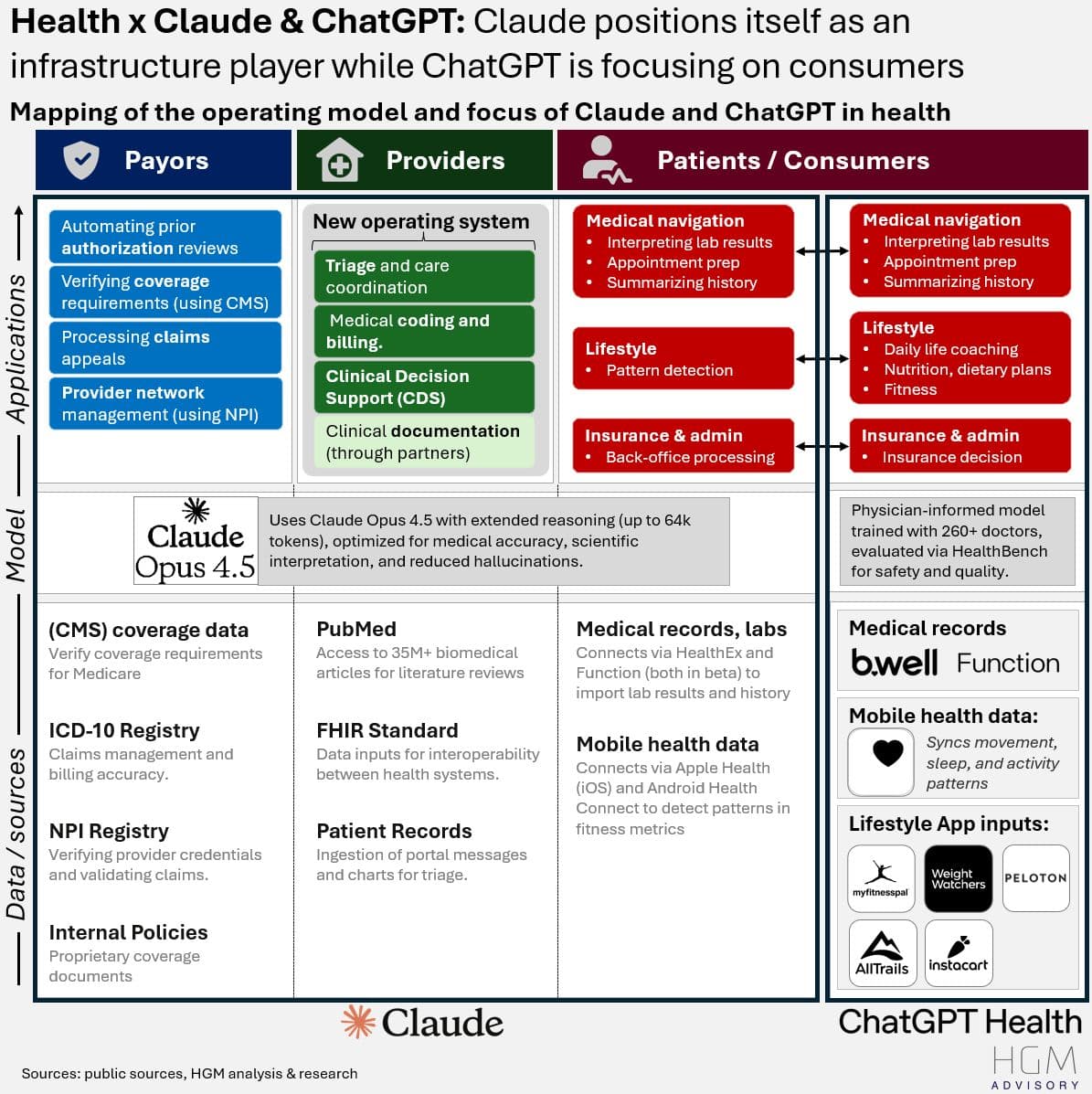
The strategic thread running through Claude for Life Sciences, the Medidata integration, and now the Coefficient Bio acquisition is consistent: Anthropic is not trying to replace Benchling, Veeva, PubMed, ClinicalTrials.gov, or Medidata. It is trying to orchestrate them.
The ambition is to position Claude as the connective layer that sits above the domain-specific platforms and reasons across them. If that works, Anthropic captures the most valuable position in any platform economy: the layer everyone else depends on but no one else controls.
The open question is whether pharma will tolerate that level of consolidation. The industry has historically resisted single points of control, preferring best-of-breed stacks and multi-vendor redundancy. Anthropic's bet is that the productivity gains will be large enough to overcome that resistance. Coefficient Bio is the clearest signal yet that they are willing to spend to find out.

About the author
Thomas HagemeijerFounder & CEO of HGM Advisory. Management consultant and HealthTech expert working across the full healthcare ecosystem: pharma, MedTech, investors, startups, hospitals, and policymakers. Investor at Springboard Health Angels. Ambassador at HLTH Europe and HBI. Regular keynote speaker on AI in healthcare and digital health transformation.