February 2026
Health x Claude & ChatGPT: Claude positions itself as infrastructure, ChatGPT focuses on consumers

Founder & CEO, HGM Advisory
Key takeaway
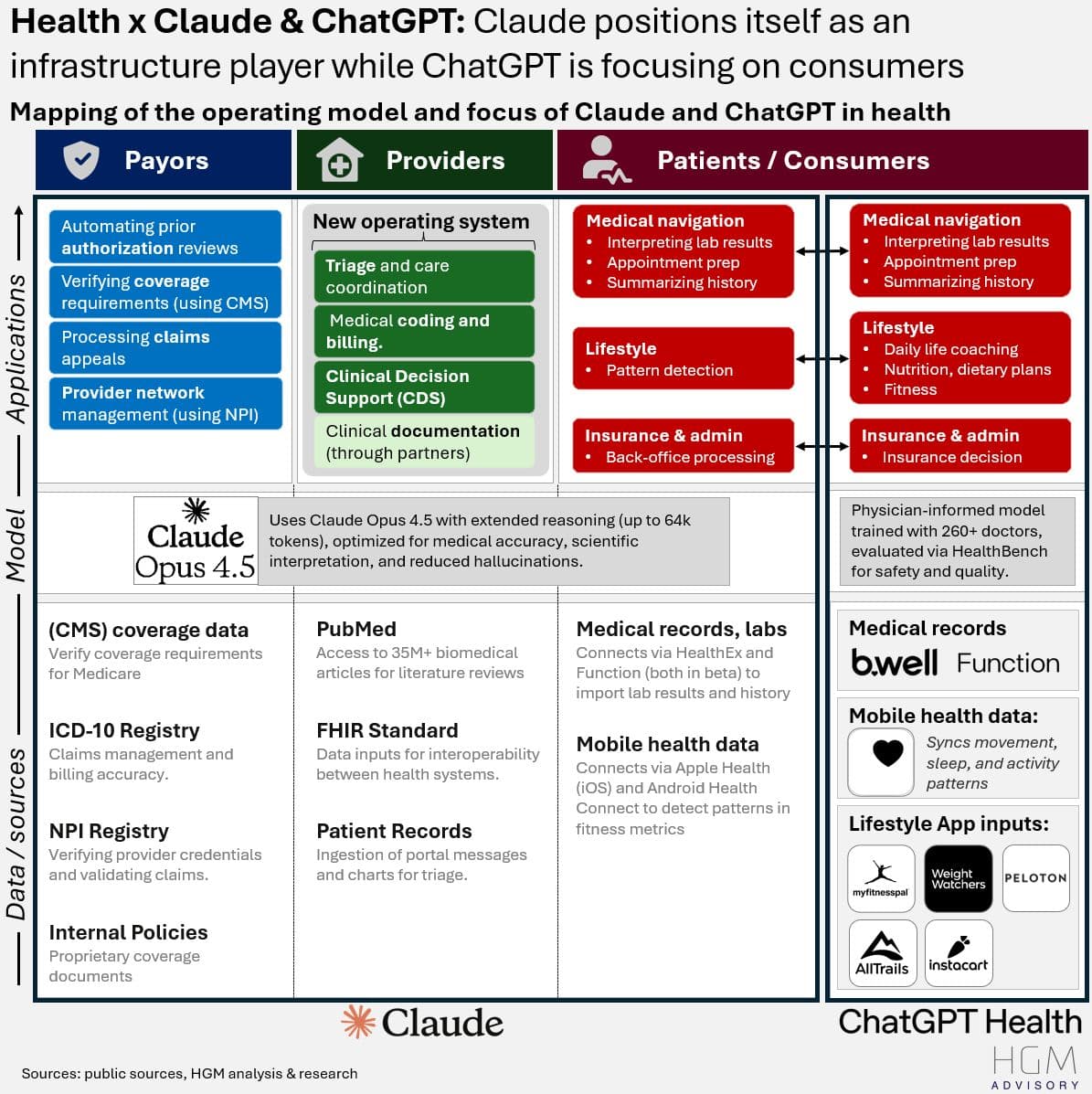
Anthropic is positioning Claude as healthcare infrastructure, an API-first platform for health systems and developers building clinical tools. OpenAI is pursuing a consumer-first strategy with ChatGPT health features. Healthcare organizations must understand this fundamental difference when choosing an AI foundation.
Two AI giants, two very different healthcare strategies
As generative AI embeds itself into healthcare, two platforms dominate the conversation: Anthropic's Claude and OpenAI's ChatGPT. Both are being used in clinical settings today. But beneath the surface, they are pursuing fundamentally different strategies in healthcare.
Anthropic has positioned Claude as infrastructure for healthcare, API-first, safety-focused, and oriented toward enterprise health systems. OpenAI has pursued a more consumer-facing strategy, integrating health features directly into ChatGPT.
Anthropic's approach: clinical infrastructure
Anthropic has invested heavily in clinical safety research. Claude's constitutional AI framework includes specific guardrails for medical content, the model is designed to express uncertainty and recommend professional consultation.
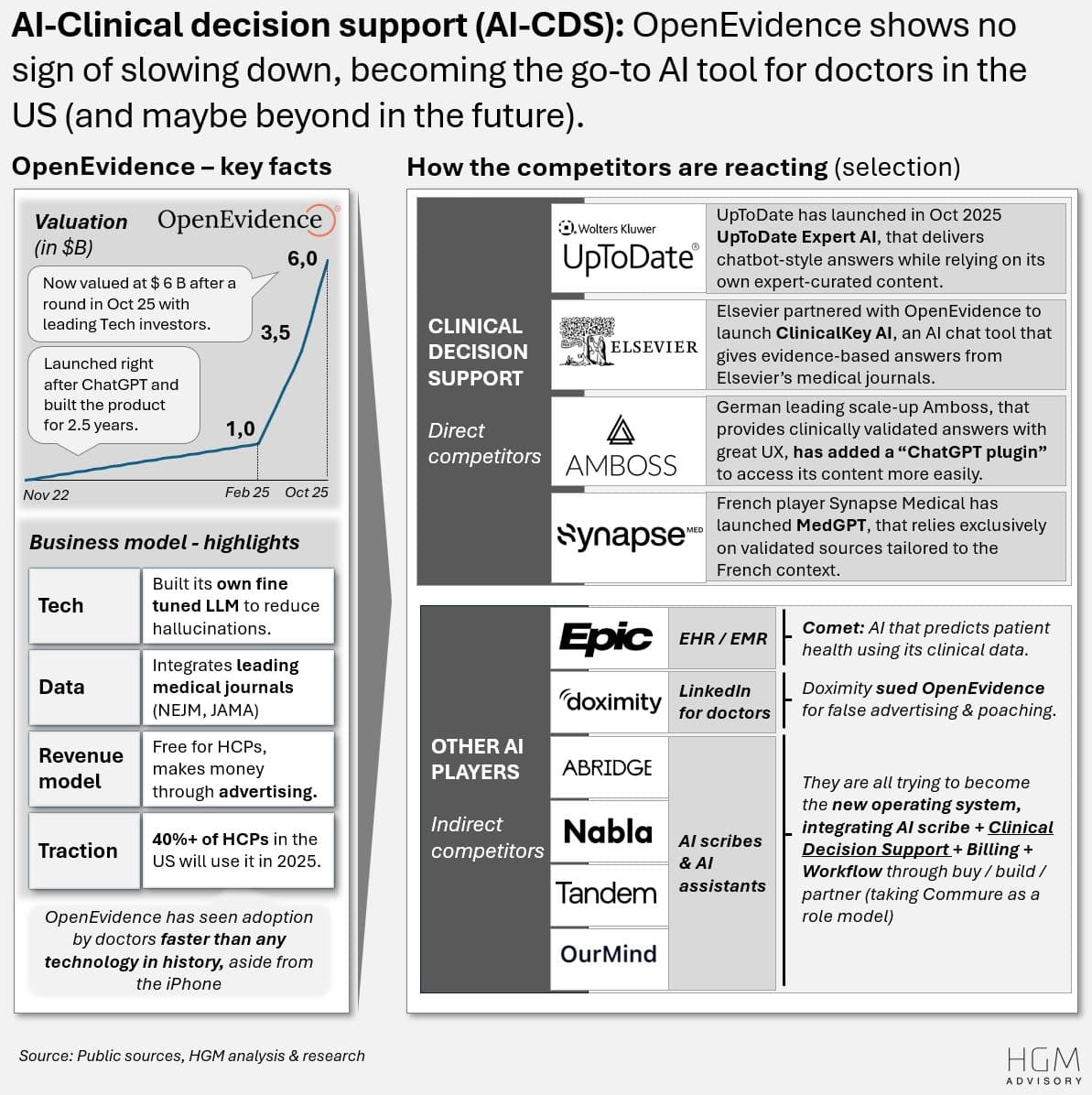
Anthropic's business model in healthcare is API-centric. It enables companies like OpenEvidence, Hippocratic AI, and Commure to build clinical products on top of Claude. Health systems like HCA Healthcare and Kaiser Permanente have evaluated or deployed Claude-based tools.
Claude's extended context windows (exceeding 200K tokens) are particularly valuable for clinical use cases that require processing lengthy patient records or research papers.
OpenAI's approach: consumer health and platform expansion
OpenAI has integrated health-related features directly into ChatGPT, making it the world's most widely used consumer health AI tool by default. Over 100 million weekly active ChatGPT users can ask health questions.
In 2024, OpenAI partnered with Color Health to develop a cancer screening navigation tool. GPT-4 passed the US Medical Licensing Examination with a score exceeding 90%.
The strength is reach. The risk is accountability: when consumers use ChatGPT for health guidance without physician involvement, the liability and safety implications are substantial.
Comparing Claude and ChatGPT in healthcare
The table below compares the two platforms across key dimensions relevant to healthcare organizations.
| Dimension | Claude (Anthropic) | ChatGPT (OpenAI) |
|---|---|---|
| Primary approach | API-first infrastructure | Consumer-first platform |
| Target user | Developers, health systems, clinical AI companies | Consumers, physicians, enterprises |
| Clinical safety | Constitutional AI with medical guardrails | Broad safety training, disclaimers |
| Business model | API revenue from enterprise customers | Subscription + API revenue |
| Key health partnerships | OpenEvidence, Hippocratic AI, Commure | Color Health, consumer integrations |
| Context window | 200K+ tokens | 128K tokens (GPT-4o) |
| Regulatory positioning | Building toward clinical-grade infrastructure | Consumer tool with enterprise capabilities |
Implications for healthcare organizations
Health systems building internal clinical AI tools may find Claude's API-first, safety-oriented approach more aligned with their requirements.
Organizations focused on patient-facing applications may find ChatGPT's consumer experience and brand recognition advantageous.
The most important recommendation: do not choose an AI platform based solely on benchmark performance. Evaluate the vendor's healthcare strategy, safety philosophy, data governance practices, and long-term commitment to clinical-grade infrastructure.

About the author
Thomas HagemeijerFounder & CEO of HGM Advisory. Management consultant and HealthTech expert working across the full healthcare ecosystem: pharma, MedTech, investors, startups, hospitals, and policymakers. Investor at Springboard Health Angels. Ambassador at HLTH Europe and HBI. Regular keynote speaker on AI in healthcare and digital health transformation.