February 2026
HealthTech failures: lessons that today's AI healthcare companies should study

Founder & CEO, HGM Advisory
Key takeaway
The graveyard of HealthTech is filled with companies that confused fundraising momentum with product-market fit. Today's AI healthcare companies must study these failures, the same patterns of overestimating adoption, underestimating regulation, and burning cash on growth before proving unit economics are reappearing.
Why studying failure matters now
The current wave of AI healthcare companies is raising capital at a pace that mirrors the previous HealthTech cycle. Rock Health reported $10.7 billion in digital health funding in 2025. AI-specific healthcare startups raised over $4.2 billion in 2025, a 60% increase from 2024.
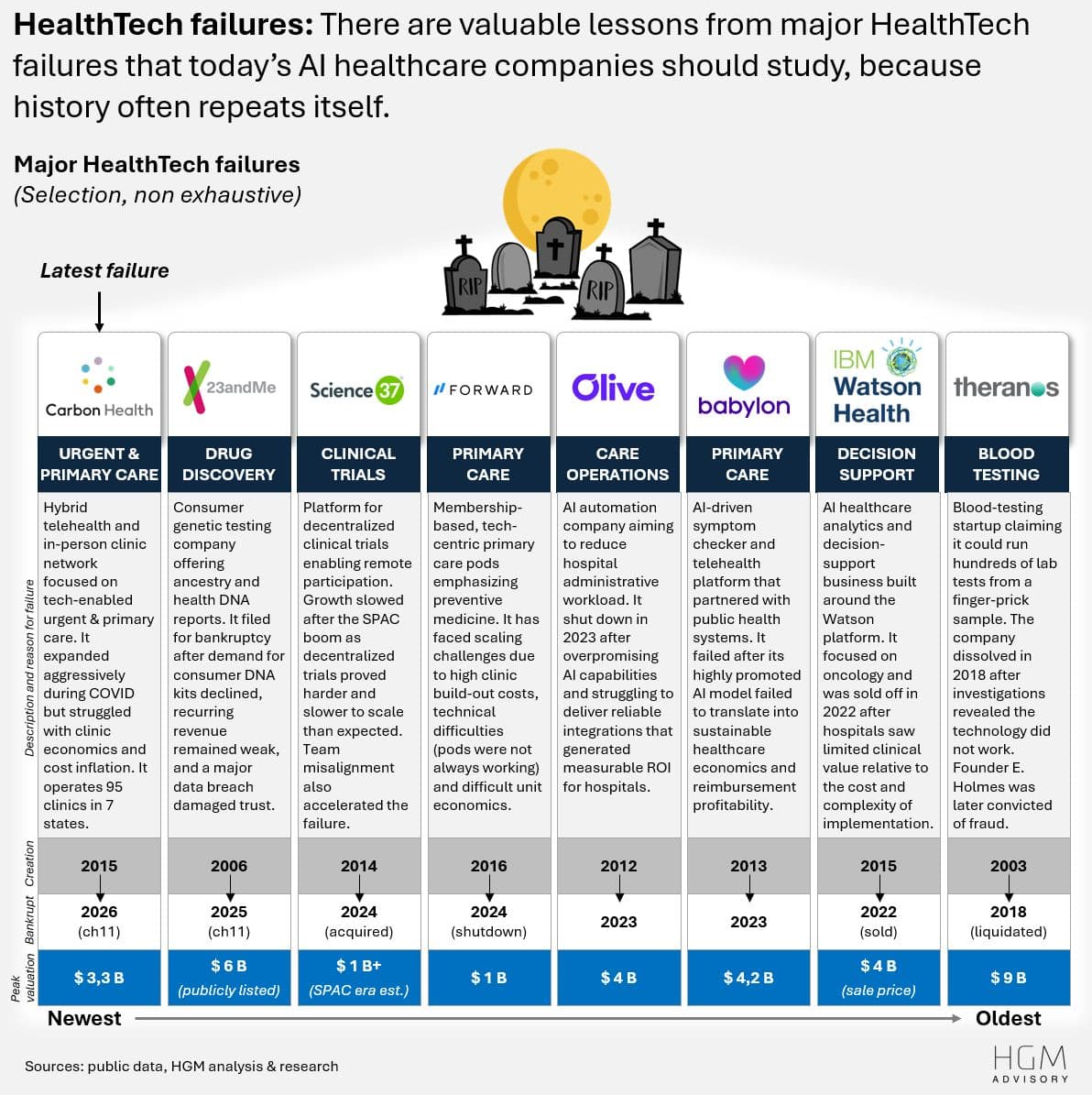
The four case studies below, Babylon Health, Pear Therapeutics, Olive AI, and Forward Health, collectively raised over $3.5 billion and employed thousands of people before shutting down or collapsing. Each failed for different reasons, but the underlying patterns are strikingly consistent.
Babylon Health: the $4B mirage
Babylon Health was once valued at over $4 billion after going public via SPAC in October 2021. By mid-2023, Babylon filed for bankruptcy with over $1 billion in accumulated losses.
The core problems were threefold. First, the SPAC listing set unrealistic revenue expectations. Second, the company expanded into clinical care delivery before its technology platform was mature enough. Third, patient acquisition costs remained stubbornly high while reimbursement rates were lower than projected.
The lesson: going public via SPAC on a narrative of future AI capabilities, while simultaneously running a capital-intensive care delivery business, is a recipe for destruction.
Pear Therapeutics: regulatory first, revenue never
Pear Therapeutics was the first company to receive FDA clearance for a prescription digital therapeutic, reSET for substance use disorders, approved in 2017. By March 2023, Pear filed for bankruptcy.
Pear achieved something remarkable, FDA-cleared digital therapeutics with real clinical evidence, but could not solve the commercial problem. Payers refused to reimburse PDTs at sustainable levels. Physicians did not prescribe them at scale.
Pear's failure reveals a crucial insight: regulatory approval is necessary but nowhere near sufficient. The hardest part is achieving adoption in a system where payers, providers, and patients all need to change behavior simultaneously.
Olive AI and Forward Health
Olive AI raised $902 million and was valued at $4 billion. Hospitals reported that Olive's bots frequently broke and did not deliver the promised ROI. By late 2023, Olive had sold off its business units.
Forward Health raised over $600 million to build technology-driven clinics. Each clinic cost $2-3 million to build, patient acquisition was expensive, and retention was low. Forward shut down in November 2024.
Both illustrate the same problem: scaling before achieving unit-level economics.
Common patterns across HealthTech failures
Across these cases, the failure patterns cluster around five themes.
| Failure pattern | Description | Companies affected |
|---|---|---|
| Overestimating adoption speed | Assumed clinicians and patients would change behavior faster than they did | Babylon, Pear, Forward |
| Underestimating reimbursement complexity | Built products without a clear path to sustainable payer coverage | Pear, Babylon |
| Premature scaling | Invested heavily in growth before proving unit economics | Olive AI, Forward, Babylon |
| SPAC mirage | Used SPAC listings to raise capital on projected, not proven, revenue | Babylon, Pear |
| Technology oversell | Marketed AI capabilities that exceeded actual product performance | Olive AI, Babylon |
Lessons for today's AI healthcare companies
First, prove unit economics before scaling. Second, design for the reimbursement environment. Third, do not conflate regulatory clearance with commercial success. Fourth, be honest about AI capabilities.
The companies that survived the previous cycle, Teladoc, Veeva Systems, Doximity, and Tempus, share common traits: durable revenue models, financial discipline, and products that clinicians genuinely needed. The difference between survivors and failures is rarely the technology. It is almost always the business model.

About the author
Thomas HagemeijerFounder & CEO of HGM Advisory. Management consultant and HealthTech expert working across the full healthcare ecosystem: pharma, MedTech, investors, startups, hospitals, and policymakers. Investor at Springboard Health Angels. Ambassador at HLTH Europe and HBI. Regular keynote speaker on AI in healthcare and digital health transformation.