April 2026
HealthTech x Providers: the scale-ups redefining hospital and ambulatory care in Germany

Founder & CEO, HGM Advisory
Key takeaway
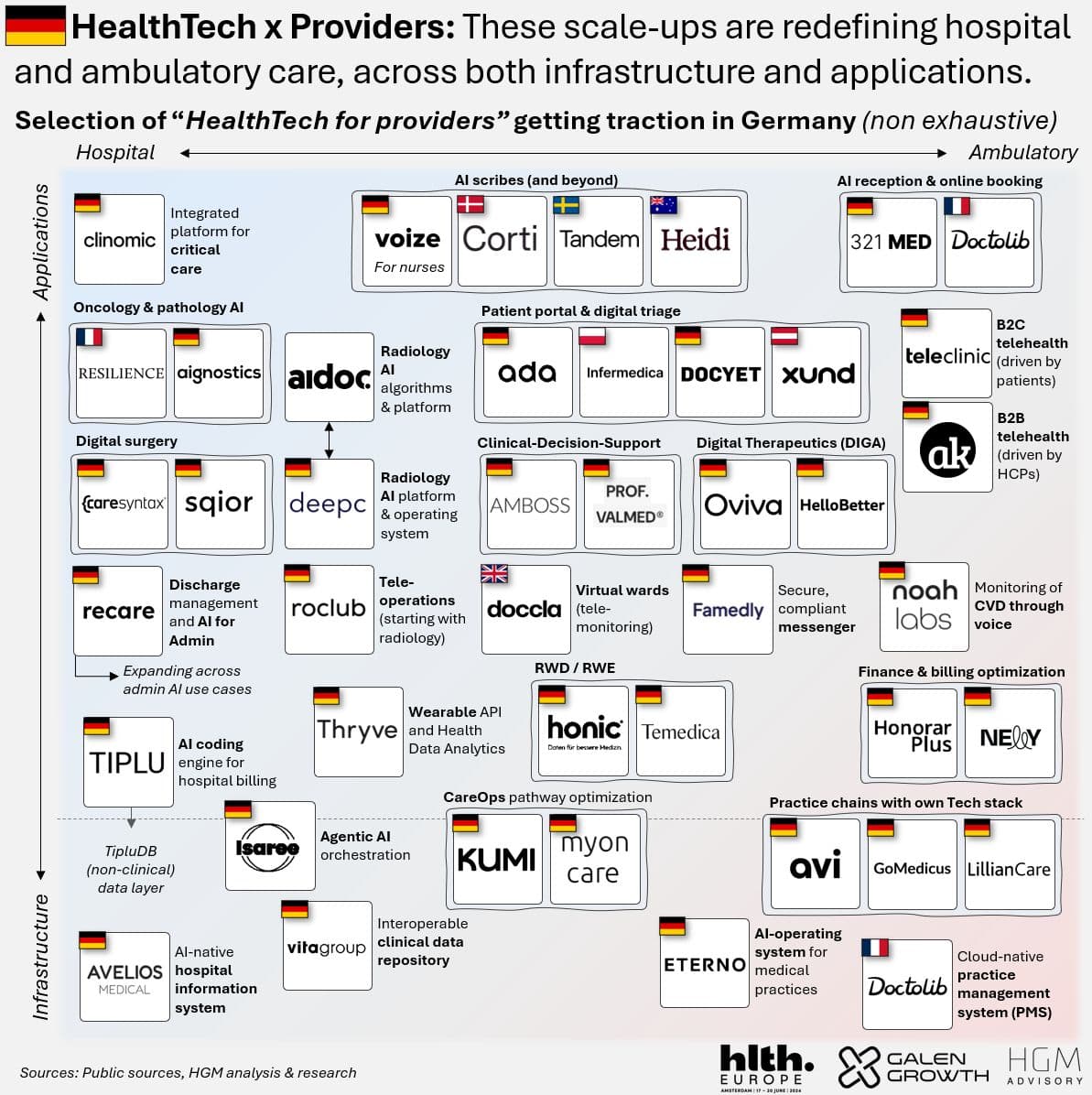
German HealthTech is dominated by local players due to healthcare system specificities and language barriers, with AI scribes (Tandem, Corti, Heidi) as the notable exception where international players gain traction. At least two companies exceed 100M euro annual revenue profitably, and many exceed 10M euro, attracting mid-cap private equity interest. The structural transformation is being driven by companies like Avelios (AI-native HIS), Eterno (AI operating system for practices), and AMBOSS (clinical decision support).
A mapping of HealthTech companies gaining traction in Germany, presented during DMEA, the country's largest Provider IT and HealthTech conference. The landscape spans hospital and ambulatory care across infrastructure and applications, from AI-native hospital information systems to agentic AI for clinical and administrative workflows.
Why is the German HealthTech market dominated by local players?
According to HGM Advisory's analysis presented at DMEA 2026, the German HealthTech market is overwhelmingly local. Healthcare system specificities create strong structural moats: the dual hospital-ambulatory structure separates provider markets in ways that do not exist in the US or UK, the SHI/PHI reimbursement split adds billing complexity that international vendors rarely support natively, and German-language clinical documentation requirements limit the applicability of English-first products.
The notable exception is AI scribes. Tandem (Denmark), Corti (Denmark), and Heidi (Australia) are all international players gaining meaningful adoption in Germany as of April 2026. Ambient clinical documentation is language-agnostic at the AI layer, and the value proposition of reducing documentation burden is universal across healthcare systems regardless of regulatory context. The scribe category may be the first wedge through which international HealthTech scales into Germany at volume, precisely because it sits above the system-specific complexity rather than within it.
Which companies are transforming hospital IT infrastructure in Germany?
In Germany, Avelios is the leading company building an AI-native hospital information system as of April 2026, positioning itself as the replacement for legacy HIS vendors (SAP, Dedalus, Nexus) that have dominated German hospitals for decades. Vitagroup is focused on clinical data interoperability, solving the data fragmentation problem that has plagued German hospital IT since the introduction of digital systems.
The application layer above infrastructure is equally active. Clinomic has built an integrated critical care platform for ICU management. Caresyntax and Sqior are digitizing surgical workflows. Recare is deploying agentic AI for discharge management and administrative automation. TIPLU uses AI for hospital billing optimization. The radiology AI cluster (Aignostics for pathology AI, Aidoc for clinical AI triage, Ada for diagnostic reasoning) continues to mature, with Resilience gaining ground specifically in digital pathology for oncology. Together, these companies represent a new generation of hospital technology that is AI-native rather than AI-augmented.
What is happening in ambulatory care technology?
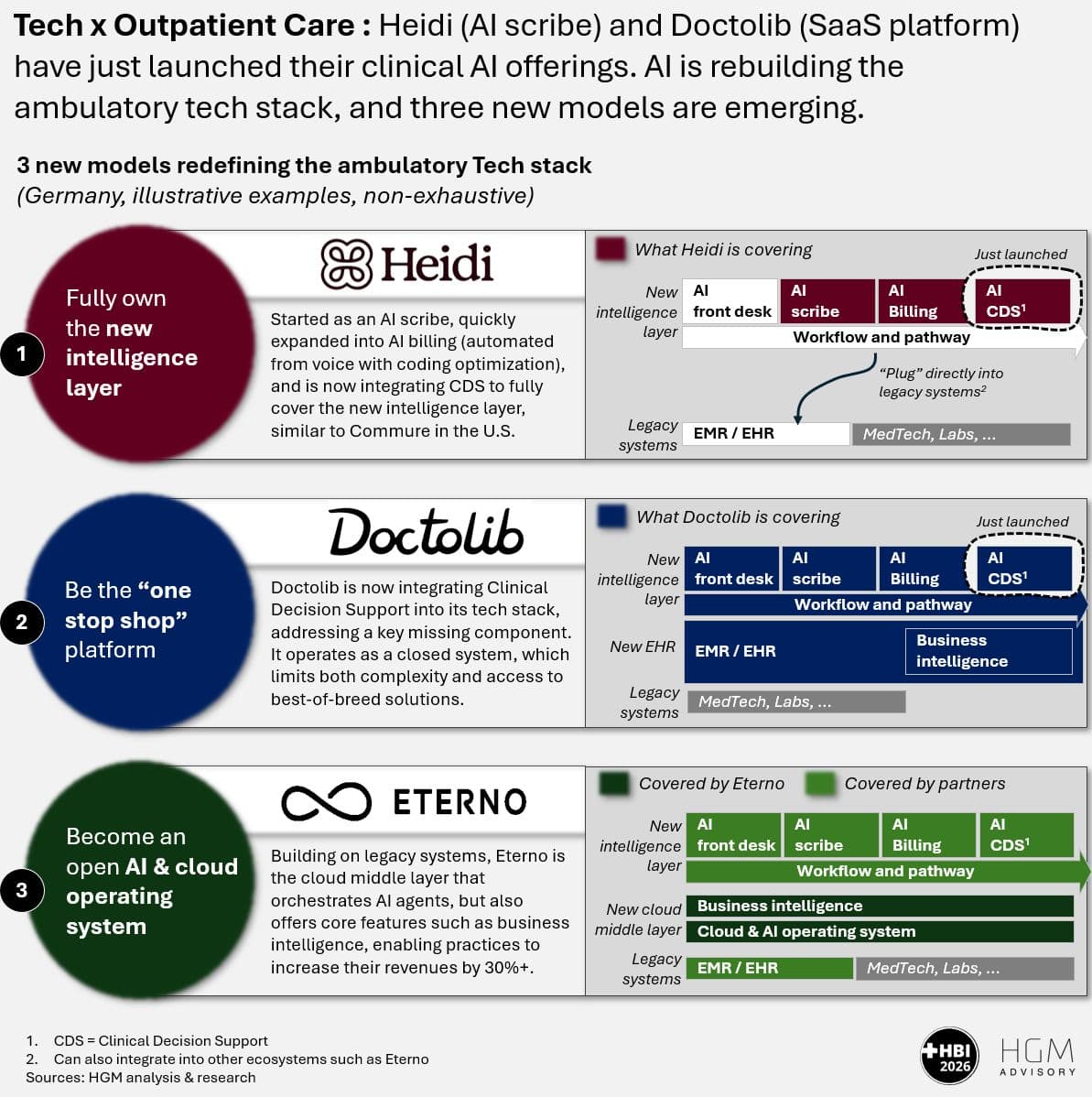
The ambulatory sector is where some of the most ambitious HealthTech plays are emerging in Germany. Eterno is building an AI operating system for medical practices, aiming to do for outpatient care what Avelios is attempting for hospitals: a ground-up reimagining of practice management with AI at the core rather than bolted on. Doctolib, already serving over 300,000 healthcare professionals in France (Doctolib, 2025), is expanding its cloud-native practice management system into Germany.
Patient portal and digital triage companies are creating the new front door to ambulatory care. Docyet, Xund, and Infermedica each use AI-driven symptom assessment to route patients before they reach a physician. AI reception and online booking tools (321 MED, Doctolib) are automating the administrative layer that currently consumes up to 30% of practice staff time. The B2C telehealth model (Teleclinic, driven by patients) and B2B telehealth (AK, driven by healthcare professionals) represent structurally different approaches to remote care delivery, each with distinct reimbursement and adoption dynamics in the German system.
How mature is the German HealthTech market?
The German HealthTech market has reached a meaningful maturity milestone in 2026. According to HGM Advisory's analysis, at least two companies in this landscape exceed 100M euro in annual revenue and are profitable. Many others have crossed the 10M euro threshold, which is the inflection point that attracts mid-cap private equity interest rather than venture capital. This shift from VC-backed growth to PE-relevant scale is significant because it signals that German HealthTech is transitioning from a speculative category to an investable asset class.
This maturity changes the competitive dynamics fundamentally. Companies are no longer competing purely on product innovation and top-line growth but on unit economics, market consolidation potential, and strategic positioning within the provider workflow. The CareOps pathway optimization layer, represented by companies like Kumi, Myon Care, and interoperable clinical data repositories such as Honic and Temedica, is becoming critical infrastructure as German hospitals and practices face mounting pressure to reduce costs while maintaining care quality under tightening budgets.
What policy reforms could accelerate HealthTech adoption in Germany?
Germany's health minister Nina Warken (CDU) is driving healthcare reform in 2026. The first batch included 66 short-term cost-cutting measures for 2027, focused on cost containment and budget rebalancing within the statutory health insurance system. While these measures address immediate fiscal pressure, they do not tackle the structural efficiency gains that technology investment can deliver over the medium term.
The opportunity for technology-driven reform lies in two areas. First, hospital costs represent over 25% of total German healthcare spending (Destatis, 2024), making hospital HealthTech the highest-leverage investment category for systemic cost reduction. Second, early pathology orchestration, connecting diagnostics, AI-assisted triage, and treatment pathway optimization, can reduce downstream costs significantly by catching conditions earlier and routing patients more efficiently. The companies in this landscape that can demonstrate measurable cost reduction per patient episode, not just workflow improvement metrics, will be best positioned as German health policy shifts from short-term cost-cutting to long-term technology investment in the second reform report expected by end of 2026.

About the author
Thomas HagemeijerFounder & CEO of HGM Advisory. Management consultant and HealthTech expert working across the full healthcare ecosystem: pharma, MedTech, investors, startups, hospitals, and policymakers. Investor at Springboard Health Angels. Ambassador at HLTH Europe and HBI. Regular keynote speaker on AI in healthcare and digital health transformation.
Related insights
April 2026
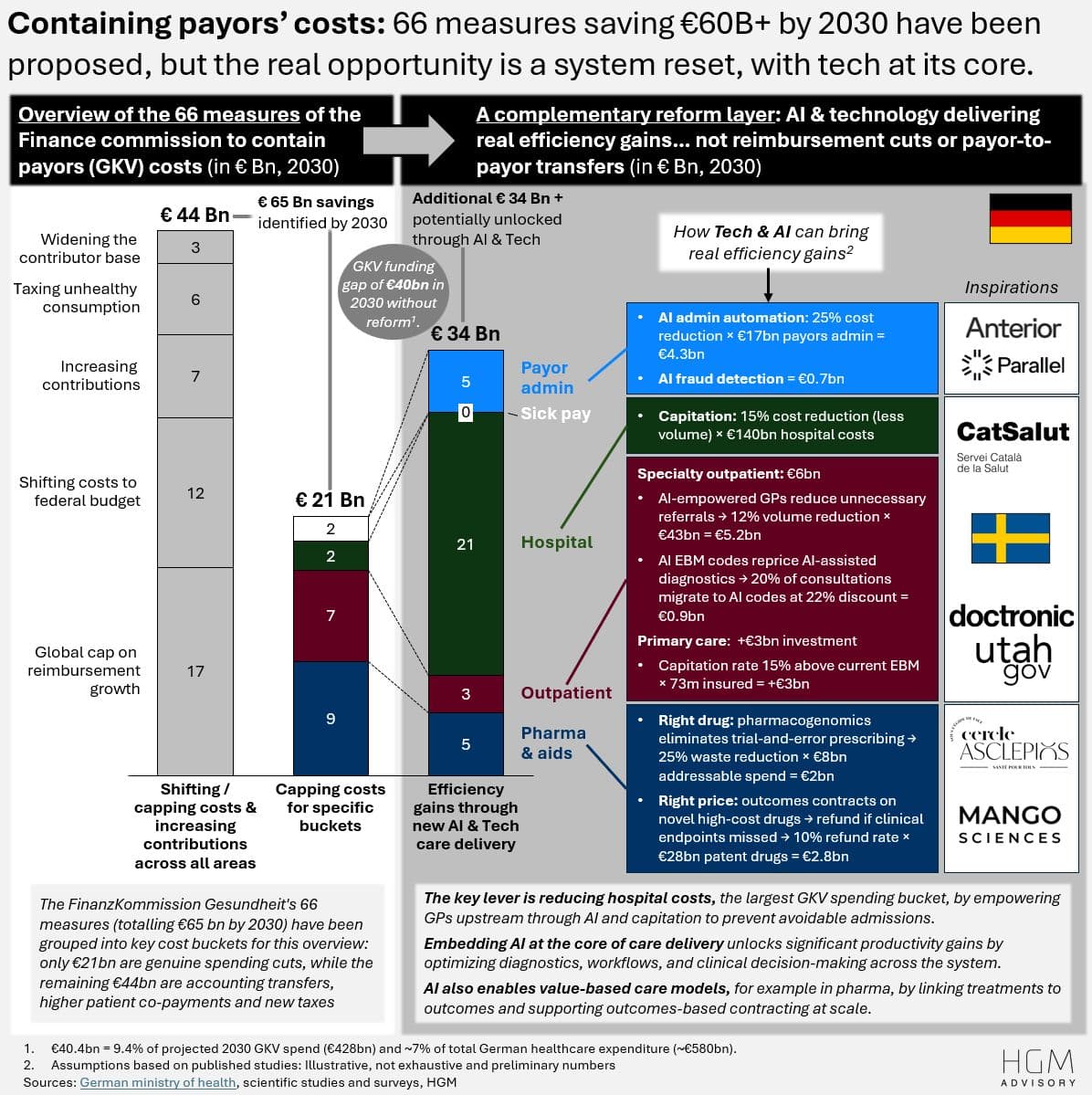
German public payors are losing billions: the funding gap could reach €40B by 2030
April 2026
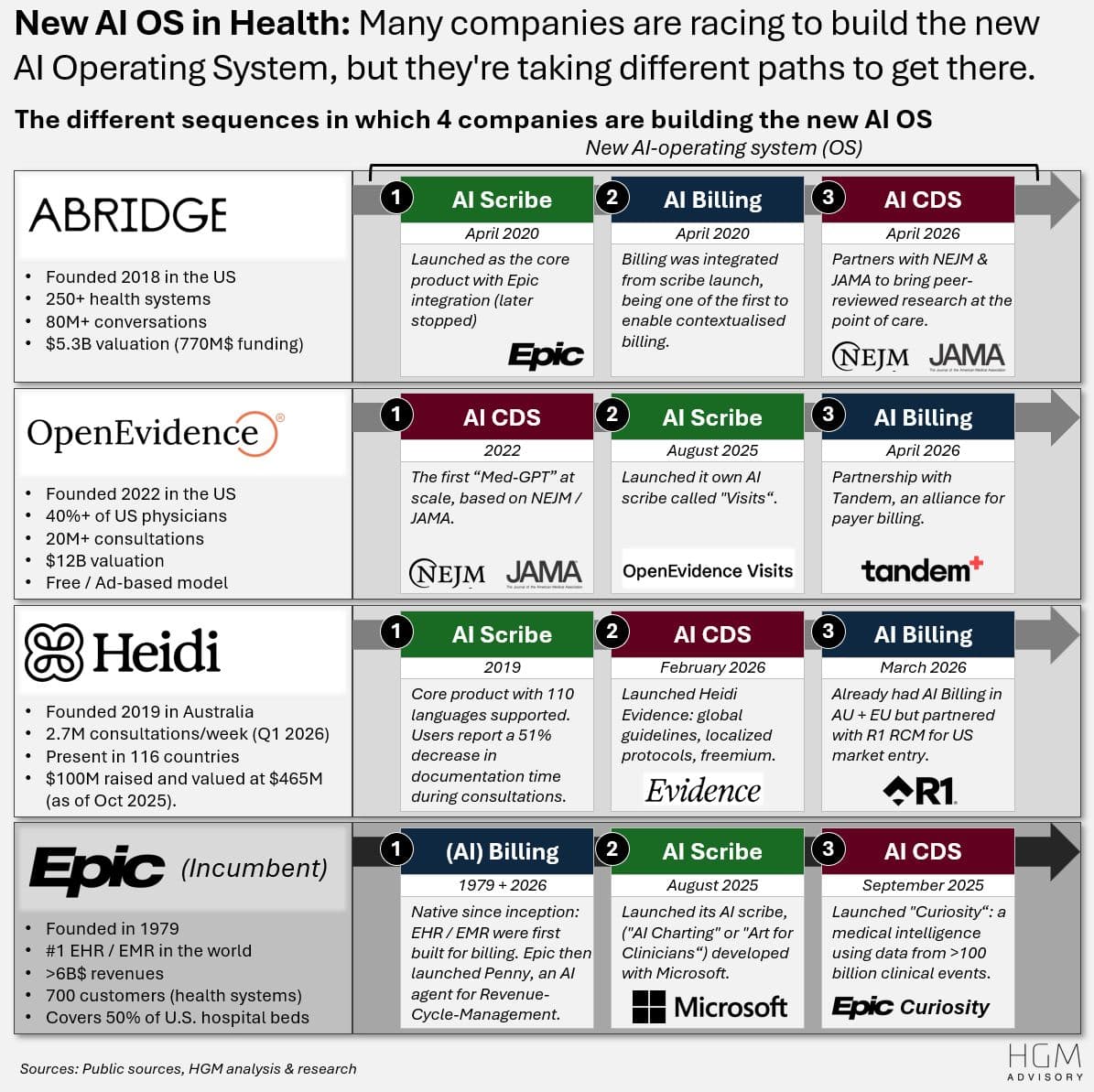
New AI OS in Health: Abridge, OpenEvidence, Heidi, and Epic are racing to build the AI operating system
March 2026
Tech x Outpatient Care: Heidi, Doctolib and Eterno are redefining the ambulatory tech stack