July 2025
AI scribes: Nabla, Tandem Health, and Abridge headline a market at an inflection point

Founder & CEO, HGM Advisory
Key takeaway
The AI scribe market is at an inflection point: Nabla ($70M Series C), Tandem Health ($50M), and Abridge ($5B valuation) are scaling fast, but rising regulatory requirements, incumbent counter-moves, and the shift from standalone scribes to full agentic AI platforms will reshape the competitive landscape within 2-3 years.
In June 2025, AI scribes made headlines: Nabla raised $70M Series C, Tandem Health secured $50M, and Abridge reached a $5B valuation. But low barriers to entry, rising regulation, and incumbent counter-moves make this a market where strategy matters more than technology.
Low barriers to entry, until now
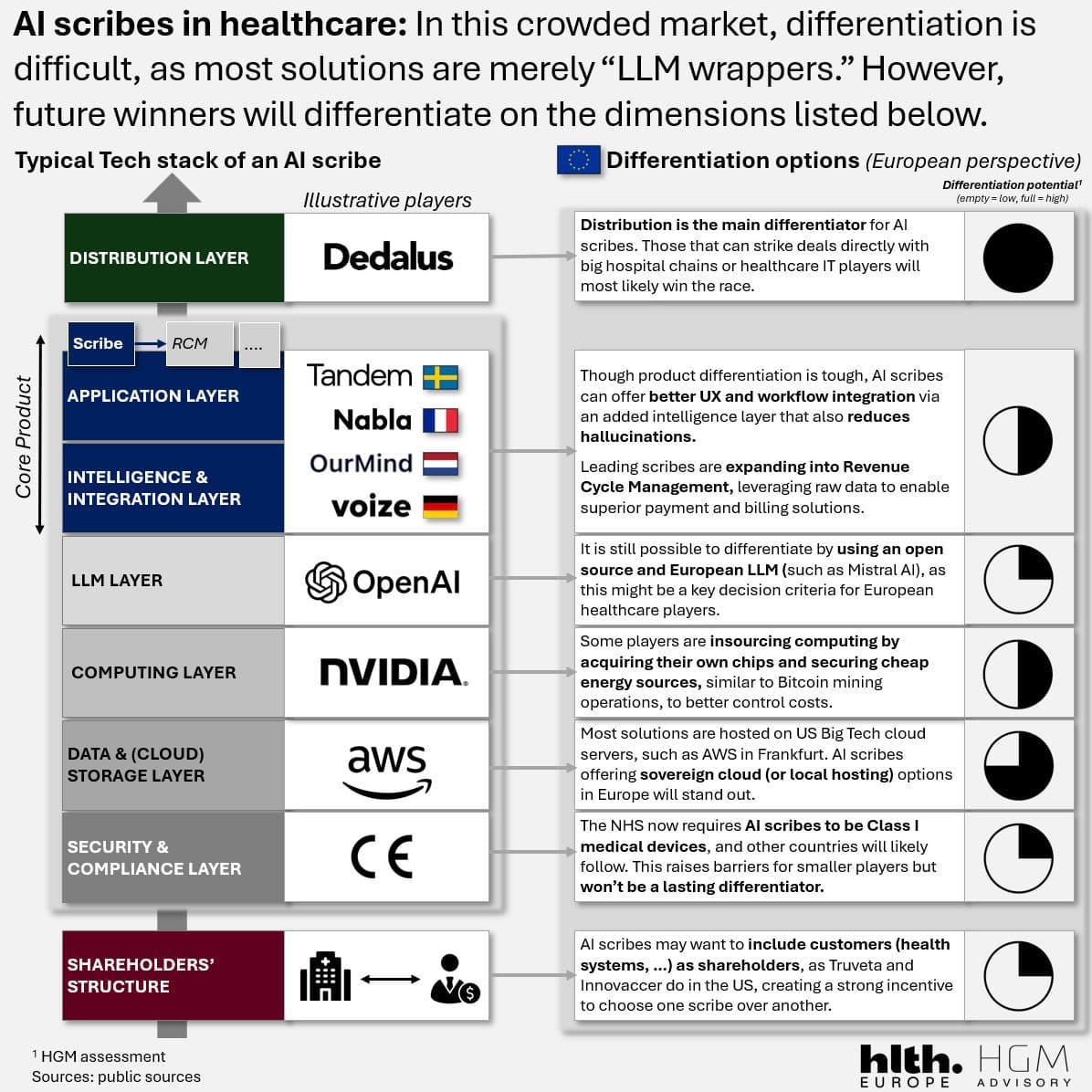
AI scribes have functioned as relatively straightforward LLM wrappers: listen to a patient-clinician conversation, transcribe it, and generate a structured clinical note. The core technology, speech-to-text plus large language model summarization, is broadly available, and building a basic AI scribe has required minimal proprietary infrastructure.
This is changing. Regulatory requirements are rising. The UK's NHS now mandates Class I medical device certification for AI scribes used in clinical settings. The EU AI Act will impose transparency and documentation obligations on clinical AI tools. And as AI scribes move from documentation into coding, billing, and decision support, the regulatory and clinical validation bar increases significantly.
The result: the window for new entrants is closing. The companies that have already achieved scale, clinical validation, and regulatory clearance will have a durable advantage over latecomers.
Market segmentation: where to compete
The AI scribe market is stratifying into distinct segments, each with different competitive dynamics.
At the top end, Abridge (now valued at $5B) and Microsoft's Nuance DAX Copilot are targeting large hospital systems and health networks. These deals involve deep EHR integration (Epic, Oracle), enterprise procurement cycles, and multi-year contracts. The barrier to entry here is distribution and integration, not technology.
In the mid-market, Nabla ($70M Series C) is pursuing a cross-market strategy spanning the US and Europe, with particular strength in France and growing traction in Germany and the UK. Tandem Health ($50M raise) is focused on European primary care, with a Swedish base and expansion into Germany and the UK.
The opportunity for smaller and newer players lies in niche segments: outpatient clinics, pharmacies, dental practices, physiotherapy, and specialized workflows that the large players are not prioritizing. Fragmented markets with specific documentation requirements (e.g., German KV billing codes, Dutch DBC classification) create defensible niches for local players.
Local players are gaining traction
One of the most interesting dynamics in the AI scribe market is the strength of local and regional players, particularly in non-English-speaking markets.
In the Netherlands, companies like Autoscriber, OurMind, and Juvoly are scaling faster than global competitors. The reasons are structural: Dutch clinical documentation has specific language requirements, local trust matters in healthcare procurement, and the Dutch healthcare system's regulatory framework favors locally validated solutions.
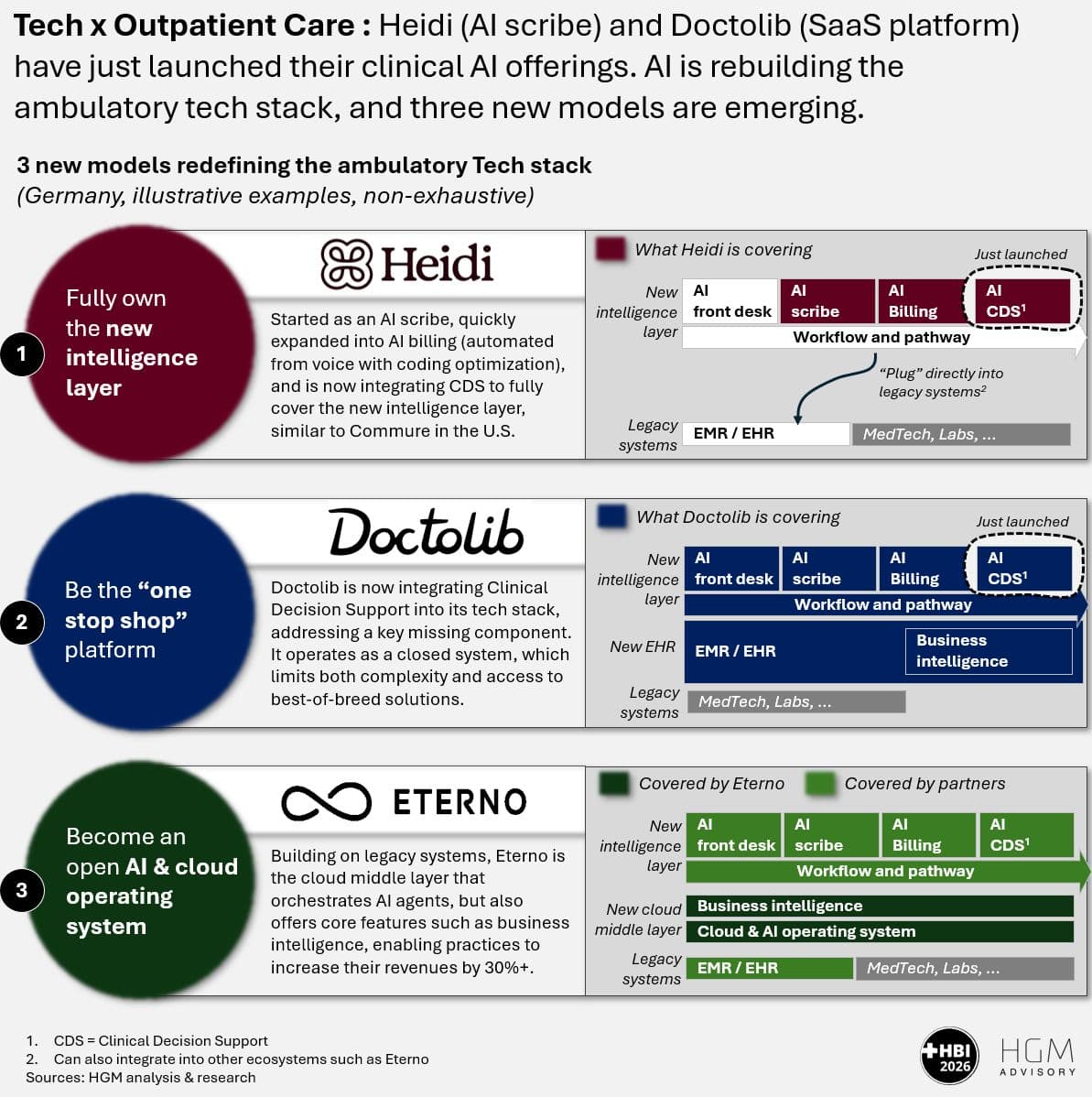
The same pattern is emerging in Germany (where Doctolib and local PMS vendors are embedding scribe features), France (where Nabla benefits from local presence), and the Nordics (where Tandem Health leverages its Swedish roots).
However, global players, particularly Microsoft with Dragon Copilot, remain formidable. Microsoft's distribution through its existing healthcare IT relationships and its integration with Epic give it an incumbency advantage that local players cannot easily match.
Consolidation is expected within 2-3 years. The most likely outcome: 3-4 global platforms survive alongside a handful of regional specialists in markets with strong language or regulatory barriers.
AI scribes as an entry point for broader ambitions
The most important strategic insight about the AI scribe market is that none of the leading companies view scribes as their endgame. Documentation is the wedge; the real ambition is far broader.
Nabla's $70M Series C is explicitly positioned to fund the expansion from AI scribes into 'agentic AI in clinical workflows': autonomous agents that handle referrals, prior authorizations, patient follow-ups, and care coordination. The scribe is the Trojan horse: once embedded in a clinician's workflow, Nabla can expand into adjacent tasks.
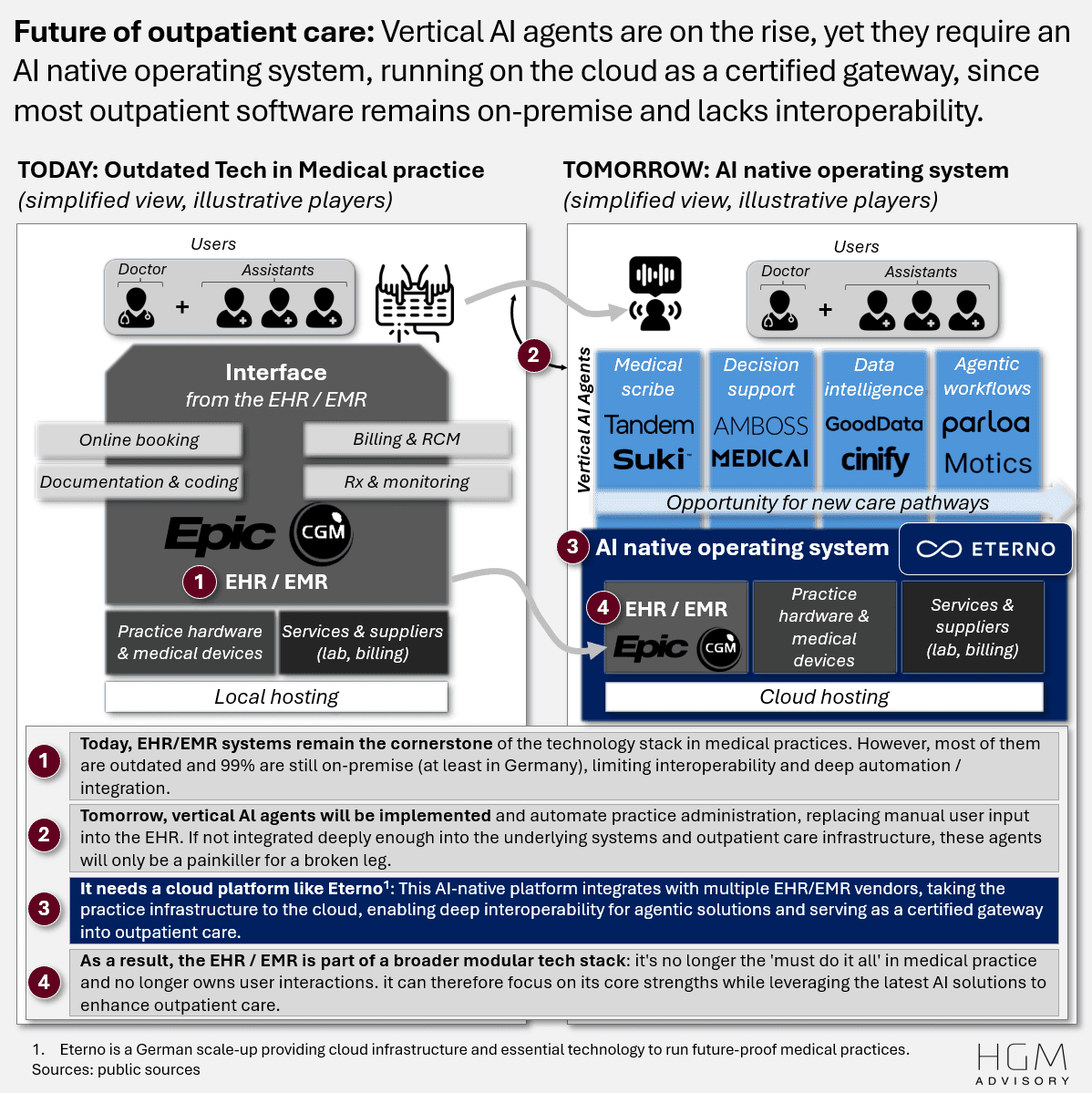
Tandem Health describes its vision as an 'AI-native operating system' for primary care, where documentation is just the first module in a platform that will eventually handle scheduling, triage, billing, and quality reporting.
Abridge's $5B valuation reflects a similar ambition: the company is already expanding from documentation into Revenue Cycle Management (RCM), using the clinical notes it generates to automate coding, billing, and denial management.
This pattern, scribe as wedge, platform as destination, is the defining strategic play in the AI scribe market. The companies that successfully make this transition will be worth multiples of their current valuations. Those that remain pure-play scribes risk commoditization as the core technology becomes table stakes.
| Company | June 2025 Milestone | Current Focus | Strategic Ambition |
|---|---|---|---|
| Abridge | $5B valuation | Hospital documentation + RCM | Full revenue cycle AI platform |
| Nabla | $70M Series C | Clinical documentation (US + EU) | Agentic AI in clinical workflows |
| Tandem Health | $50M raise | Primary care documentation (EU) | AI-native OS for primary care |
| Microsoft DAX | Integrated into Epic | Enterprise hospital documentation | Embedded AI across Microsoft health stack |
| Autoscriber | Scaling in Netherlands | Dutch outpatient documentation | Regional workflow automation |
The incumbent response
Existing practice management software vendors and hospital information systems are not standing still. Companies like CompuGroup Medical (Germany), EPIC (US/EU), and Meditech are embedding AI scribe features directly into their platforms, creating 'walled gardens' where documentation AI is bundled with the core system rather than sold as a standalone product.
This bundling strategy has a clear logic: if the PMS/EHR already captures the patient encounter context (appointments, lab results, medications), adding a scribe feature on top is a natural extension that is difficult for standalone players to match.
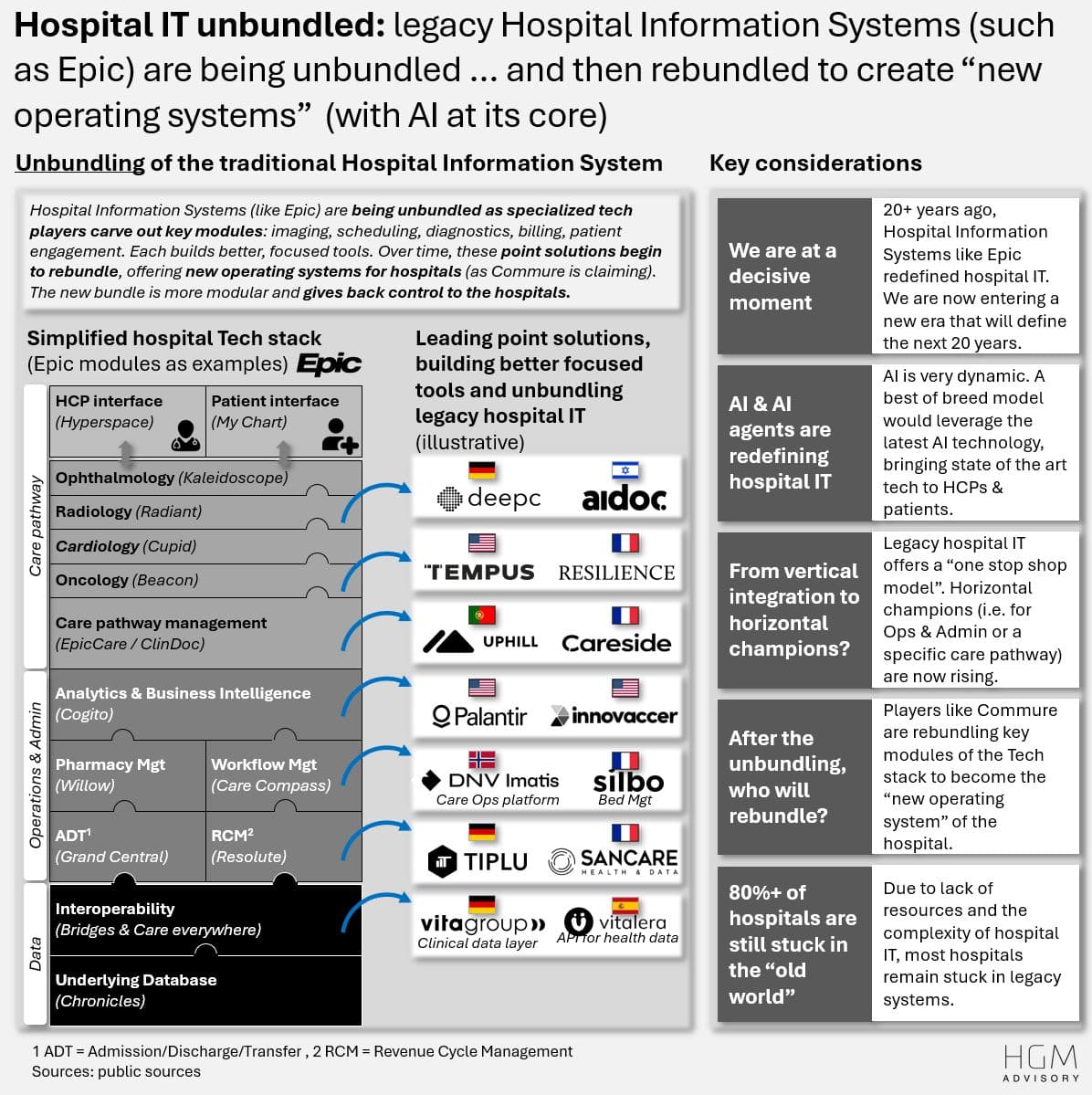
However, the broader transformation of healthcare technology may diminish the incumbents' market power over time. If the healthcare tech stack unbundles, as we are seeing with Doctolib capturing the patient access layer and OpenEvidence capturing clinical decision support, then the EHR's position as the center of gravity weakens, and standalone AI tools gain distribution power through their own clinician adoption.
For HealthTech strategists and investors, the key question is not 'which AI scribe will win?' but 'which AI scribe will successfully evolve into a platform?' The documentation layer is being commoditized. The value lies in what comes next.

About the author
Thomas HagemeijerFounder & CEO of HGM Advisory. Management consultant and HealthTech expert working across the full healthcare ecosystem: pharma, MedTech, investors, startups, hospitals, and policymakers. Investor at Springboard Health Angels. Ambassador at HLTH Europe and HBI. Regular keynote speaker on AI in healthcare and digital health transformation.