June 2026
Value-Based Procurement: the UK's new NHS framework and what it means for Europe

Founder & CEO, HGM Advisory
Key takeaway
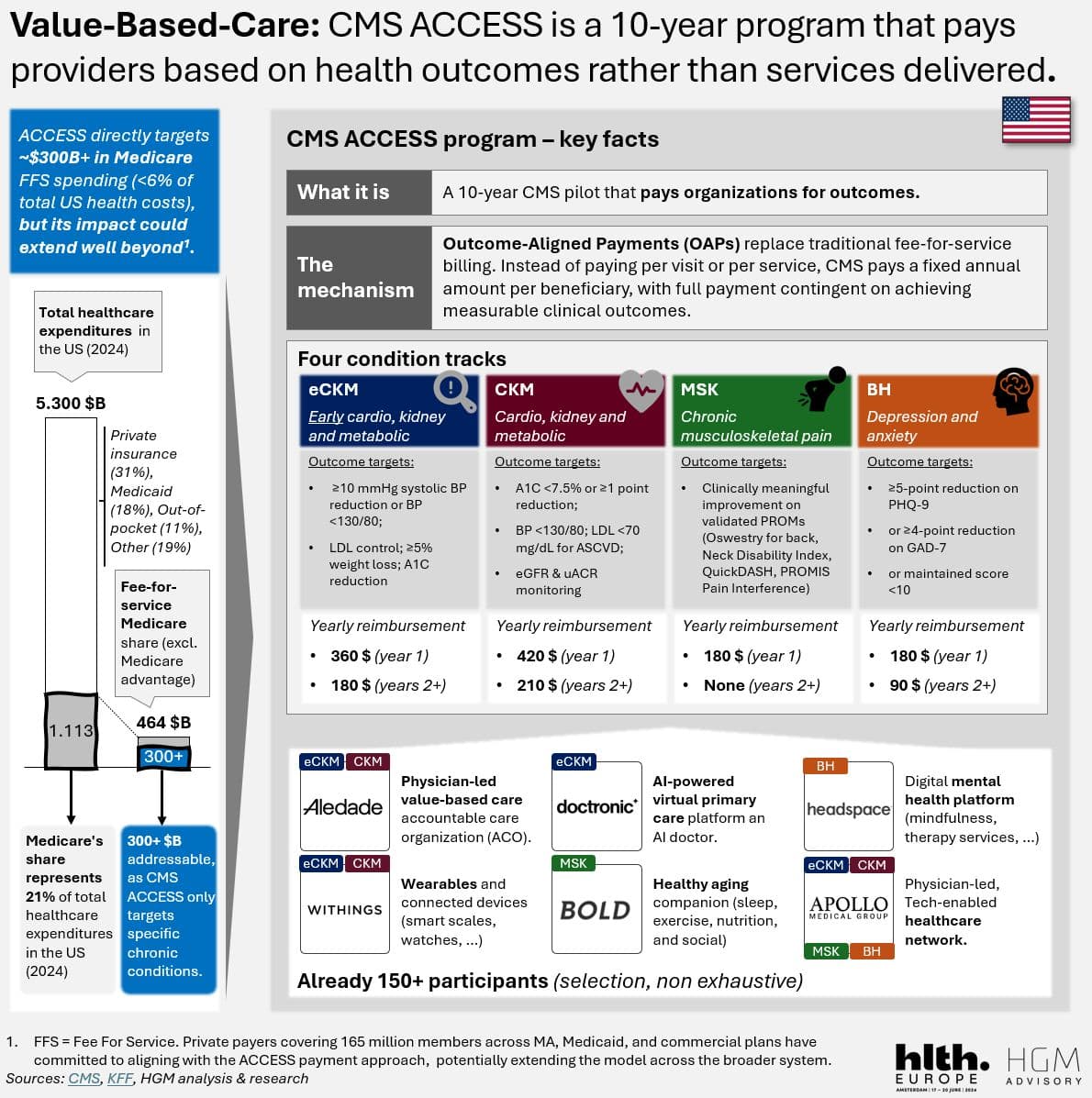
Procurement is the most effective entry point for value-based care because it embeds incentives from the start of a contract. The DHSC's new framework identifies multiple dimensions of value, but value differs across MedTech categories and hospitals. In France, La Poste Sante & Autonomie is pioneering VBC by acting as a trusted third party and financial buffer. In the US, CMS launched the ACCESS program, a 10-year initiative tying provider payments to health outcomes. The UK has a track record of strong ideas but weak delivery - Integrated Care Systems (ICS) have not yet delivered on their promises despite being a strong concept on paper.
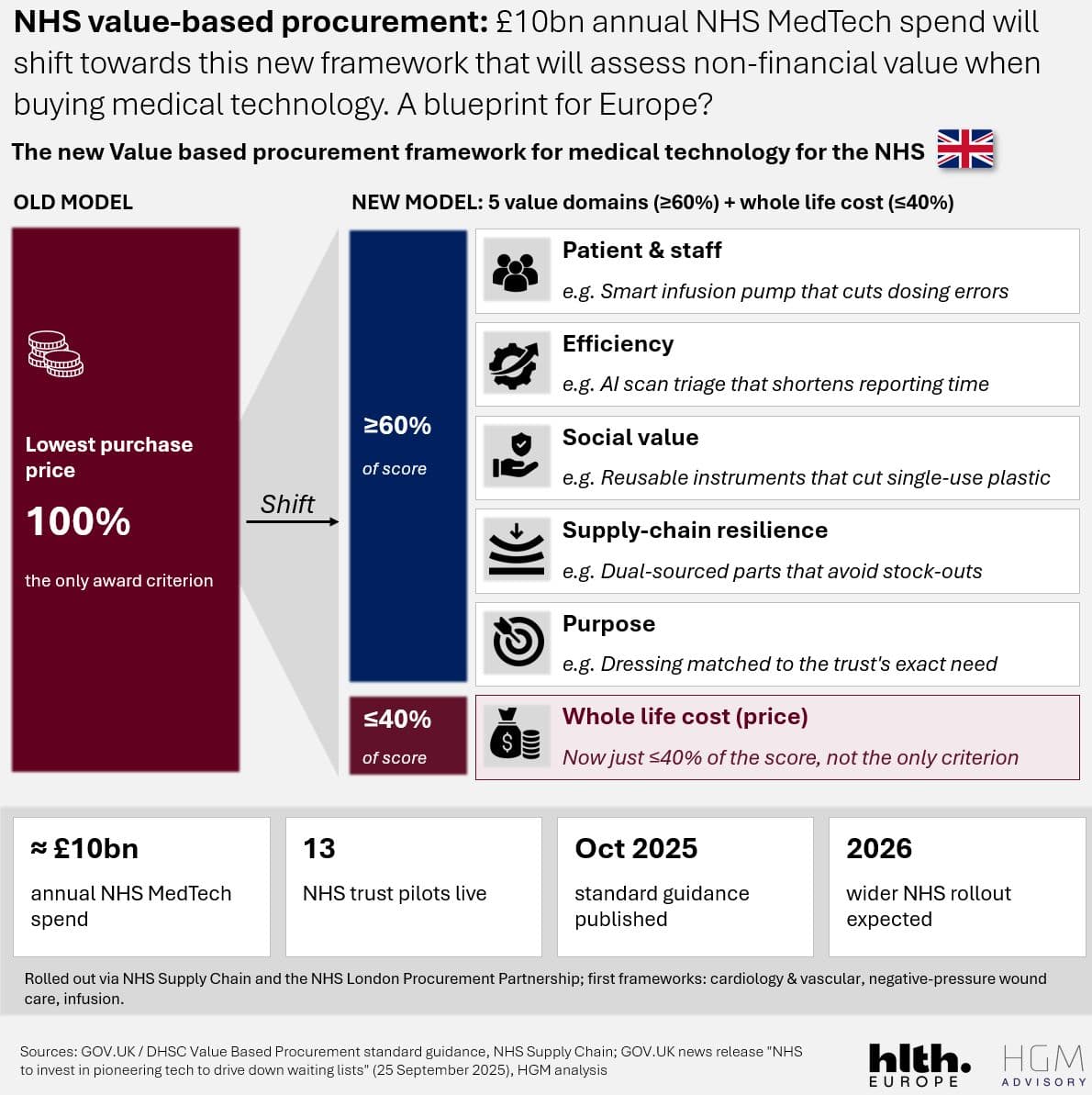
The UK Department of Health and Social Care (DHSC) has released a new Value-Based Procurement (VBP) framework for the NHS. Procurement is the right entry point for value-based care: once a contract is signed on volume and price, incentives are hard to change. VBP is gaining traction across Europe and the US, but defining 'value' remains an ongoing discussion.
Why is procurement the right entry point for value-based care?
Once a contract is signed on volume and price, the incentives are hard to change. The purchasing decision locks in the economic logic for the life of the contract. When procurement contracts are signed on value instead, the incentive to deliver that value stays in place throughout. This is why procurement reform is more effective than trying to retrofit value-based incentives onto existing volume-based contracts. The shift from 'buy the cheapest device' to 'buy the device that delivers the best outcomes per pound spent' requires a fundamentally different contracting framework, which is exactly what the DHSC's new VBP framework aims to provide.
Why is value-based procurement gaining traction now after 20+ years of discussion?
One of the main reasons is that workflows are becoming more connected and more complex, so a cheap, poorly integrated piece of MedTech can actually create more cost across the wider workflow. A low-cost surgical tool that increases complication rates or extends recovery times generates costs that dwarf the initial savings. On top of this, the geopolitical context shows that globalisation has its limits, and that each country or region needs to localise production to be more resilient and sovereign in the event of a crisis. Supply chain disruptions during COVID exposed the fragility of global procurement strategies optimized purely for cost.
How do you define 'value' in healthcare procurement?
The DHSC's new framework aims to answer this question by identifying different dimensions of value. But value can differ from one MedTech category to another, and from one hospital to another. A hip implant's value might be measured in revision rates and patient mobility scores, while a diagnostic device's value might be measured in diagnostic accuracy and time to result. In pharma, the holy grail of value-based procurement would be to tie price directly to health outcomes. We are not there yet, and we will probably need some intermediate steps before we get there - starting with process outcomes and working toward clinical endpoints.
Where is VBP advancing beyond the UK?
VBP and value-based care are hot topics across multiple geographies. The Health Proc Europe Association is working to bring value-based procurement frameworks to Europe and beyond, with concrete initiatives under discussion. In France, La Poste, through its healthcare arm La Poste Sante & Autonomie, is pioneering the value-based care approach by acting as the trusted third party and the financial buffer that makes it possible to tie procurement contracts to health outcomes. In the US, CMS recently launched the ACCESS program, a 10-year initiative that would pay providers based on health outcomes rather than the services they provide. Each market is finding its own path to VBC, shaped by its healthcare system structure and regulatory environment.
Can the UK deliver on this framework?
The UK often has good ideas but struggles to deliver. The Integrated Care Systems (ICS) were launched and are, on paper, a great concept, but their implementation has not yet delivered on its promises. And despite many strong ideas and a lot of innovation in recent years, the NHS keeps sliding deeper into crisis. The question for the VBP framework is whether it will follow the same pattern: a well-designed policy that gets diluted in implementation, or whether the economic pressures facing the NHS are now severe enough to force genuine adoption. The DHSC framework provides the structure, but execution will depend on whether procurement teams, clinicians, and suppliers can align on value definitions and measurement.

About the author
Thomas HagemeijerFounder & CEO of HGM Advisory. Management consultant and HealthTech expert working across the full healthcare ecosystem: pharma, MedTech, investors, startups, hospitals, and policymakers. Investor at Springboard Health Angels. Ambassador at HLTH Europe and HBI. Regular keynote speaker on AI in healthcare and digital health transformation.