March 2025
Healthcare AI agents: Dragon Copilot, Oracle, Salesforce, and the weekly avalanche of new launches

Founder & CEO, HGM Advisory
Key takeaway
Healthcare AI agents are being launched at an unprecedented pace, with Microsoft, Oracle, Salesforce, and startups all entering the market simultaneously. Early results are promising (60% burnout reduction, 30% less documentation time), but 95%+ of European hospitals lack the infrastructure to deploy them. The market is headed for rapid consolidation by 2026.
New AI agents in healthcare are being announced every week: Microsoft Dragon Copilot, Oracle Health Clinical AI Agent across 30+ specialties, Salesforce, Talkdesk, Deepgram. First results emerge: 60% burnout reduction, 30% less documentation time. But most European health systems are not ready.
The weekly avalanche of AI agent launches
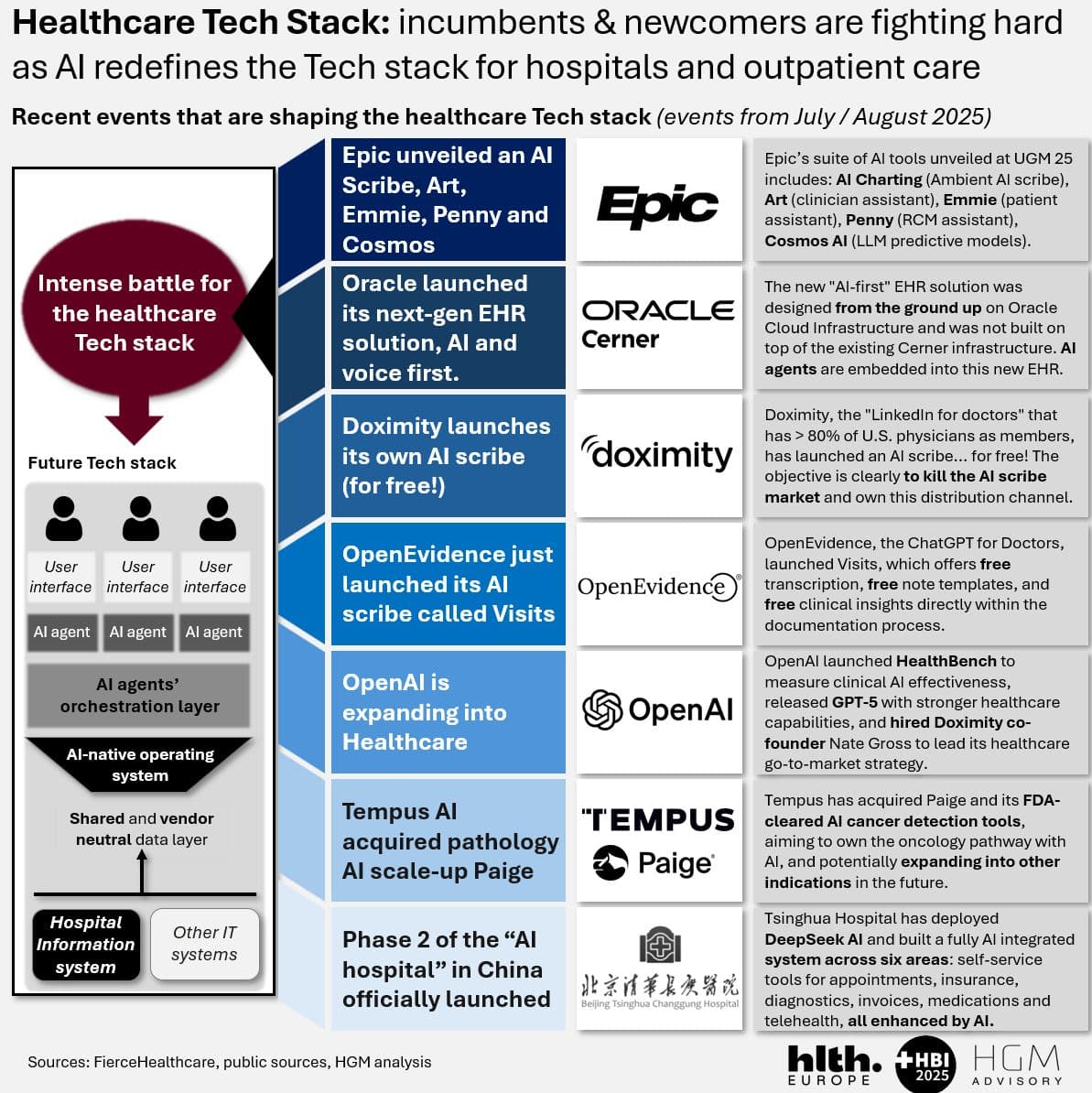
The pace of AI agent announcements in healthcare has become relentless. In a single week in early March 2025: Microsoft unveiled Dragon Copilot (clinical notes, referral letters, post-visit summaries); Talkdesk expanded into healthcare with AI-powered self-service; Deepgram launched Nova-3 Medical for speech-to-text; Ushur introduced an AI agent for member services; Salesforce unveiled pre-built AI agents for healthcare tasks; Oracle Health rolled out its Clinical AI Agent across 30+ specialties; and Harvard debuted VoxelPrompt for radiological tasks.
This density of launches signals that healthcare AI agents have moved from experimental to strategic priority across the entire technology industry.
First results are emerging
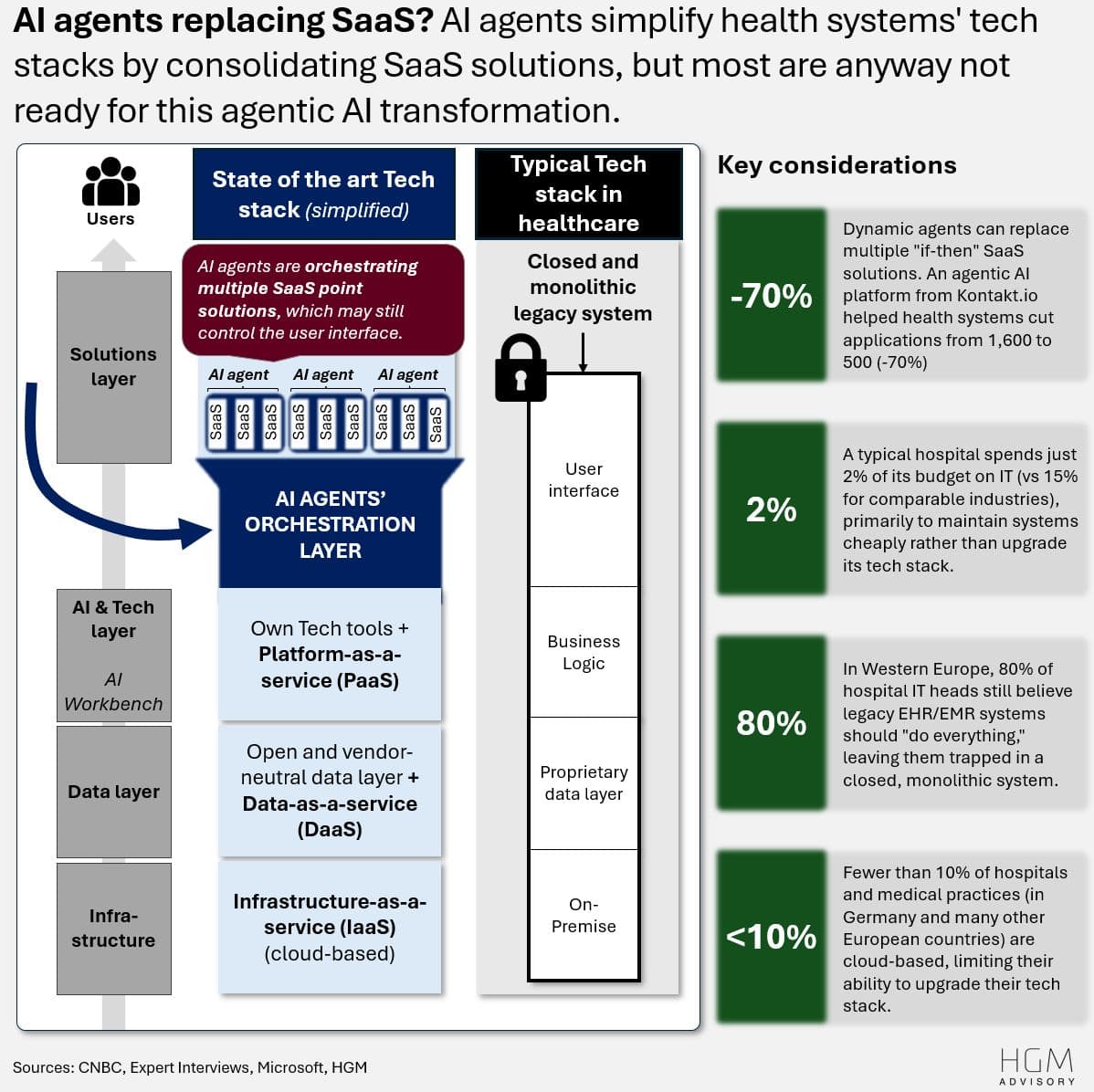
Early deployments are generating concrete performance data. Phyx claims its ambient scribes reduce burnout by 60% for small primary care providers. Oracle Health's Clinical AI Agent helps physicians cut documentation time by 30%. Kontakt.io's agentic AI platform enabled health systems to reduce applications from 1,600 to 500, a 70% decrease.
These numbers are significant but should be interpreted carefully. Most come from vendor-reported metrics in controlled deployments. Independent, peer-reviewed studies on AI agent impact in real-world clinical settings remain scarce. The gap between vendor claims and verified clinical impact will narrow over the next 12 months as more health systems publish their own data.
Will AI agents kill SaaS?
Satya Nadella and others have argued that agentic AI will disrupt SaaS entirely, replacing static software workflows with autonomous agents that adapt to each user. In healthcare, this thesis has particular relevance: if an AI agent can handle scheduling, documentation, billing, and patient communication end-to-end, does a hospital still need separate SaaS products for each function?
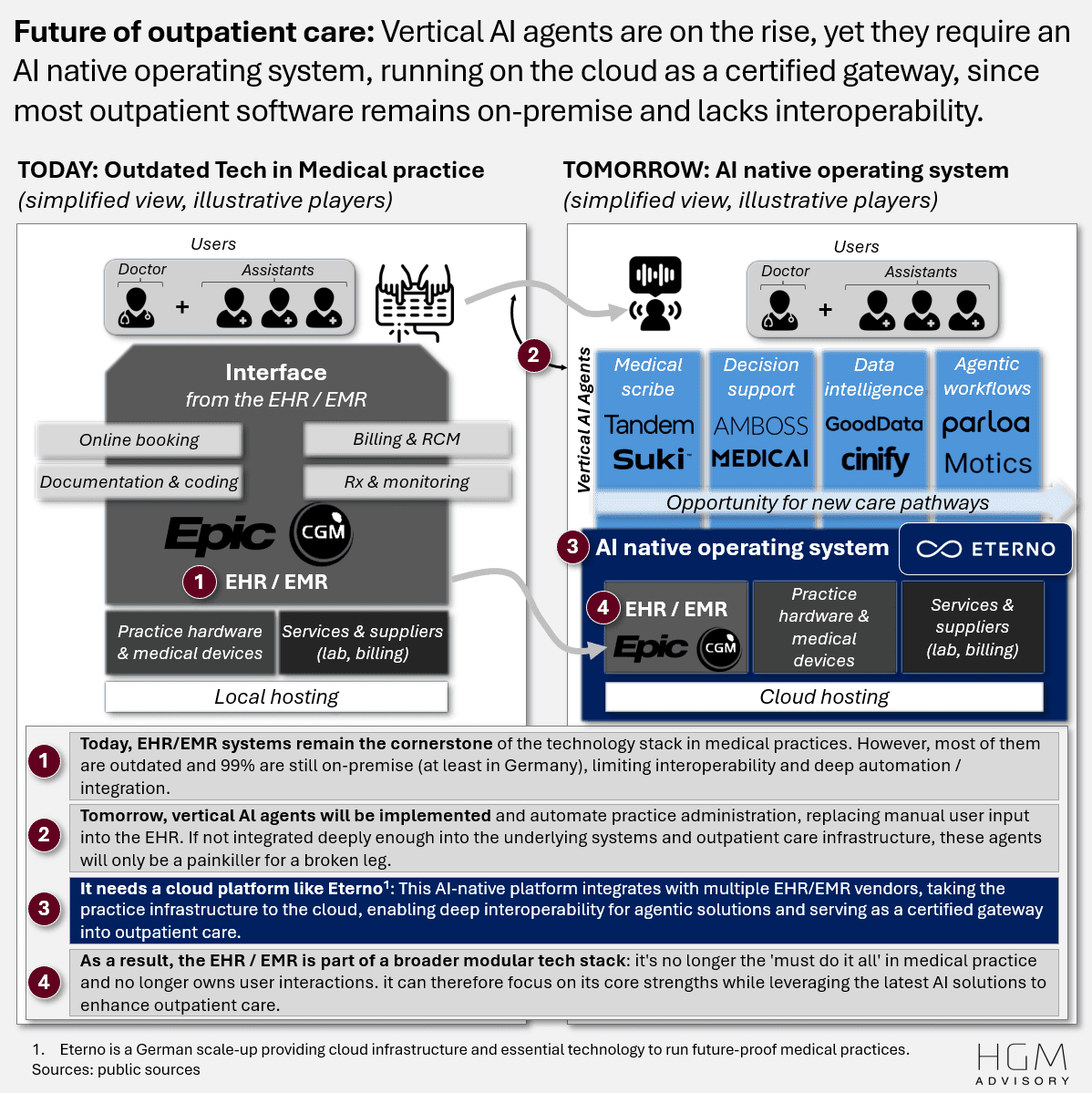
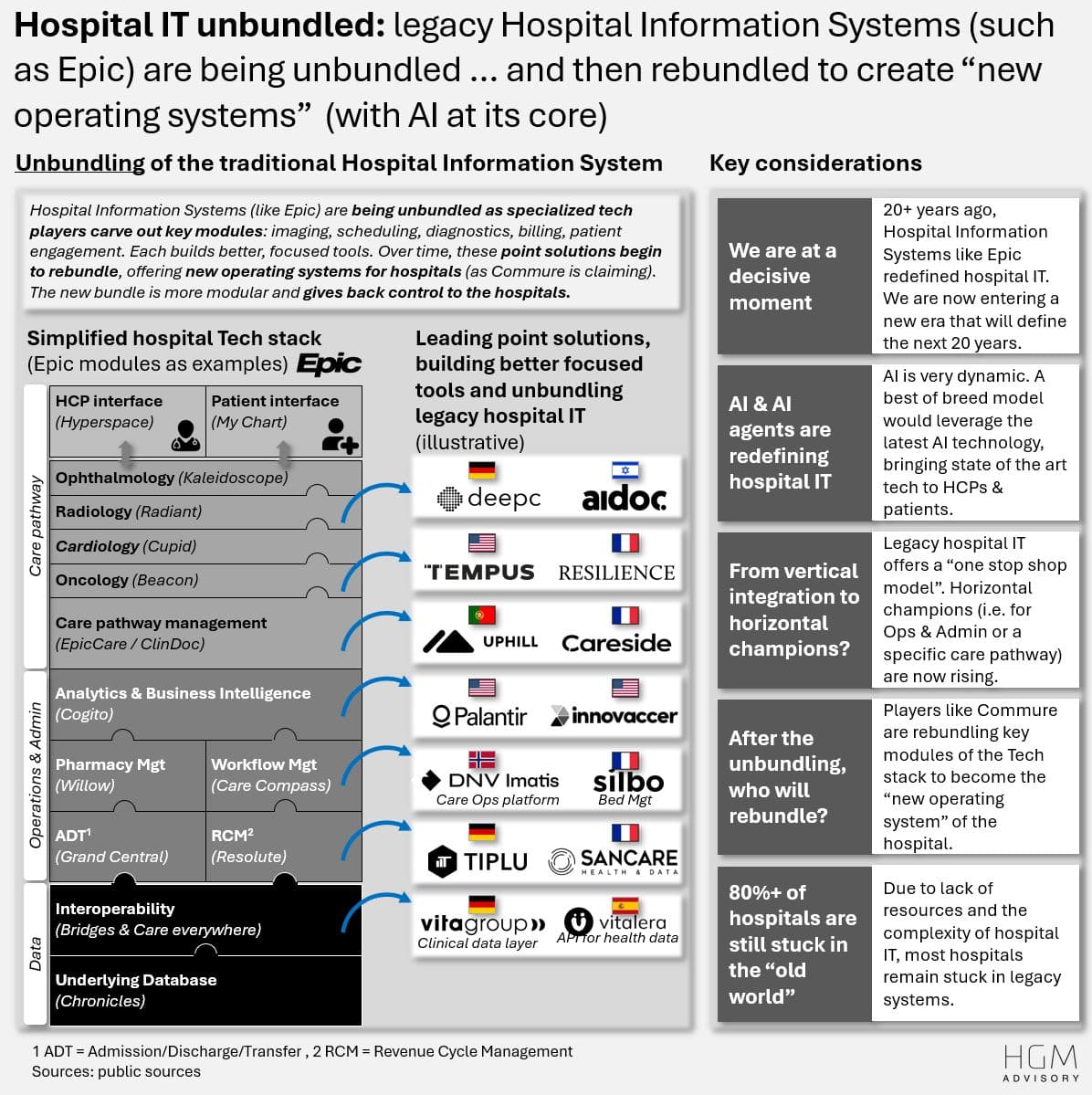
The reality is more nuanced. AI agents will enhance rather than replace most SaaS in the near term. Core systems of record (EHRs, billing platforms) will persist because they serve regulatory and audit functions that require deterministic, auditable processes. AI agents will sit on top of these systems, automating the workflows between them.
European health systems are not ready
The EHDS regulation was just announced, but European health systems face a fundamental readiness gap. Most hospital IT departments remain under-resourced, and the majority of hospital IT leaders still view their EMR/EHR as the core of their tech stack rather than as one layer in a broader platform.
The question is whether a European fund is needed to drive agentic AI transformation, similar to Germany's KHZG program for hospital digitization. Without coordinated investment in data infrastructure, interoperability, and AI governance, European hospitals risk falling further behind US health systems that are already deploying AI agents at scale.
Who will win: Big Tech or scale-ups?
The AI agent market in healthcare is crowded, and few will survive. By 2026, M&A activity will likely accelerate as winners begin to emerge.
Big Tech, especially Microsoft with its Cloud + OpenAI + Nuance + Epic partnership, appears best positioned to dominate through sheer distribution power. However, leading health systems seem to prefer smaller players like Innovaccer or VoccaCare to maintain more control over this critical technology layer. The tension between convenience (Big Tech) and control (scale-ups) will define the competitive landscape.

About the author
Thomas HagemeijerFounder & CEO of HGM Advisory. Management consultant and HealthTech expert working across the full healthcare ecosystem: pharma, MedTech, investors, startups, hospitals, and policymakers. Investor at Springboard Health Angels. Ambassador at HLTH Europe and HBI. Regular keynote speaker on AI in healthcare and digital health transformation.