January 2025
Neko Health raises $260M at $1.8B: the rise of D2C clinical healthcare

Founder & CEO, HGM Advisory
Key takeaway
The D2C clinical healthcare category is gaining serious traction, with Neko Health ($260M, $1.8B valuation) and Function Health leading the charge. Andreessen Horowitz's thesis that 'the biggest company in the world will be a consumer HealthTech company' is bold but the category faces real challenges: false positive rates, unproven science in areas like microbiome testing, and the leap from 'worried well' to mainstream adoption.
Neko Health (co-founded by Spotify's Daniel Ek) raised $260M at $1.8B valuation. Andreessen Horowitz believes 'the biggest company in the world will be a consumer HealthTech company.' But D2C clinical is still a massive false positive generator, and for many categories, the science is too early.
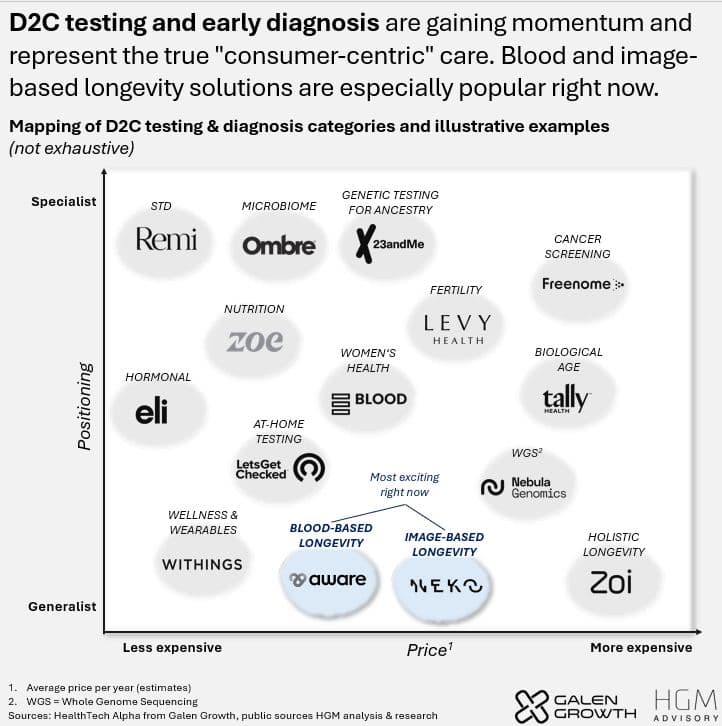
The D2C clinical category gains traction
Neko Health, co-founded by Spotify founder Daniel Ek, secured $260 million at a $1.8 billion valuation. The company offers full-body health scans using proprietary hardware and AI-driven diagnostics.
Andreessen Horowitz believes 'the biggest company in the world will be a consumer HealthTech company.' They backed Function Health (co-founded by Mark Hyman) in June 2024. Function Health and its European equivalent Aware offer subscription models with 100+ blood tests and predictive disease prevention.
The common thread: shifting healthcare from reactive (treating disease after symptoms) to proactive (detecting risk before disease develops), delivered directly to consumers.
From the 'worried well' to wider adoption
D2C clinical services are currently mostly out-of-pocket, limiting adoption to health-conscious, higher-income consumers. But signals of broader adoption are emerging.
Germany's Handelsblatt reported that public payors may start reimbursing Aware's blood tests, signaling a potential shift from reactive reimbursement to earlier intervention. If statutory health insurers begin covering preventive D2C diagnostics, the addressable market expands dramatically from the 'worried well' to the general population.
The false positive problem
D2C clinical healthcare faces a fundamental scientific challenge: screening healthy populations generates substantial false positives. Virtual twins for a single disease are already cutting-edge research. The broader D2C clinical approach, screening for dozens of conditions simultaneously, would produce significant false positive rates, especially in the first million patients.
False positives are not just a statistical inconvenience. They trigger anxiety, unnecessary follow-up tests, invasive procedures, and healthcare costs that may exceed the value of early detection. The companies that solve the false positive problem will win the D2C clinical category.
For many categories, the science is too early
The Guardian reported in July 2024 that at-home gut microbiome testing kits produce results that vary drastically between companies, even from the same sample. Similar concerns exist for period blood testing and other emerging diagnostic categories.
For D2C clinical to scale beyond early adopters, the underlying science needs to mature. Neko Health's hardware-based approach (full-body scans with proprietary sensors) may have an advantage over software-only models because it controls the data collection process end-to-end. But even Neko will need to demonstrate that population-level screening produces actionable, reliable results rather than noise.

About the author
Thomas HagemeijerFounder & CEO of HGM Advisory. Management consultant and HealthTech expert working across the full healthcare ecosystem: pharma, MedTech, investors, startups, hospitals, and policymakers. Investor at Springboard Health Angels. Ambassador at HLTH Europe and HBI. Regular keynote speaker on AI in healthcare and digital health transformation.