January 2025
Lessons from 2024: AI agents, AI scribes, and CompuGroup going private

Founder & CEO, HGM Advisory
Key takeaway
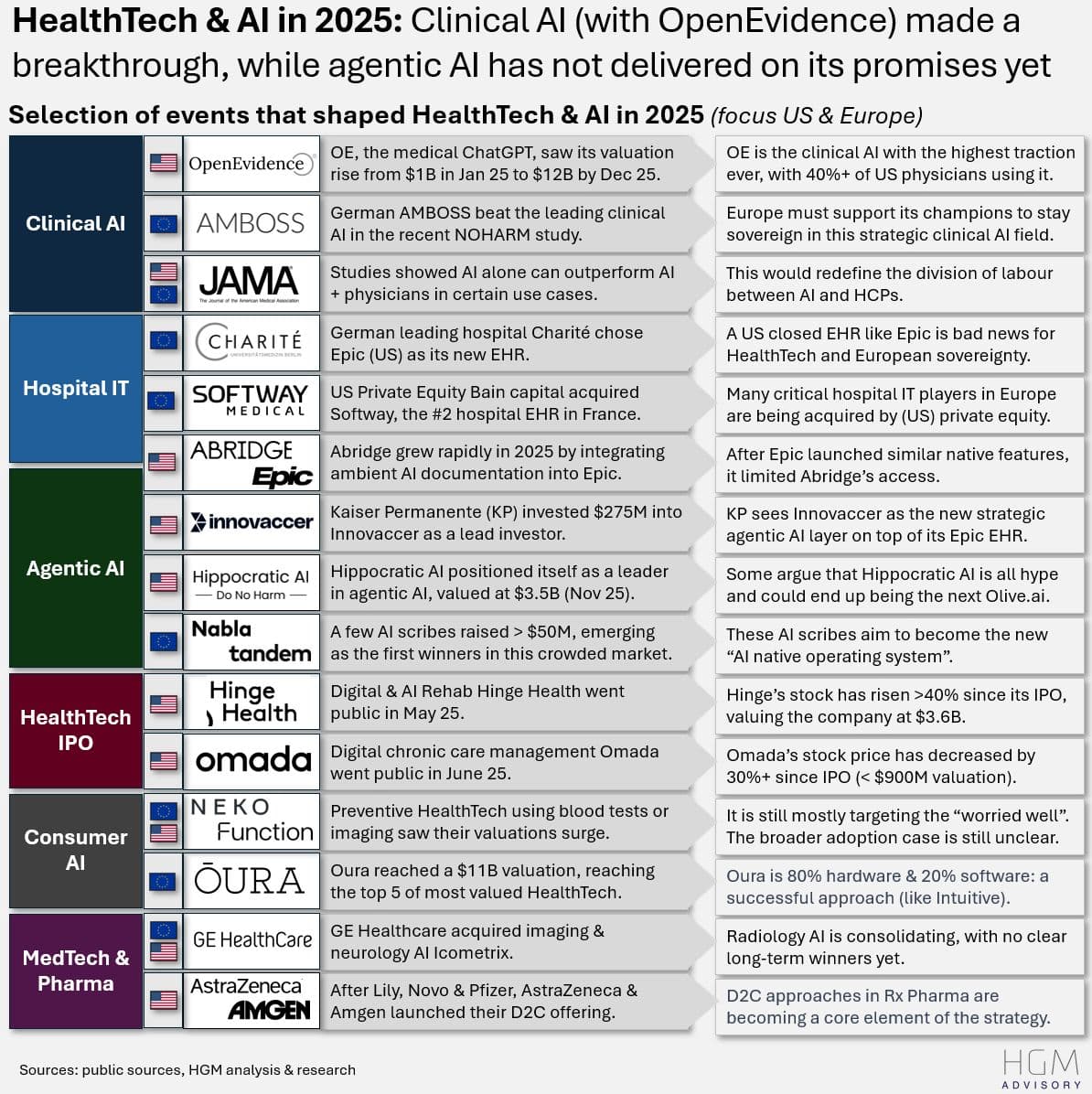
2024 delivered three signals that will define healthcare for the next decade: AI agents proved they can outperform nurses at specific clinical tasks (16-43% better, at $9/hour vs $39/hour); AI scribes became the entry point for technology into medical practices; and CompuGroup's privatization showed that legacy EHR vendors need radical transformation that public markets cannot support.
Three key events from 2024 that will shape healthcare's future: Hippocratic AI and Nvidia proving AI agents are 16-43% better than nurses at specific tasks (at $9/hour vs $39/hour); AI scribes entering medical practices as 'the most transformative thing in 15 years'; and CompuGroup going private to rebuild its legacy EHR.
AI agents: Hippocratic AI, Nvidia, and Tsinghua
Nvidia CEO Jensen Huang declared that 'the IT department of the future will evolve into the HR department for AI agents.' The distinction matters: automations are rule-based, AI workflows call LLMs within automations, and AI agents perform non-deterministic autonomous tasks.
Results from Nvidia and Hippocratic AI (April 2024) were striking: AI agents are 16% better than nurses at identifying medication impact on lab values, 24% more accurate at detecting toxic OTC drug dosages, and 43% better at identifying condition-specific negative interactions from OTC medications. All at $9/hour compared to $39.05 median US nurse hourly pay.
Tsinghua University launched an AI hospital (April 2024) using virtual patients treated by AI-doctor-agents, creating a fully simulated clinical environment for testing AI decision-making at scale.
AI scribes: the most transformative technology in 15 years
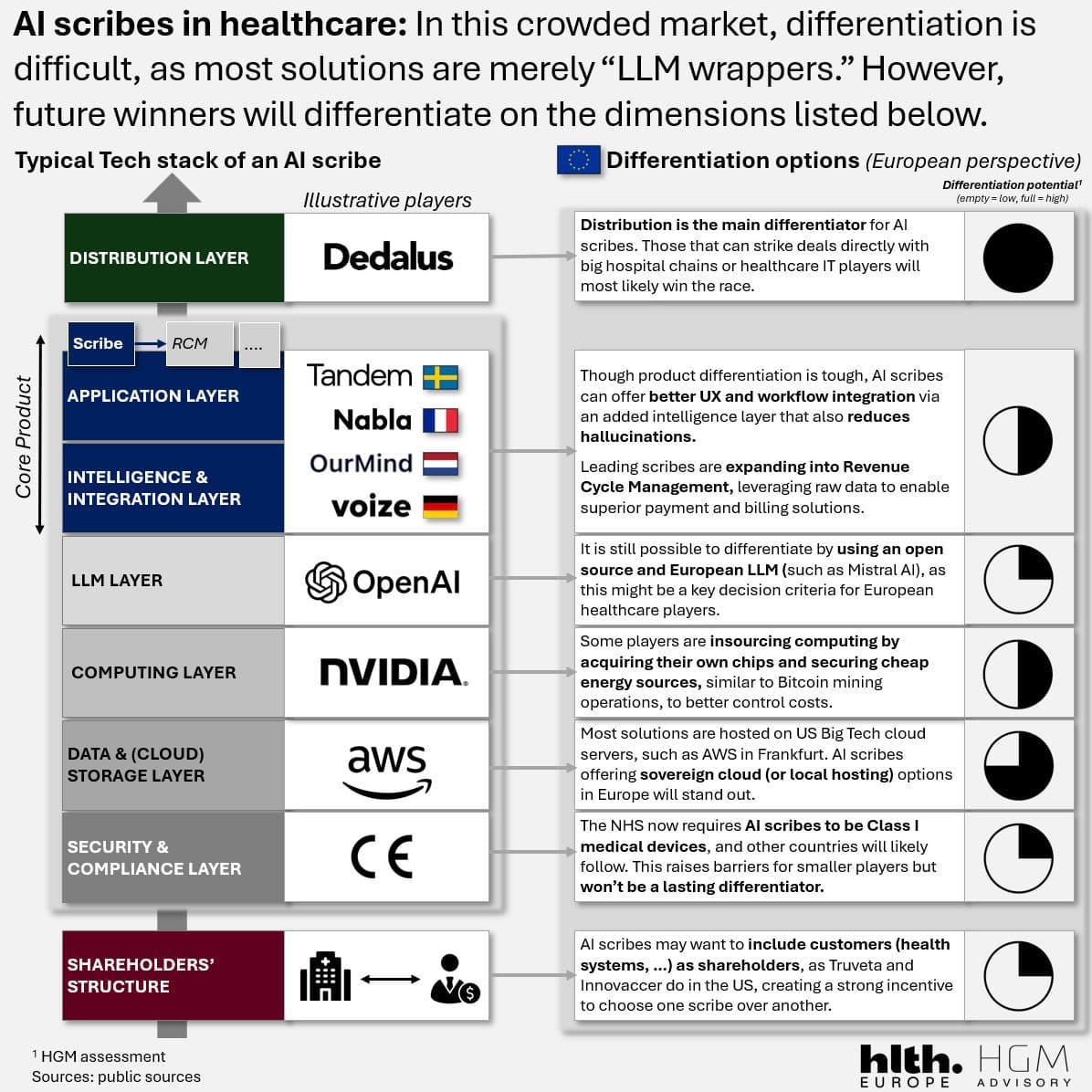
Physician Harpreet Sood told the Financial Times: 'I don't think I've ever seen anything more transformative in 15 years of healthcare than this,' referring to AI scribes entering medical practices.
Doctolib's AI scribe launch was particularly significant because it demonstrated that AI scribes are not just a US phenomenon: European physicians are equally eager to adopt tools that eliminate documentation burden. The technology may become commoditized over time, but AI scribes serve as the ideal land-and-expand entry point for HealthTech companies seeking to embed themselves in clinical workflows.
CompuGroup going private
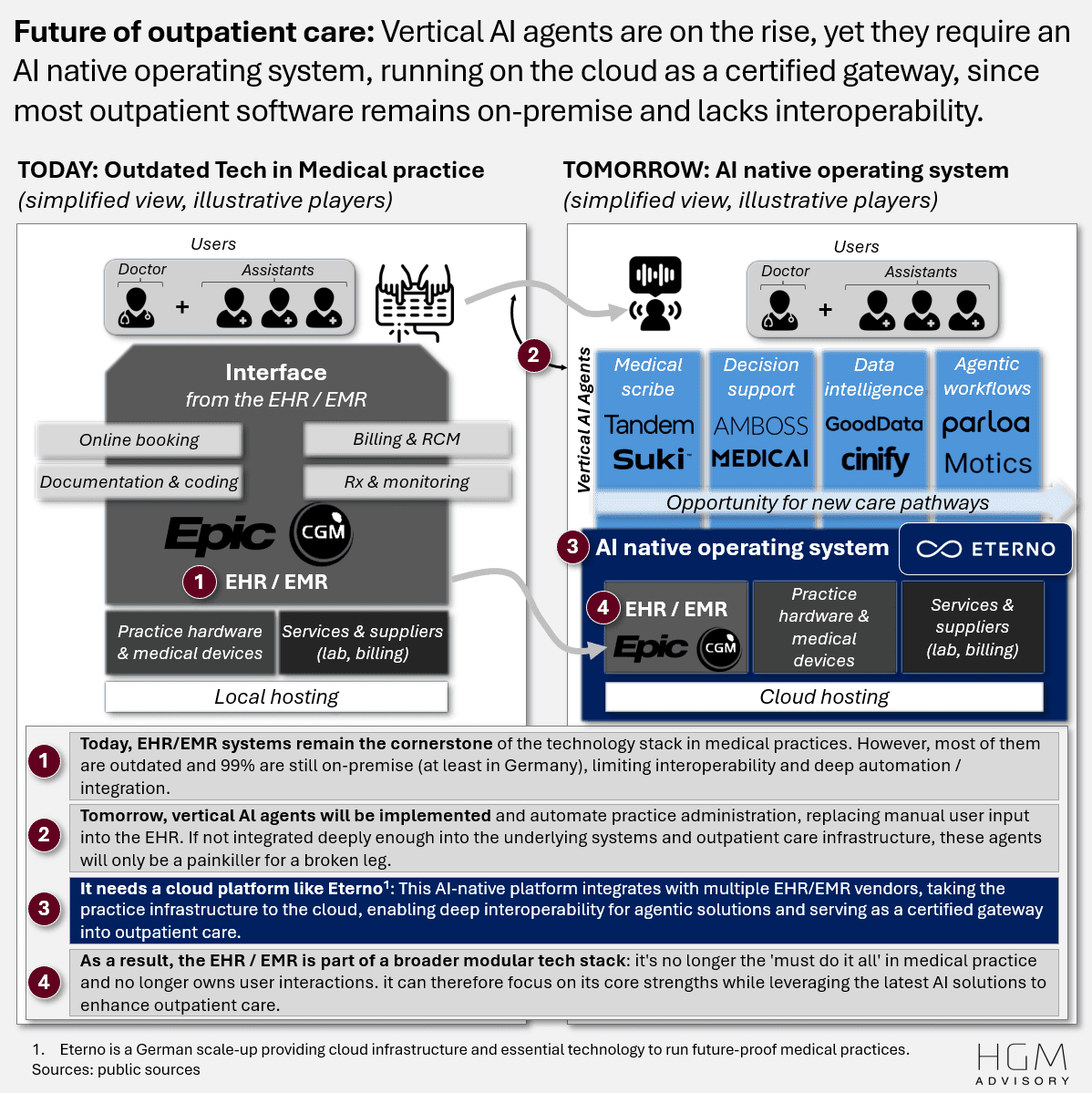
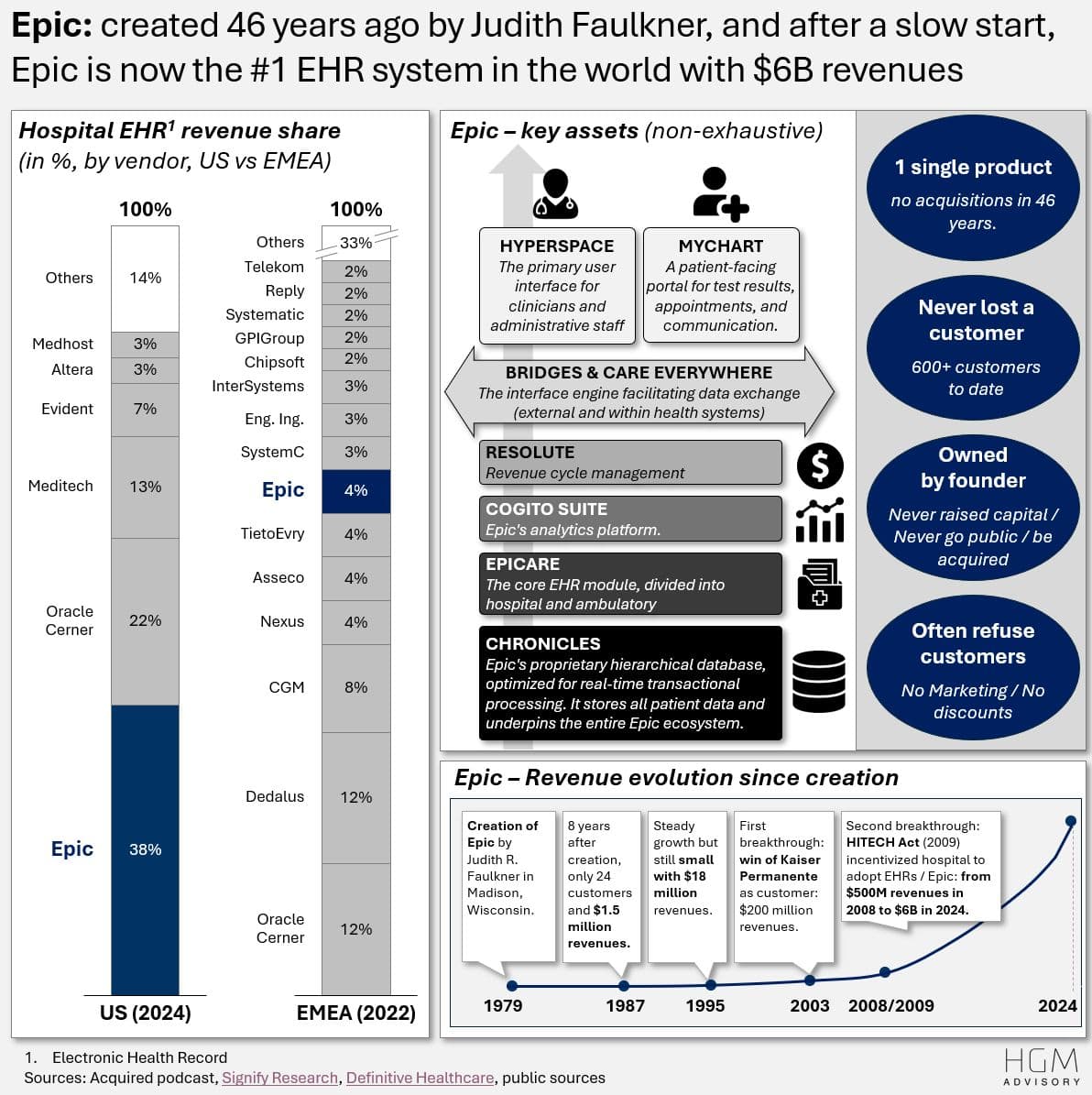
CompuGroup Medical, one of the leading European EHR providers, was taken private in 2024. The company's portfolio includes many systems built in the 1990s that are now struggling to compete with modern, AI-native alternatives.
Going private allows CompuGroup to invest in long-term product transformation without the pressure of quarterly earnings reports. For investors, the thesis is straightforward: buy a large installed base of physician practices and hospitals, then rebuild the software and AI layer on top.
This mirrors a broader trend in healthcare IT: legacy vendors going through private equity-backed transformations to modernize their platforms. The question is whether modernization can happen fast enough to prevent customer churn to AI-native competitors.

About the author
Thomas HagemeijerFounder & CEO of HGM Advisory. Management consultant and HealthTech expert working across the full healthcare ecosystem: pharma, MedTech, investors, startups, hospitals, and policymakers. Investor at Springboard Health Angels. Ambassador at HLTH Europe and HBI. Regular keynote speaker on AI in healthcare and digital health transformation.