April 2026
Sovereignty and AI: why European healthcare is decoupling from US cloud and building local AI operating models

Founder & CEO, HGM Advisory
Key takeaway
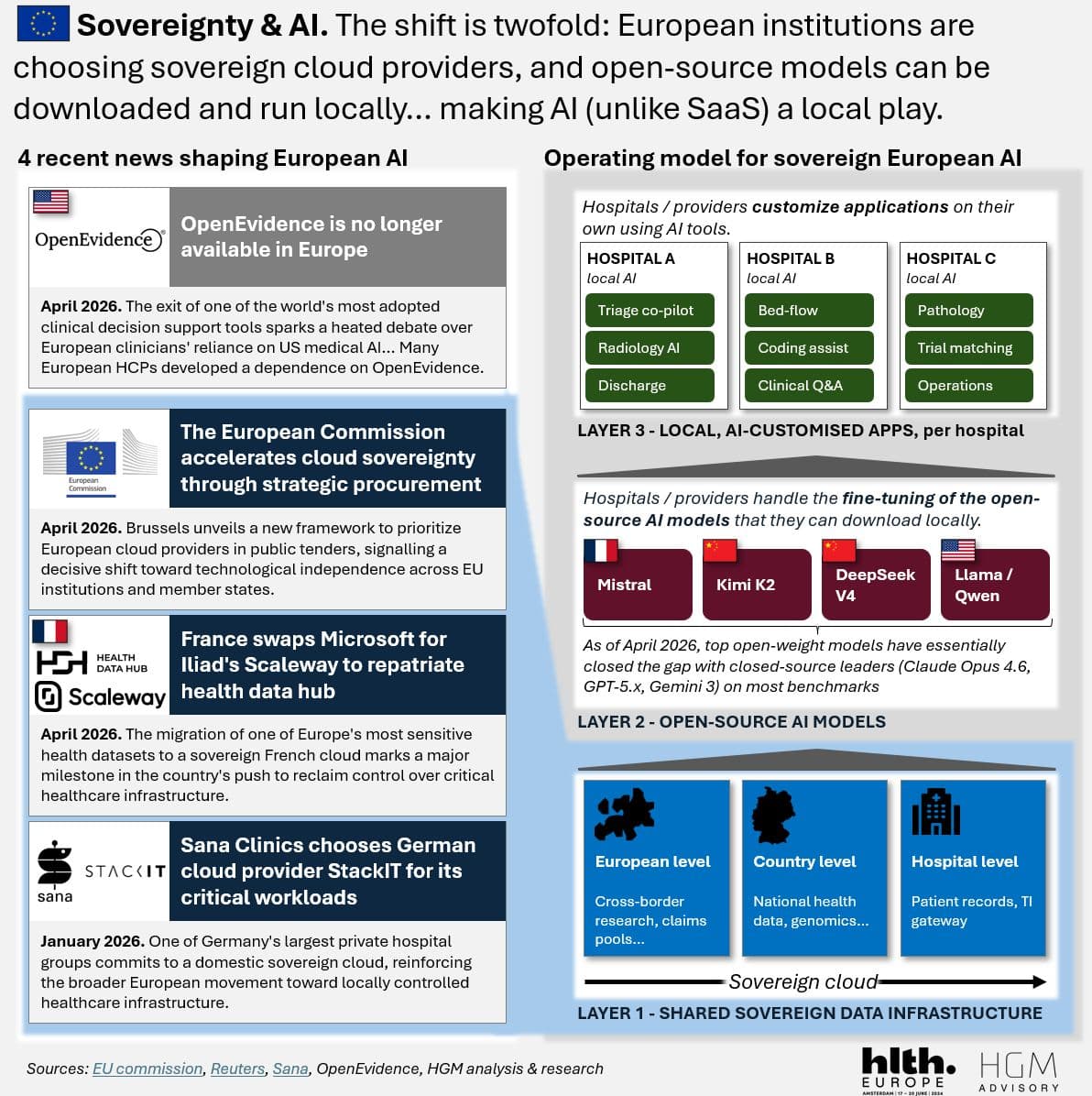
As of April 2026, top open-weight AI models (Mistral, Kimi K2, DeepSeek V4, Llama/Qwen) have essentially closed the gap with closed-source leaders (Claude Opus 4.6, GPT-5.x, Gemini 3) on most benchmarks. This changes the sovereignty equation: European hospitals and providers can now download and fine-tune frontier-quality models locally, building customized AI applications (triage copilots, radiology AI, coding assistants) without sending patient data to US cloud infrastructure.
European healthcare institutions are making a decisive shift toward sovereignty on two fronts: choosing sovereign cloud providers over US hyperscalers, and leveraging open-source AI models that can be downloaded and run locally. Unlike SaaS, AI is becoming a local play. Four recent events in early 2026 illustrate the trend: OpenEvidence exiting Europe, France repatriating its Health Data Hub, the EU prioritizing European cloud in procurement, and Sana Clinics choosing German cloud provider StackIT.
What triggered the European sovereignty shift in healthcare AI?
Four events in early 2026 crystallized the European sovereignty movement in healthcare. In April 2026, OpenEvidence, one of the world's most adopted clinical decision support tools reaching 40% of US physicians (OpenEvidence, 2026), blocked access for European users, citing regulatory uncertainty around the EU AI Act and pharmaceutical advertising rules. Many European healthcare professionals had developed a dependency on the platform, exposing the risk of relying on US-controlled medical AI infrastructure.
Simultaneously, France migrated its Health Data Hub, one of Europe's most sensitive health datasets, from Microsoft Azure to Scaleway, a French sovereign cloud provider owned by Iliad Group. The European Commission announced a new framework to prioritize European cloud providers in public procurement. And in January 2026, Sana Clinics, one of Germany's largest private hospital groups, committed to German cloud provider StackIT for its critical workloads. Together, these moves signal a decisive shift from rhetoric to action on digital sovereignty in European healthcare.
Should Europe protect its healthcare AI market from US dominance?
The OpenEvidence exit sparked a heated debate within European healthcare. Proponents of open markets argue that clinicians should have access to the best tools regardless of origin, and that restricting access to superior AI harms patient care. Others see the exit as an opportunity: European alternatives like AMBOSS (Germany), Synapse Medicine (France), and AskAletta are positioned to fill the gap with platforms designed for European regulatory and linguistic requirements.
According to HGM Advisory's analysis, Europe's technology policy has maintained open doors for over 20 years, resulting in deep structural dependence on US hyperscalers for critical healthcare infrastructure. China pursued the opposite strategy, restricting foreign platforms and developing domestic champions. The EU AI Act, championed by former Commissioner Thierry Breton, nearly eliminated open-source AI models like Mistral, which is now recognized as a strategic European asset. The lesson is that regulation should actively support open-source AI rather than inadvertently disadvantaging it, particularly as China's open-source push through DeepSeek and Moonshot may paradoxically align better with European sovereignty goals than closed US models.
How does the three-layer sovereign AI operating model work?
HGM Advisory's proposed operating model for sovereign European healthcare AI consists of three layers. Layer 1 is shared sovereign data infrastructure: a sovereign cloud at the European, country, and hospital level, hosting cross-border research, national health data and genomics registries, and hospital-level patient records and TI gateways. This replaces the current dependency on AWS, Azure, and Google Cloud for sensitive health data storage.
Layer 2 is open-source AI models. As of April 2026, top open-weight models including Mistral, Kimi K2, DeepSeek V4, and Llama/Qwen have essentially closed the performance gap with closed-source leaders like Claude Opus 4.6, GPT-5.x, and Gemini 3 on most clinical benchmarks. Hospitals can download and fine-tune these models locally, maintaining full control over patient data. Layer 3 is local, AI-customized applications per hospital: each provider uses the fine-tuned models to build institution-specific tools such as triage copilots, radiology AI, bed-flow optimization, coding assistants, and clinical Q&A systems. This three-layer model makes AI a local deployment rather than a SaaS subscription, fundamentally changing the sovereignty equation.
What does this mean for healthcare SaaS and enterprise AI vendors?
The shift toward local AI deployment challenges the dominant SaaS-plus-cloud delivery model in healthcare IT. Current enterprise SaaS creates significant friction: pharmaceutical clients typically manage four or more AI tools simultaneously, losing 30-40% of productive time to administrative overhead including data governance, vendor management, and compliance documentation. Downloaded open-source models eliminate much of this friction by enabling local deployment without ongoing data transfer to external cloud providers.
For US-based healthcare AI companies, the European sovereignty shift creates a strategic dilemma. They can either establish European data residency through sovereign cloud partnerships (as some are beginning to do), open-source their models to enable local deployment, or risk losing the European market entirely to local alternatives. European companies like AMBOSS, which already operate within EU data frameworks, have a structural advantage. The companies that will win in European healthcare AI are those that can deliver frontier-quality clinical intelligence while keeping patient data under local institutional control.
Why is open-source AI critical for European healthcare sovereignty?
Open-source AI models are the linchpin of European healthcare sovereignty because they decouple clinical AI capability from US cloud infrastructure dependency. When a hospital downloads Mistral or DeepSeek and fine-tunes it on local clinical data, no patient information leaves the institution's network. The model runs on sovereign infrastructure, the training data stays local, and the resulting AI application is fully owned by the hospital. This is fundamentally different from using a cloud-based API where every clinical query is sent to a US-controlled server.
The policy implication is clear: European regulators should actively support open-source AI ecosystems rather than imposing compliance requirements that favor large closed-source providers with dedicated regulatory teams. Mistral (France), already valued at over $6B (Mistral AI, 2025), demonstrates that Europe can produce frontier AI models. The broader European movement toward locally controlled healthcare infrastructure, reinforced by the EU's new procurement framework and France's Health Data Hub migration, creates the institutional foundation for an AI sovereignty strategy that is technically viable, not just politically aspirational.

About the author
Thomas HagemeijerFounder & CEO of HGM Advisory. Management consultant and HealthTech expert working across the full healthcare ecosystem: pharma, MedTech, investors, startups, hospitals, and policymakers. Investor at Springboard Health Angels. Ambassador at HLTH Europe and HBI. Regular keynote speaker on AI in healthcare and digital health transformation.