July 2026
Anthropic launches Claude Science: will AI finally commoditize drug development?

Founder & CEO, HGM Advisory
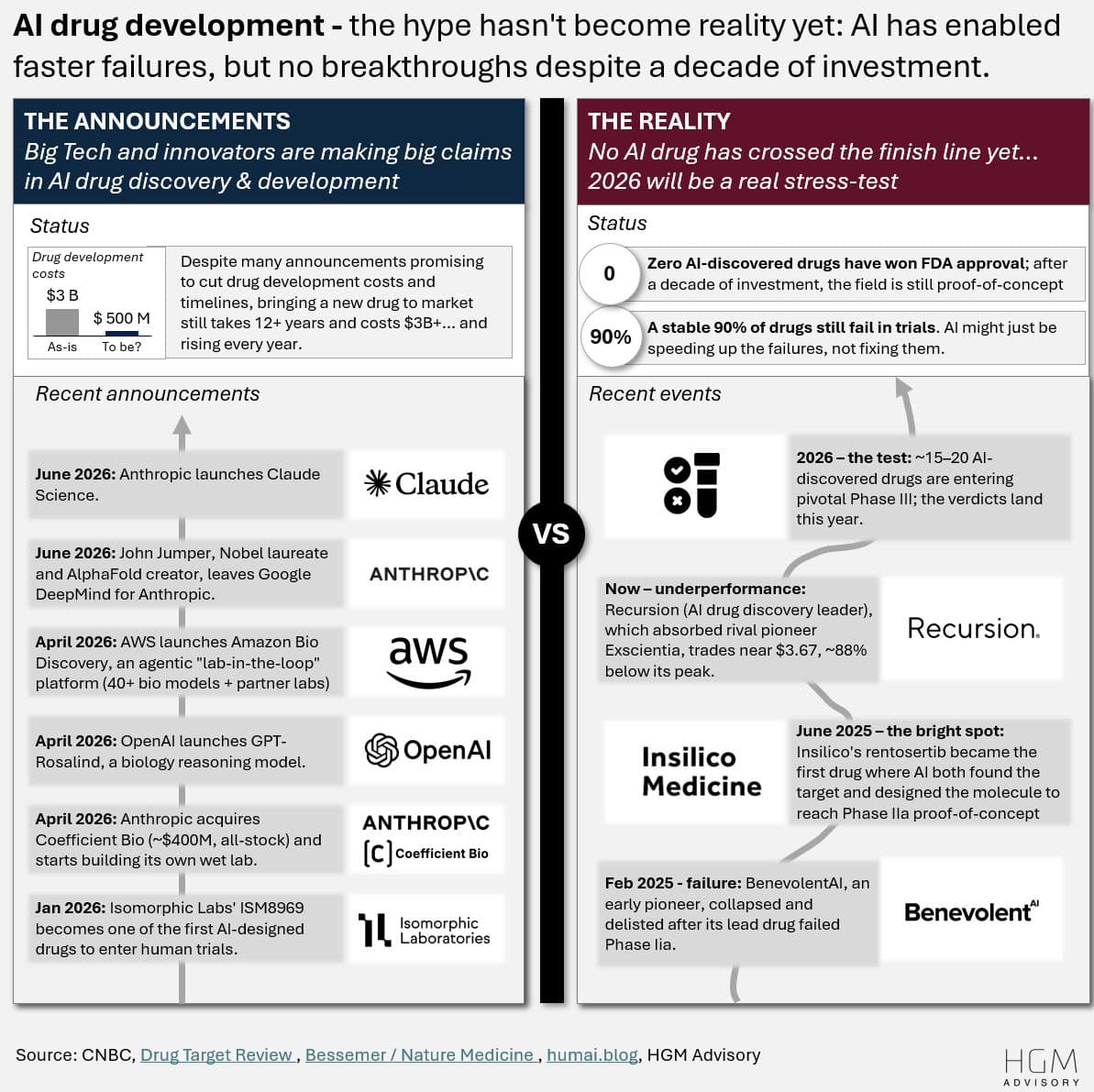
Key takeaway
Today it takes 12+ years and costs $3B+ to bring a new drug to market. If AI commoditizes drug discovery (15% of cost, 3-6 years), the pharma value chain will shift. The winners will be companies that have become 'commercialization engines,' excelling at downstream steps: market access, manufacturing, and commercial. Most investment is going upstream into drug development, but the real long-term differentiator may lie downstream, since personal relationships with doctors, local knowledge, and distribution are much harder to replicate.
After acquiring Coefficient Bio earlier this year, Anthropic launches Claude Science, an AI workbench for scientists with major applications in AI drug discovery. Anthropic now has a strong healthcare portfolio: Claude for Healthcare (hospitals/insurers), Claude for Life Sciences (pharma business), and Claude Science (lab discovery). But AI in drug development has not delivered yet - no approved drug to show for it despite years of foundational work by Google, Amazon, and Nvidia.
What did the earlier wave of tech giants achieve in drug discovery?
Google DeepMind's AlphaFold (2020-2022) cracked a 50-year science puzzle by predicting the shape of nearly every known protein. It won a Nobel Prize and showed that AI could do real biology. Amazon Omics (2022) offered tools to store and analyze huge amounts of genetic data at scale. Nvidia BioNeMo (2023) provided cloud tools and chips to power AI-driven drug research. These were the tech giants building the foundations: models, data, and computing power. Years on, there is still no approved drug to show for it. Now it is the LLMs' turn: OpenAI and Anthropic.
How is Anthropic building a healthcare portfolio?
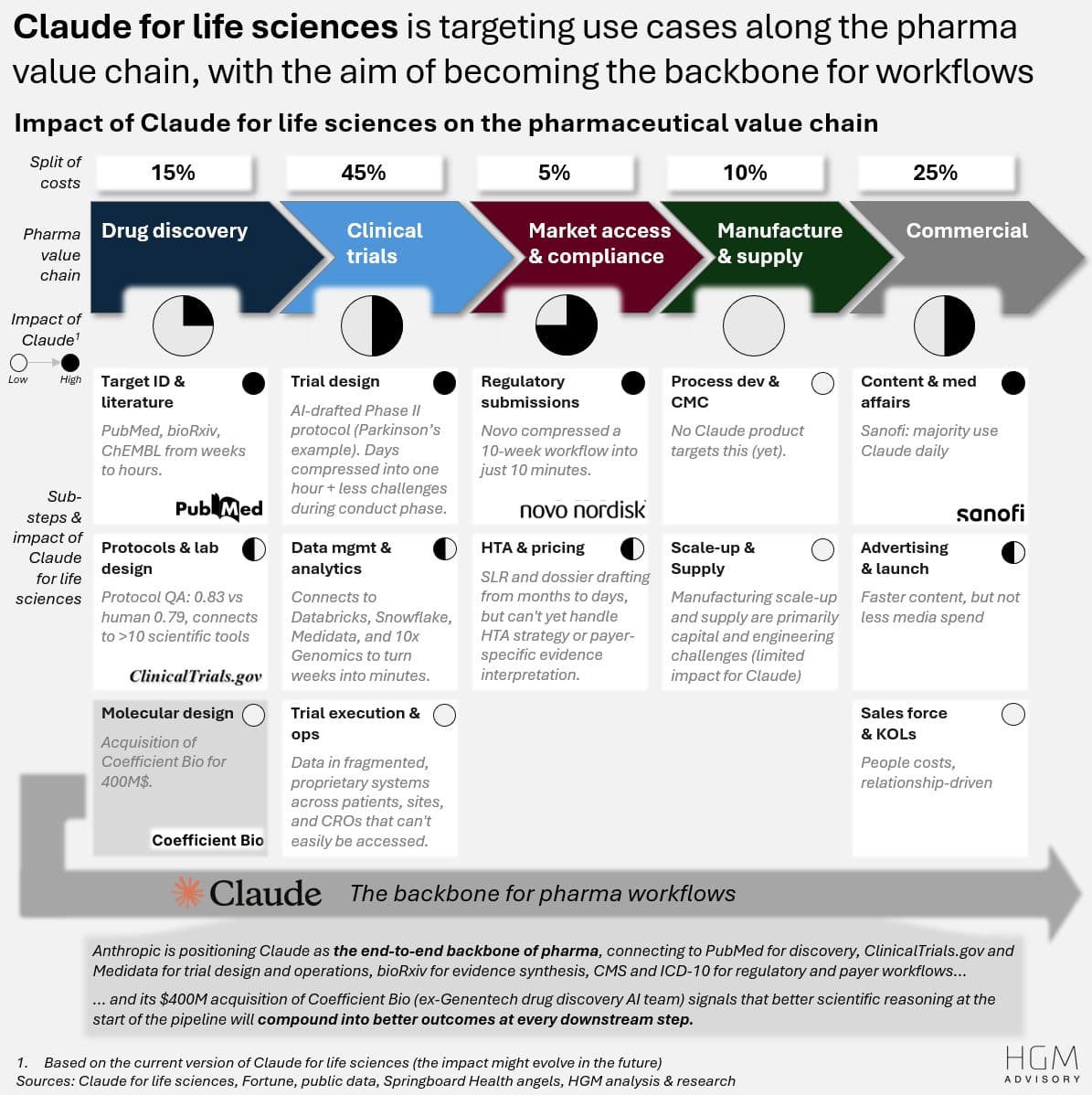
In recent months, Anthropic has launched three distinct products. Claude for Healthcare, designed for hospitals, insurers, and health companies, keeps patient data safe and private, connects to medical databases, and helps people understand their own health records. Claude for Life Sciences targets the business side of drug companies, helping get a medicine through the system and to patients by writing trial plans, tracking trials, and preparing documents for regulators. And now Claude Science, for scientists in the lab doing the actual discovery - a separate workspace that pulls together their data, code, and computing, runs research tasks, and checks its own work.
Where does Claude Science fit in the drug development pipeline?
A new drug typically goes through five stages: drug discovery (15% of cost, approximately 3 to 6 years), clinical trials (45% of cost, approximately 6 to 7 years), market access and compliance (5% of cost, approximately 1 to 2 years), manufacture and supply (10% of cost, ongoing), and commercial (25% of cost, ongoing). Claude Science is really a research and discovery tool, so it mostly touches the first stage. The question is whether accelerating discovery alone is enough to transform the economics of drug development, or whether AI needs to penetrate clinical trials - the most expensive stage - to make a real difference.
| Stage | % of cost | Timeline |
|---|---|---|
| Drug discovery | 15% | 3-6 years |
| Clinical trials | 45% | 6-7 years |
| Market access & compliance | 5% | 1-2 years |
| Manufacture & supply | 10% | Ongoing |
| Commercial | 25% | Ongoing |
Will AI commoditize drug development, and who wins if it does?
Today it takes 12+ years and costs $3B+ to bring a new drug to market. What happens when it takes a few months and a fraction of the cost? The pharma value chain will shift, and the winners will be the companies that have become 'commercialization engines,' excelling at the downstream steps: market access and compliance, manufacture and supply, and commercial. So far, most investment is going upstream into drug development, but the real long-term differentiator may lie downstream, since personal relationships with doctors, local knowledge, and distribution are much harder to replicate than algorithmic drug discovery.

About the author
Thomas HagemeijerFounder & CEO of HGM Advisory. Management consultant and HealthTech expert working across the full healthcare ecosystem: pharma, MedTech, investors, startups, hospitals, and policymakers. Investor at Springboard Health Angels. Ambassador at HLTH Europe and HBI. Regular keynote speaker on AI in healthcare and digital health transformation.