January 2026
258 AI algorithms approved by the FDA in 2025, a record year

Founder & CEO, HGM Advisory
Key takeaway
The FDA approved a record 258 AI-enabled medical device algorithms in 2025, bringing the cumulative total to 1,387. Radiology dominates with 79% of approvals, but the shift toward treatment-planning AI and growing international competition signal a maturing market.
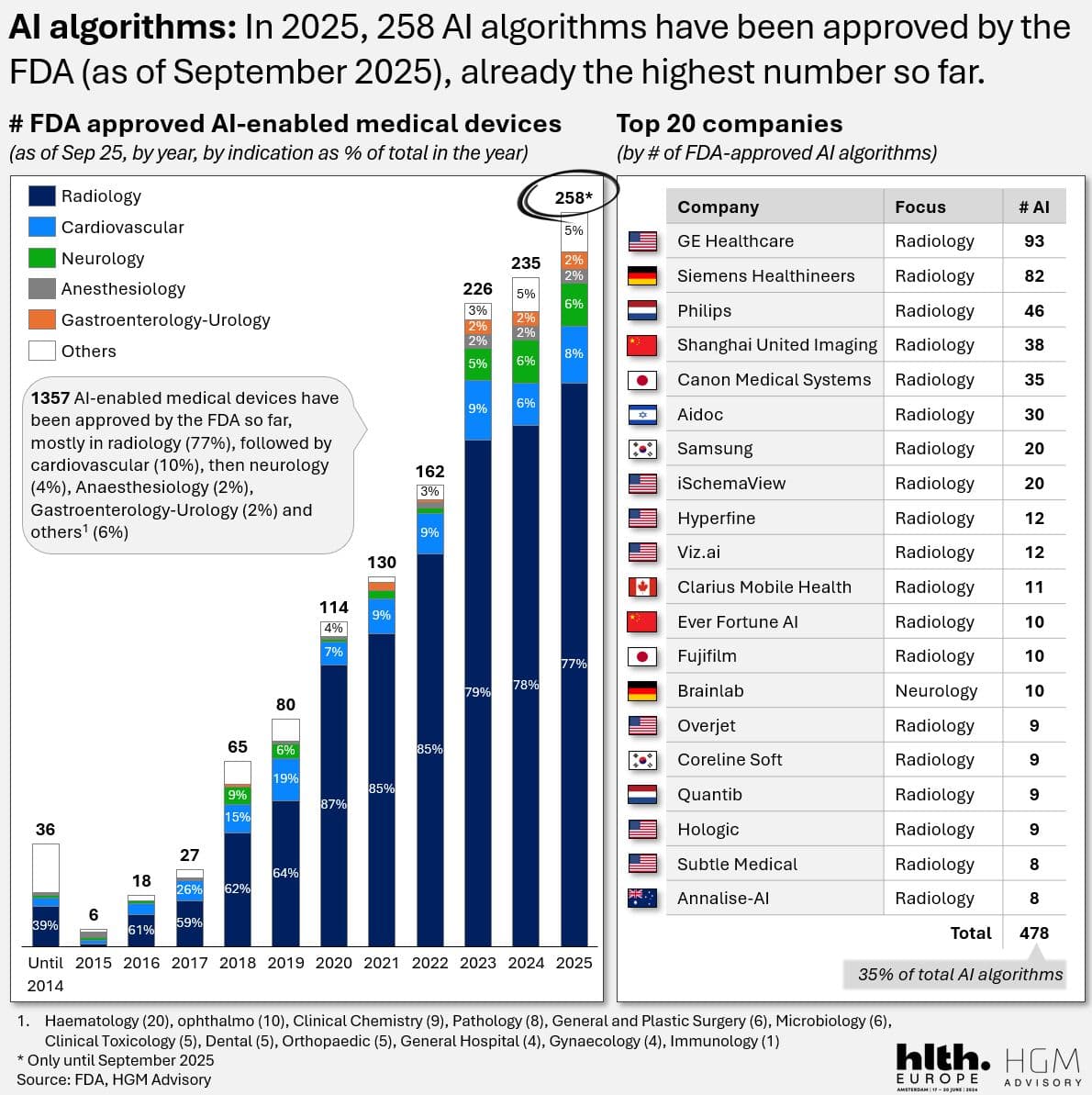
In 2025, 258 AI algorithms were approved by the FDA, the highest number so far. 1,387 AI-enabled medical devices have been approved total, mostly in radiology (79%), followed by cardiovascular (10%) and neurology (5%). Top 20 companies led by GE HealthCare, Siemens, and Shanghai United Imaging.
A record year: 258 new approvals
The growth trajectory has been remarkable: from 29 approvals in 2017 to 258 in 2025, a 31% CAGR. The 510(k) pathway accounted for 89% of approvals.
Notably, 2025 saw the FDA issue its first guidance on ‘continuously learning' AI algorithms, systems that update their models after deployment.
Breakdown by specialty
Radiology: 79% (204 approvals). Cardiovascular: 10% (26 approvals). Neurology: 5% (13 approvals). The most significant trend is the shift from diagnostic-only AI to treatment-planning AI, approximately 12% of new approvals included treatment recommendations.
Pathology AI remains notably underdeveloped with only 4 cumulative FDA approvals, representing a significant white space.
Top companies by FDA approvals
GE HealthCare and Siemens Healthineers lead. The most notable trend was the rise of Chinese manufacturers, Shanghai United Imaging entered the top five with 34 approvals.
| Rank | Company | Total Approvals | Primary Specialty | HQ |
|---|---|---|---|---|
| 1 | GE HealthCare | 83 | Multi-specialty | Chicago, US |
| 2 | Siemens Healthineers | 71 | Radiology / Cardiology | Erlangen, Germany |
| 3 | Philips | 52 | Radiology / Cardiology | Amsterdam, Netherlands |
| 4 | Canon Medical | 38 | Radiology | Tochigi, Japan |
| 5 | Shanghai United Imaging | 34 | Radiology | Shanghai, China |
| 6 | Aidoc | 29 | Radiology (triage) | Tel Aviv, Israel |
| 7 | Viz.ai | 24 | Neurology / Cardiology | San Francisco, US |
What this means for the market
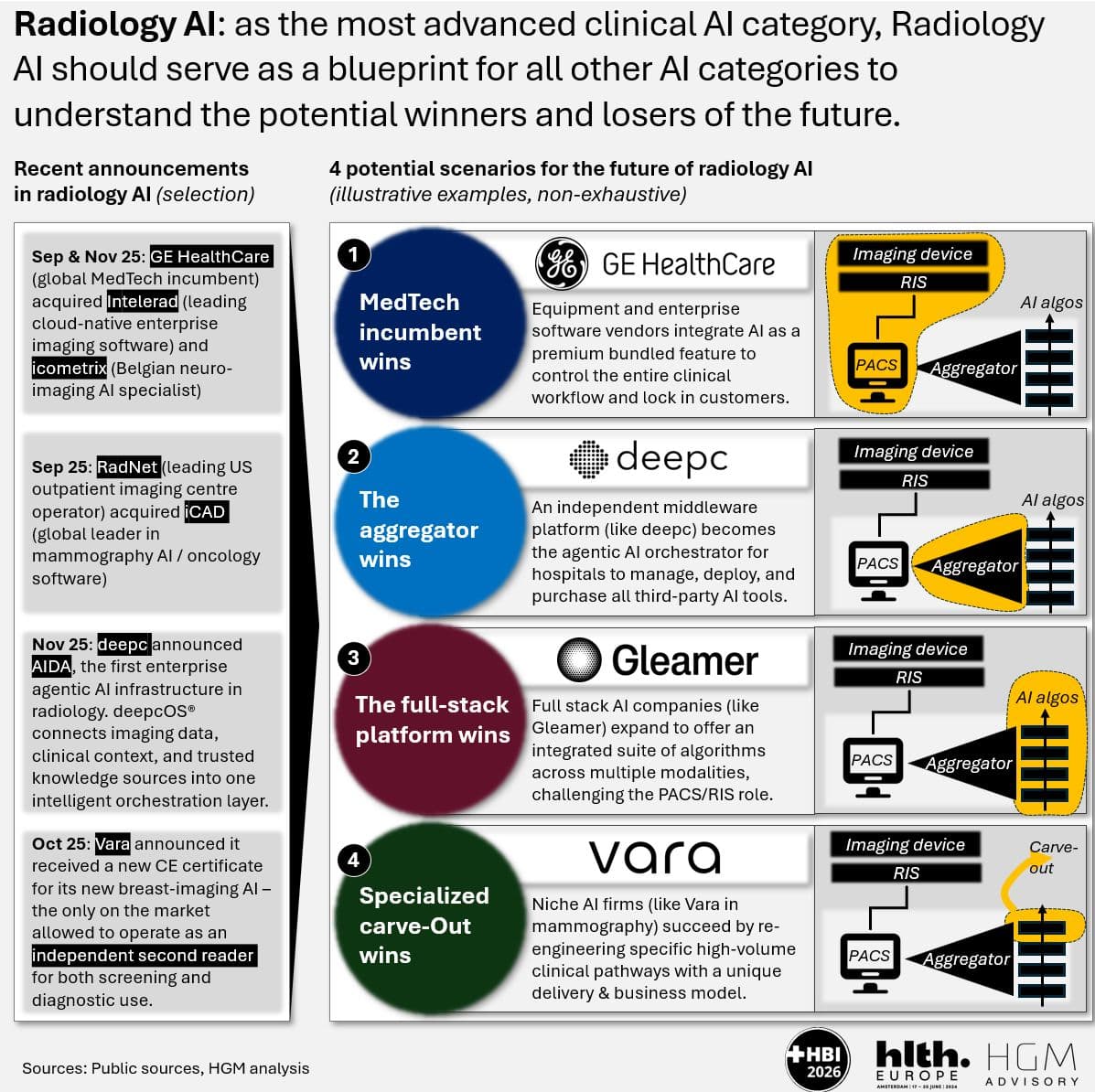
The market is consolidating around two tiers: MedTech incumbents that embed AI into hardware, and pure-play AI companies that build platforms on top of existing infrastructure.
Reimbursement remains the bottleneck, fewer than 50 of 1,387 approved algorithms have established CMS reimbursement pathways. Closing the gap between approved and deployed algorithms is the defining challenge for AI in medicine.

About the author
Thomas HagemeijerFounder & CEO of HGM Advisory. Management consultant and HealthTech expert working across the full healthcare ecosystem: pharma, MedTech, investors, startups, hospitals, and policymakers. Investor at Springboard Health Angels. Ambassador at HLTH Europe and HBI. Regular keynote speaker on AI in healthcare and digital health transformation.